 National Assembly Deputy Nguyen Hoang Uyen of Tay Ninh province, speaks at the discussion session on the draft Population Law. (Photo: National Assembly) National Assembly Deputy Nguyen Hoang Uyen of Tay Ninh province, speaks at the discussion session on the draft Population Law. (Photo: National Assembly) |
According to the national population database, Vietnam has approximately 16.1 million elderly people, who account for 16% of the population. Vietnam has one of the fastest aging rates in the world. By 2049, one in every four Vietnamese will be 60 or older. This demographic shift poses enormous challenges in healthcare, mental well-being, and social security for the elderly.
Maintaining replacement fertility rate
Projections show that by 2050, the fertility rate will fall to 1.63, and by 2100 to 1.38, well below the replacement level of 2.1 children per woman. It’s crucial for Vietnam to maintain the replacement fertility rate. In addition to raising public awareness, Vietnam needs to implement coordinated measures of economic support, social welfare, education, and healthcare. In addition to government efforts, participation by businesses, economic organizations, and social institutions is essential.
During the National Assembly meeting this week, Deputy To Van Tam of Quang Ngai province said maintaining fertility rate is feasible only if enterprises and organizations actively support workers with flexible maternity policies, financial assistance, and a family-friendly work environment.
Deputy Nguyen Thi Viet Nga Nga of Hai Phong city proposed expanding childcare support measures, including developing nurseries for children as young as six months, especially in industrial zones, urban areas, and regions with a large female workforce. Deputy Nguyen Hoang Uyen of Tay Ninh province gave some suggestions: "We need to add more sustainable and practical policies, such as expanding both public and private early childhood care services, ensuring quality standards, and offering personal income tax reductions for families with two children. Such direct and incentive-based measures are in line with successful approaches adopted by countries dealing with low fertility."
Another major challenge is the rising rate of infertility, which directly affects both the quality and scale of the population. Vietnam has about one million infertile couples, accounting for 7.7% of all couples of child-bearing age. Treatment costs are high, and health insurance coverage is limited.
Therefore, incorporating support for infertility diagnosis and treatment into the draft Population Law, including coverage under the national health insurance system, is both necessary and humane. Deputy Nguyen Thi Viet Nga said infertility support should be viewed as an essential component of a modern population policy.
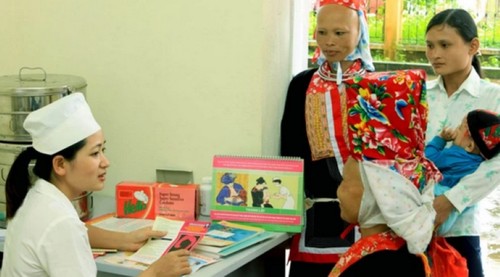 Guidelines for reproductive health care for ethnic minority women. (Photo: Duong Ngoc/phunuvietnam.vn) Guidelines for reproductive health care for ethnic minority women. (Photo: Duong Ngoc/phunuvietnam.vn) |
Nga said: "Maintaining replacement fertility rate should focus on couples “wanting children but unable to have them” as well as couples “having fewer children”. Financial, technical, and psychological support should be strengthened for infertile couples, along with public awareness campaigns to reduce the social stigma of infertility. It should be treated as a normal medical condition, deserving the same support and empathy as other health issues. Infertility support would help stabilize the population and demonstrate the State’s compassion and respect for citizens’ right to parenthood."
Population quality in remote areas
Many legislators agreed that policies should be more targeted toward financial support for ethnic minority women giving birth. The fertility rate among ethnic minorities ranges from 4 to 4.3 children per woman, more than twice the national average. But 20–24% of the women in ethnic minority communities still give birth at home without medical assistance.
The issue in those communities is not the fertility rate but the lack of access to quality healthcare, education, and childcare. An effort should be made to improve infrastructure in healthcare, education, and transportation, and adopt policies that enhance the economic status and autonomy of ethnic minority women, empowering them to make informed reproductive choices.
National Assembly discussions have revealed a fundamental shift in thinking about population policy. It’s now less about “how many people” than about how well people live and develop.
Solutions to maintain fertility rates, support infertility treatment and childcare, provide flexible maternity leave, and develop ethnic minority regions all share one goal: to ensure reproductive rights, gender equality, and quality of life for every citizen.