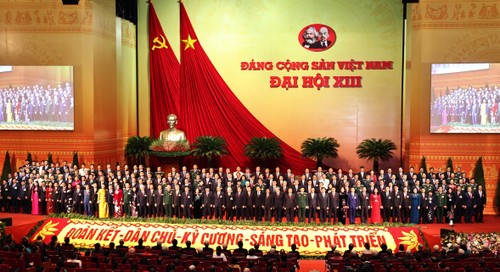
 The 13th Party Central Committee makes debut at the 13th National Party Congress (Photo: VNA) The 13th Party Central Committee makes debut at the 13th National Party Congress (Photo: VNA) |
Modern national governance is fundamentally about building a righteous, rules-based state capable of serving its people where laws are tools, data is the foundation, people are the center, and development is the ultimate goal.
Putting citizens first
At the Public Administrative Service Center in Trung Khanh commune, Cao Bang province, Ms. Hoang Thi Tieng was helped to process a land-use transfer online.
Ms. Tieng said:
“Officials are helpful, the paperwork is quicker than before, and everything is clearly explained.”
After more than five months of implementation, Vietnam’s governance system is shifting from passive, management-heavy administration to proactive service delivery and development facilitation.
Do Xuan Hieu, Deputy Chairman of Hoa Phu commune, Dak Lak province, said: “The administration is service-oriented. Instead of waiting for people, authorities must reach out to the people and businesses, identifying their needs to develop responsive policies, plans, and projects.”
Advancing modern governance thinking
With the traditional governance model, decision-making relied heavily on administrative orders and experience. Today, leadership capacity is increasingly measured by evidence-based, data-driven decisions and responsiveness to public feedback.
Nguyen Quang Đồng, Director of the Institute for Policy Studies and Media Development, said: “Vietnam’s governance philosophy puts the people at the center. But digital technology has transformed how the state operates and serves citizens. The old ‘ask–give’ mindset is fading. Now online, borderless administrative services shorten the distance between citizens and government. Data-driven planning and execution also accelerate national decision-making.”
Many localities are shifting the governance mindset. Quang Ninh province’s Intelligent Operations Center (IOC) provides real-time data to enable transparent and timely decisions, while Da Nang city’s interactive digital governance model facilitates two-way communication between authorities and citizens.
While traditional management focuses on control and oversight, governance emphasizes coordination and facilitation.
Dr. Nguyen Van Dang of the Ho Chi Minh National Academy of Politics said: “A modern, effective national governance system that serves the people must promote the roles of multiple stakeholders. While the State and the political system remain central, non-state actors including the business community, reflected in Resolution 41 on entrepreneurs, are recognized as key drivers of national development.”
Addressing the 10th session of the 15th National Assembly, General Secretary To Lam highlighted new directions in the draft documents for the 14th National Party Congress.
“We must define the national governance model for the coming period. Governance must be rooted in transparent laws, reliable data, modern digital infrastructure, a streamlined apparatus, and upright, disciplined yet service-oriented officials. This is governance for development, not governance based on the ‘ask–give’ mechanism,” said the Party leader.
Building a modern, flexible, and competitive national governance system is essential for international integration and also the foundation for realizing Vietnam’s development aspirations. Modern governance will serve as a pillar of the socialist rule-of-law state, where the Party leads through vision, the State governs through law, and society operates on trust and citizen participation.