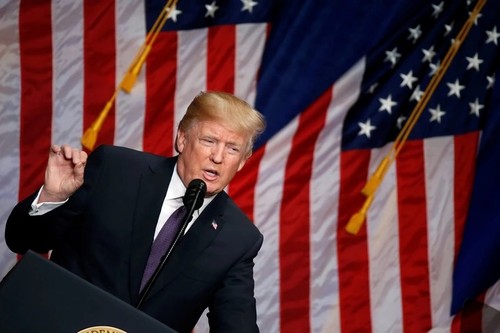
 President Donald Trump talks about the new National Security Strategy (photo: Reuters) President Donald Trump talks about the new National Security Strategy (photo: Reuters) |
The new National Security Strategy reaffirms Trump’s “America First” stance and rejects the concept of US global domination.
Reasserting the Monroe Doctrine
The most notable difference from the national security strategy of previous administrations is making the Western Hemisphere Washington’s top priority. The Trump administration intends to maintain a larger military presence in the Western Hemisphere to address illegal immigration, narco-terrorists, and the rise of competitors in the region.
The strategy declares that “The United States must be preeminent in the Western Hemisphere as a condition of our security and prosperity—a condition that allows us to assert ourselves confidently where and when we need to in the region.” The terms of US alliances, and the terms upon which the US provides any kind of aid, must be contingent on winding down adversarial outside influence, from control of military installations, ports, and key infrastructure to the purchase of strategic assets broadly defined.
Analysts say these changes clearly reassert the Monroe Doctrine introduced by President James Monroe in 1823, proclaiming that the US would not tolerate harmful outside interference in its hemisphere.
Professor Atilio Boron of the University of Buenos Aires, Argentina, said: “What the United States cares most about is controlling Latin America, because the region possesses all the essential resources it needs, from water, oil, and gas to cobalt, lithium, timber, and gold. These resources are geographically close to the US, a significant advantage. Therefore, the US will closely monitor all diplomatic and political developments in the region.”
This shift entails more moderate and less confrontational language when it comes to counterterrorism or competition with Russia and China. It is a core interest of the US to negotiate an expeditious cessation of hostilities in Ukraine, in order to reestablish strategic stability with Russia and begin reconstruction of Ukraine to enable its survival as a viable state.
The new strategy adopts more cautious and non-provocative language toward China. It commits to rebalancing bilateral economic relations, prioritizing reciprocal trade to restore US economic independence, and maintaining a mutually advantageous economic relationship with Beijing.
 The US increases its naval military presence. (photo: Reuters) The US increases its naval military presence. (photo: Reuters) |
Major shifts with regard to Europe
In contrast to a more constructive and measured tone toward Russia and China, the new US National Security Strategy contains extensive criticism of European allies. It notes Europe’s declining share of global GDP and ascribes the decline to migration policies and cratering birthrates, but says the economic decline is eclipsed by a real and starker prospect of civilizational erasure, warning that “should present trends continue, the continent will be unrecognizable in 20 years or less.”
The strategy echos arguments made by Vice President J.D. Vance in a controversial address at the Munich Security Conference earlier this year claiming that many European countries restrict free speech and political opposition to suppress parties labeled as “far-right” or “populist.”
These criticisms have intensified tensions across Europe. Many analysts see the criticisms as confirmation that the US is “beginning to abandon” the continent, but a few have downplayed the new strategy, saying the US remains Europe’s biggest ally.
German Foreign Minister Johann Wadephul said: “The United States remains our most important ally within NATO. This alliance focuses on political and security issues based on shared values, meaning other subjects can also be discussed. However, I believe that matters such as freedom of expression or the organization of free societies, at least in Germany, do not fall within this context. We do not believe anyone needs to give us advice on these issues, as they are already defined in our Constitution.”
Another issue raised in the new US strategy is the future of NATO. It says countries need to end the perception – and prevent the reality – of NATO as a perpetually expanding alliance. Washington, it says, is counting on its allies and partners to assume primary responsibility for their region and contribute far more to their own defense, rather than expecting the US to prop up the entire world like Atlas.
European diplomatic sources say 2027 may be the deadline set by Washington for Europe to take full responsibility for its own security, instead of depending on NATO with the US as the cornerstone.
Matthew Kroenig of the US’s Atlantic Council said the new National Security Strategy is somewhat harsh on Europe but reflects a new geopolitical reality that mirrors the US’s shifting foreign policy and Europe must find ways to adapt.