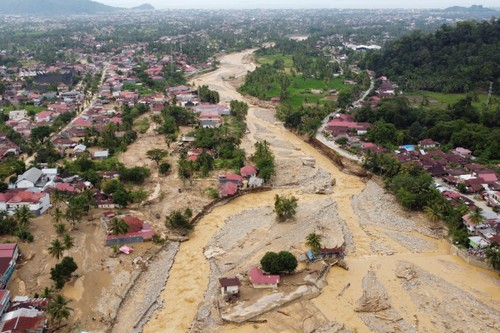
 An area hit by deadly flash floods following heavy rains in Padang, West Sumatra province, Indonesia, November 30, 2025. (Photo: Aidil Ichlas/Reuters) An area hit by deadly flash floods following heavy rains in Padang, West Sumatra province, Indonesia, November 30, 2025. (Photo: Aidil Ichlas/Reuters) |
2025 began with severe flooding in southern China and is ending with historic floods in Sumatra, Sri Lanka, and central Vietnam.
Historic rain and flooding
Indonesian authorities reported on Thursday that more than 800 people have died and 560 are missing due to flooding and landslides in Aceh, North Sumatra, and West Sumatra. 1.5 million people have been affected, with nearly 600,000 forced to flee their homes.
Sri Lankan officials reported that late-November flooding killed at least 479 people and left hundreds missing, with economic losses estimated at 7 billion USD. The situation may worsen in the coming days as a northeastern monsoon, forecast to intensify, is raising the risk of landslides in regions already devastated by last week’s disaster.
In southern Thailand, waters rose as high as 3 meters in Songkhla province in late November, the deepest flooding in a decade, killing 162 people and displacing more than 40,000 residents.
The Philippines, which is hit by dozens of storms and super typhoons every year, has reported hundreds of deaths from flooding and billions of dollars in damage, with Typhoon Kalmaegi causing the worst destruction in Cebu in early November.
In Vietnam, historic flooding in the south-central region in mid-November left hundreds dead, destroyed thousands of homes, and caused economic losses of hundreds of millions of dollars.
Even South Korea, which rarely sees such disasters, was severely affected this year, with 20 deaths and missing persons due to heavy rains in July.
Experts say that while extreme weather events have become increasingly common worldwide due to climate change, the scale of historic flooding across Asia in 2025 reflects more worrying factors. The World Meteorological Organization (WMO) highlighted unusual and rare patterns accompanying tropical storms in Asia this year.
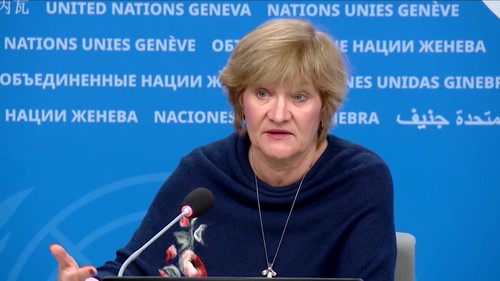 WMO spokesperson Clare Nullis (Photo: Reuters) WMO spokesperson Clare Nullis (Photo: Reuters) |
WMO spokesperson Clare Nullis said: « Tropical cyclones are rare, so close to the equator, so it's not something that we see very often and it means the impacts are magnified because local communities have got no experience in this.”
Davide Faranda, Director of Climate Physics Research at France’s National Center for Scientific Research (CNRS), analyzed unusual developments in several Asian storms this year, such as Matmo, which struck southern China and Vietnam in October and Ditwah, which hit Sri Lanka in late November. They made landfall twice and strengthened after hitting the mainland rather than dissipating. Faranda noted that every 1°C rise in temperature increases atmospheric moisture by 7%. This intensifies rainfall, as seen in central Vietnam last month, which reached the second-highest level ever recorded in global meteorological history.
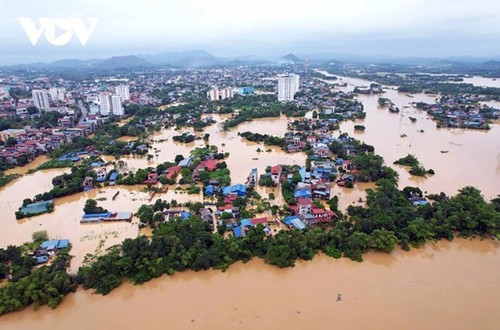 Severe flooding in Vietnam's central region (photo: VOV) Severe flooding in Vietnam's central region (photo: VOV) |
Responses
Flooding and landslides pose major problems for Asian countries where agriculture and forestry are economic pillars. Tommy Adam of the Indonesian Environment Forum called what is happening “an ecological catastrophe”. Sumatra alone lost 4.4 million hectares of primary forest between 2001 and 2024. Large-scale deforestation across Asia is worsening the impacts of storms and floods.
Experts recommend that Asian nations develop long-term strategies to adapt to a future where climate-driven floods will become more severe and unpredictable. They must move beyond emergency response to coexisting with threats and finding ways to avoid a mass evacuation every time a disaster strikes.
Ugochi Daniels, Deputy Director-General for Operations at the International Organization for Migration (IOM), said: «Early warning systems, resilience services, and livelihoods in the high-risk areas are vital to support the right to stay. When we as IOM speak to many of those who have been displaced, when you ask them what they want and what solutions mean for them, it's about being able to go home. But the homes that they know, the livelihoods that they had, have been impacted by climate. So it's about building their resilience.”
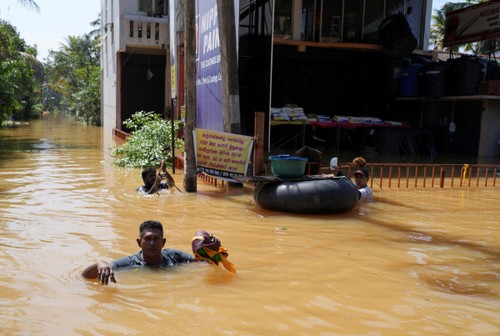 People wade through a flooded street, following Cyclone Ditwah in Kelaniya, Sri Lanka, November 30, 2025. (Photo: Thilina Kaluthotage/ Reuters) People wade through a flooded street, following Cyclone Ditwah in Kelaniya, Sri Lanka, November 30, 2025. (Photo: Thilina Kaluthotage/ Reuters) |
Many sectors also need rapid adaptation economically. In agriculture and forestry, green sustainable development is no longer just a target but a vital requirement for many Asian communities.
Meanwhile, this year’s historic floods have sounded an alarm for Asia’s insurance industry. Experts say that as extreme weather events become more frequent and severe, rising insurance payouts may force companies to exclude certain climate-related risks from coverage. Governments will need to fill the insurance gap. The World Bank says more than 90% of disaster-related losses in developing countries are uninsured and the global insurance gap has reached nearly 2 trillion USD.