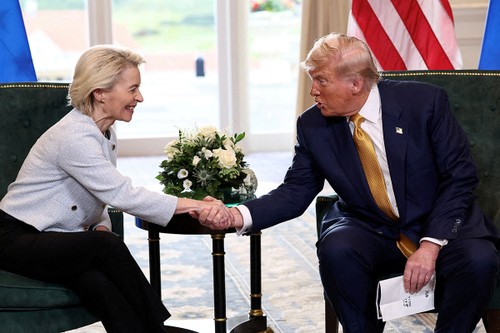
 US President Donald Trump and EC President Ursula von der Leyen shake hands after the annoucement of the US-EU trade deal in Turnberry, Scotland on July 27, 2025. (Photo: REUTERS/Evelyn Hockstein) US President Donald Trump and EC President Ursula von der Leyen shake hands after the annoucement of the US-EU trade deal in Turnberry, Scotland on July 27, 2025. (Photo: REUTERS/Evelyn Hockstein) |
End of an uncertain period
Under the deal, the US will impose a baseline tariff of 15% on most EU exports, matching the rate applied to Japan and significantly lower than the 30% it had threatened to levy on EU goods starting August 1 if no agreement had been reached.
For some key EU sectors, including aircraft, aviation equipment, select chemicals, and essential raw materials, specific tariff rates have not yet been disclosed and are likely to be addressed in future specific negotiations.
In exchange for the 15% tariff rate, the EU will maintain a 0% tariff on US goods, purchase 750 billion USD worth of American energy, primarily liquefied natural gas (LNG), and invest 600 billion USD in the US in the coming years.
Striking a deal just before the August 1 deadline eased concerns on both sides. President Trump touted it as “the biggest trade deal ever made”, claiming it would benefit everyone. Von der Leyen said that salvaging the world’s largest trade relationship, worth approximately 1.9 trillion USD in goods and services annually, would help stabilize and reinforce transatlantic economic and political-security ties.
“Today's deal creates certainty in uncertain times. It delivers stability and predictability for citizens and businesses on both sides of the Atlantic. Just a few weeks after the NATO summit, this is the second building block reaffirming the transatlantic partnership,” said von de Leyen.
While global financial markets have responded positively to the US-EU agreement, the European business and investment communities were far more cautious. The EU fell short of its original goal of securing 0% tariffs from the US, and its massive commitments to purchase and invest in the US showed its aim to avoid a massive trade dispute with the US.
Wolfgang Niedermark, a member of the executive board of the Federation of German Industries (BDI), said the deal could mark the beginning of an era where European businesses face greater imposition. ING Bank's Chief Economist Carsten Brzeski shared a similar perspective: “A 15% tariff may seem acceptable, especially compared to the 25-30% rate previously threatened. But compared to earlier this year, 15% is still high. If there is a losing side in these negotiations, it’s Europe because the economic losses for the EU will far outweigh any potential inflationary impact on the US.”
Not the final chapter
EU leaders reacted cautiously, many calling the agreement “the least bad option” under current circumstances, rather than a good deal. German Chancellor Friedrich Merz said he could not be satisfied with the outcome, arguing that it would significantly hurt Germany’s export-heavy economy. Still, he admitted he hadn’t expected a better deal at this time, given the EU’s weaker negotiating position.
This view is echoed by leaders from Italy, the Netherlands, and Ireland. Some Central and Eastern European nations said the agreement is positive, saying further erosion of US-EU trade ties could negatively affect broader political relations, particularly amid rising anxiety over waning US security commitments.
French Minister for Industry Marc Ferracci said that the agreement reached in Scotland is not the end, and Europe must continue pushing negotiations to get more European goods excluded from the US tariff list.
Cinzia Alcidi, a senior researcher at the Centre for European Policy Studies (CEPS) in Brussels, said: “I think the next step will be really to have an agreement. Now we have a political deal, we will have to have a full-fledged written trade agreement. And I think somehow this could be the part on which the EU expertise is very well funded.”
Observers note that several parts of the agreement remain vague, leaving room for further talks, particularly the EU's commitment to invest 600 billion USD in the US. Economist Carsten Brzeski said the European Commission does not have the authority to compel member states or private companies to invest in a foreign country. How the EU will implement this pledge remain an unresolved question.