 NATO Secretary General Mark Rutte holds a press conference before the NATO Summit in The Hague on June 23, 2025. (Photo: REUTERS/Yves Herman) NATO Secretary General Mark Rutte holds a press conference before the NATO Summit in The Hague on June 23, 2025. (Photo: REUTERS/Yves Herman) |
The NATO Summit convenes the heads of state of 32 member countries. US President Donald Trump will attend the summit for the first time in his second presidential term.
The 5% target
On Monday, just one day before the Summit, NATO Secretary General Mark Rutte announced that member states have agreed to increase their defense spending to 5% of GDP – 3.5% for direct defense expenditures and 1.5% for infrastructure and related services.
The agreement went through after Spain dropped its opposition to pressure from the US and other NATO members, particularly Central and Eastern European countries. Previously, Spain’s Prime Minister Pedro Sanchez called the 5% spending "disproportionate and unnecessary."
With this historic consensus, NATO members have met one of the demands President Trump made during his first term – to significantly increase defense budgets. Observers say that this agreement might satisfy Trump and ensure a smooth start to the Summit, avoiding a repeat of last week's G7 Summit in Canada, which Trump left early and which, as a consequence, issued no joint statement.
Max Bergmann, Director of the Europe, Russia, and Eurasia Program at the Center for Strategic and International Studies (CSIS) in Washington, D.C, said the situation may be more complicated for Europe. He warns that efforts to meet the 5% target may actually encourage the US's withdrawal from its security commitments to Europe.
“Europeans think that they're agreeing to a big spending increase to appease Trump to keep the Americans in. When in fact, I think by agreeing to a big spending increase, it will allow President Trump and the Trump administration to say, look what they've succeeded in doing. Europeans are finally getting their act together on defense, and now we no longer need to be in Europe. I think the big thing overshadowing this summit is that the Pentagon is looking at its force presence in Europe and around the world and is looking to make major cuts,” said Bergmann.
Iana Maisuradze, an analyst at the European Policy Centre (EPC) in Brussels, is concerned about the ability of some members to meet the 5% target, given their financial weakness. “The test of the target will be the timeline, because there are different perceptions of what it could be. Is it 2032, 2030, 2035? Depending on which member states spend how much on the defense spending, they have different perceptions of how and when they can achieve 5%.”
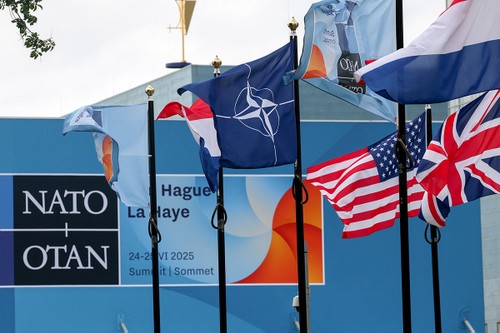 Venue of NATO Summit in The Hague (Photo: REUTERS/Yves Herman) Venue of NATO Summit in The Hague (Photo: REUTERS/Yves Herman) |
Ukraine and Middle East
In addition to increased defense spending and the US’s future security commitments to Europe, all eyes are on what NATO will do about the Russia-Ukraine conflict, the Israel-Iran conflict, and the US’s engagement in the Middle East.
The US and other NATO members have big differences when it comes to pressuring Russia and supporting Ukraine. While many NATO officials insist that Ukraine’s path to NATO membership is “irreversible,” senior US officials, including President Trump, have repeatedly opposed the idea.
The US is gradually reducing its financial and military support for Ukraine, even as NATO chief Mark Rutte has pledged 40 billion USD in aid for Ukraine this year.
One day before the NATO Summit, the EU and Canada held a summit and signed a defense cooperation agreement, signaling their own path in light of the uncertainty of US security policy and commitments. The European NATO members are also hoping to challenge the US policy and define Europe’s role in the Israel-Iran conflict.
Beatrice de Graaf, a security and terrorism expert at Netherlands’ Utrecht University, said the European leaders are trying not to criticize the US’s actions in the Middle East, hoping to preserve NATO unity and create new opportunities for diplomatic negotiations on Iran’s nuclear program.
“I have the feeling that they still want to tuck the United States in, exert pressure, and at the same time want to open the diplomatic overture. Starmer and Macron have said that we need to talk to Iran again. They were on a good track, so perhaps they are able to rekindle, to start the diplomatic venue again.”
Observers say European diplomatic efforts with Iran, restarted last weekend with a meeting between the foreign ministers of Germany, the UK, France, and Iran in Geneva, might gain momentum from Trump’s announcement that Israel and Iran have agreed to a full ceasefire and that the US aims to pursue a long-term diplomatic solution with Iran.