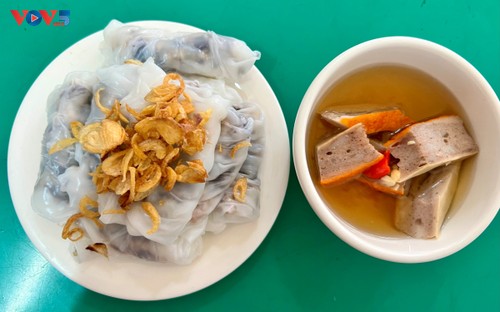
 Thanh Tri steamed rice rolls (Photo: Huyen Trang/VOV5) Thanh Tri steamed rice rolls (Photo: Huyen Trang/VOV5) |
The knowhow of Thanh Tri steamed rice roll making has been handed down through generations of people in Hanoi’s Vinh Hung ward.
Hoang Thi Lan is demonstrating the delicate art of spreading a thin layer of batter over a steaming pot. Whenever visitors come, Mrs. Lan proudly shares the story of her village’s steamed rice roll tradition. Her family has practiced this craft for three generations, passing the knowledge from mother to daughter. There’s no fixed recipe, Lan says. Everything is based on experience, intuition, and love for the craft.
In the past, Thanh Tri villagers used charcoal stoves and copper steamers, and everything was done manually. Today, electric steamers and flour grinders have made the process easier, but the basic technique remains deeply traditional.
Lan recalls how her mother balanced baskets of freshly made rolls on a shoulder pole and sold them on the streets of Hanoi. In her time, Lan used a bicycle. Today’s generation rents stalls to make and sell the rolls on-site. While the method has evolved, the passion is unchanged, according to Lan.
“I started making steamed rice rolls when I was 12, hurrying home from school to grind flour for my mother. We used stone grinders back then,” Lan told VOV, adding, “Every girl in Thanh Trì had to know how to coat the cake layers. I learned from my mother, and now my children have learned from me. In my mother’s time, she raised five children in this craft. I raised two. Now, both my son and daughter can make steamed rice rolls.”
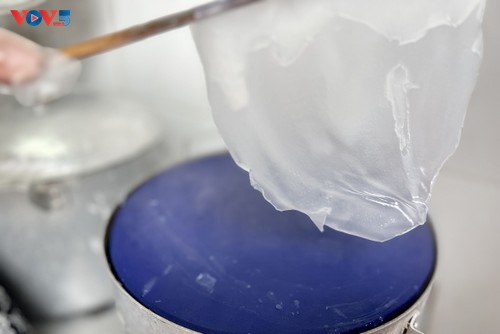 The steamed rice roll pancakes are spread into thin layers of ultra-thin, translucent sheets. (Photo: Huyen Trang/VOV5) The steamed rice roll pancakes are spread into thin layers of ultra-thin, translucent sheets. (Photo: Huyen Trang/VOV5) |
The craft’s essence lies in the meticulous preparation—from selecting rice to the batter coating technique known as “cau banh.” There are two main varieties: plain rolls, often brushed with fragrant scallion oil, and rolls filled with savory minced pork. The hallmark of a quality Thanh Tri steamed rice roll is its ultra-thin, translucent sheet, often described poetically as a “slice of moonlight.”
Local artisan Duong Thi Tuyet says that the most typical characteristic of Thanh Tri steamed rice rolls is how thinly they are spread. “In the past, flour was ground unevenly by hand, but now machines produce a smooth, silky batter. I soak the rice for two hours before grinding, chill the batter with ice, and mix in a precise amount of salt—one tael per three kilos of rice. The preparation process is a skill unique to Thanh Tri. No other place does it quite like we do,” according to Tuyet.
The craft’s inscription on the national heritage list has been warmly welcomed, especially by younger generations eager to carry on the legacy. Nguyen Thi Lan Huong, a local villager, said she is proud to have been born into a family with this steamed rice roll tradition. “To promote it, we must perfect our craft—making each roll thinner, tastier, and better every day. When customers praise our food, that’s our greatest reward. Then I can share our story on Facebook, Zalo, and other digital platforms to introduce our village’s specialty to more people,” said Huong.
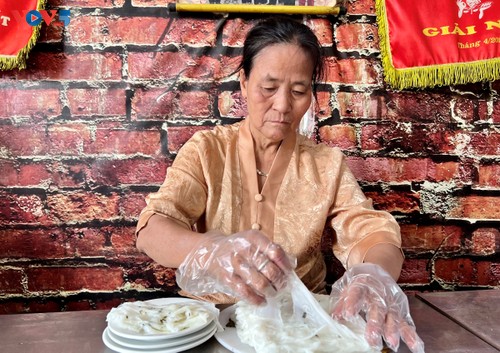 Mrs. Hoang Thi Lan has been engaged in the craft since she was 12 years old. (Photo: Huyen Trang/VOV5) Mrs. Hoang Thi Lan has been engaged in the craft since she was 12 years old. (Photo: Huyen Trang/VOV5) |
Quan Thi Van Anh, Vice Chairwoman of the Vinh Hung ward People's Committee, said that this reflects the State’s appreciation for the unique cultural values passed down through generations. “It affirms the historical, cultural, and technical importance of the tradition, helping us to preserve, honor, and professionally promote the craft. It also creates new opportunities for artisans and families to access support policies and raises public awareness about preserving traditional crafts and training the younger generation,” said Van Anh, adding, “We’re planning specific measures to develop the craft in tandem with tourism promotion.”
Thanh Tri steamed rice rolls inspired celebrated Vietnamese writers like Thach Lam, Vu Bang, and To Hoai. Since 2015, the craft has been protected under a collective trademark and now enjoys national heritage status, reinforcing its role in Hanoi’s rich and distinctive culinary identity.