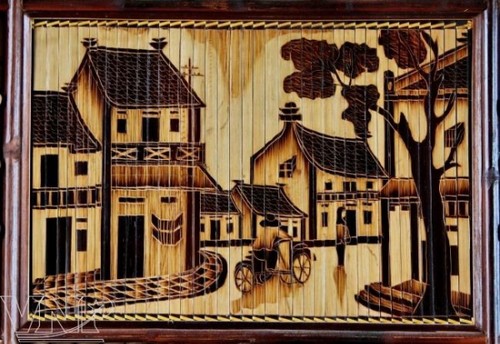
 A painting from Thu Hong bamboo craft village (Photo: Trinh Van Bo/VNP) A painting from Thu Hong bamboo craft village (Photo: Trinh Van Bo/VNP) |
In the past, Thu Hong was surrounded entirely by bamboo and rattan groves, so villagers even used these materials to build their communal house. Over time, they began crafting all household items from bamboo—baskets, sieves, winnowing trays, as well as tables, chairs, wooden beds, and bamboo daybeds.
At first, these items met only domestic needs. But with time, the skill and creativity of Thu Hong villagers turned these bamboo products into sought-after goods favored by consumers nationwide.
To create a refined bamboo product, artisans must be exceptionally skillful and possess a keen eye for aesthetics. Thick bamboo culms become legs for beds, daybeds, and chairs; the more flexible sections are used for handicrafts, carved Chinese characters, decorative elements, and weaving slats for beds and mats; bamboo roots are shaped into statues of the Three Gods of Happiness, Prosperity, and Longevity.
With their craftsmanship and diligence, the artisans’ works—though humble in material—are durable, sturdy, and elegant. Artisan Dang Phuong Cuc explains, “Thu Hong bamboo is much sturdier than bamboo from other places. All the furniture we make is joined all the way through, from one side to the other, which makes it extremely strong. We also treat the bamboo thoroughly—we soak it in rafts or boats for at least a year before taking it out for production.”
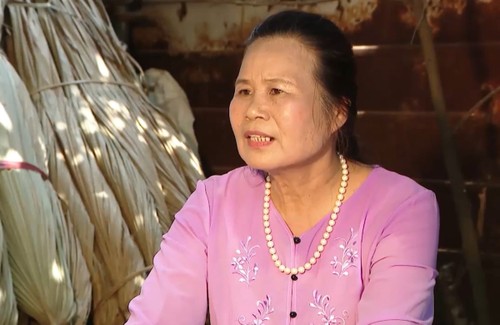 Artisan Dang Phuong Cuc of Thu Hong bamboo craft village. (Photo: VOV) Artisan Dang Phuong Cuc of Thu Hong bamboo craft village. (Photo: VOV) |
At a time when many traditional crafts are fading, the women of Thu Hong have found ways out by introducing eco-friendly materials, modernizing designs, and even bringing their handmade goods onto e-commerce platforms. Their passion, skill, and perseverance have helped build a sustainable green handicraft industry on their own homeland.
Local resident Nguyen Thi Tuyet said that for villagers, handwoven bamboo work is not just a livelihood, it is memory, heritage, and pride passed down through generations. That is why young people remain determined to preserve and develop the craft. “I treasure the craft our ancestors left for us. I want to maintain and develop it so that our craft village continues to flourish,” Tuyet added.
Women in the village also serve as strong motivators for the community, encouraging more sustainable production and consumption practices that are economical, responsible, and nature-friendly. To meet changing consumer tastes, the craftswomen continually develop new designs that blend rustic, traditional charm with the dynamism of modern urban life. Their designs and craftsmanship have become increasingly appealing to customers.
Customer Nguyen Van Ba said, “Products from Thu Hong bamboo craft village embody many values—from quality and culture to the soul of a long-standing traditional craft village.”
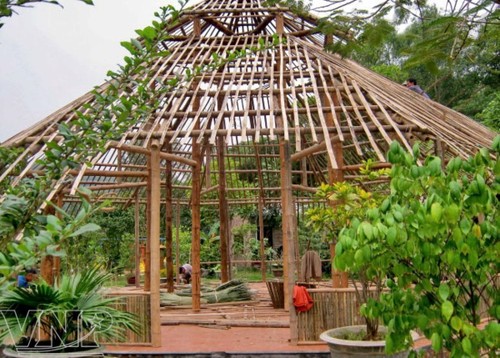 Bamboo houses built by Thu Hong craftsmen can last for a hundred years. (Photo: Trinh Van Bo/VNP) Bamboo houses built by Thu Hong craftsmen can last for a hundred years. (Photo: Trinh Van Bo/VNP) |
In addition to traditional household items, Thu Hong villagers now produce large-scale bamboo architectural works—homes and structural installations. Their signature lies in the precision of their joinery: the way bamboo mortises are carved ensures beams fit together seamlessly, tightly, and securely. Alongside techniques handed down through generations, the artisans continue to learn and refine their skills to ensure that the craft is sustainable.
Artisan Nguyen Xuan Tua said, “Bamboo houses in Thu Hong have a unique character. Our products are now exported to Taiwan (China), China, and South Korea. In the future, we’ll expand even further while preserving our national identity.”
The 300-year-old Thu Hong bamboo craft village has weathered countless ups and downs. With government policies supporting the revival of traditional crafts, the village has secured a stronger foothold in the market, but it is the steady effort of local women that has brought the Thu Hong bamboo craft to new heights.