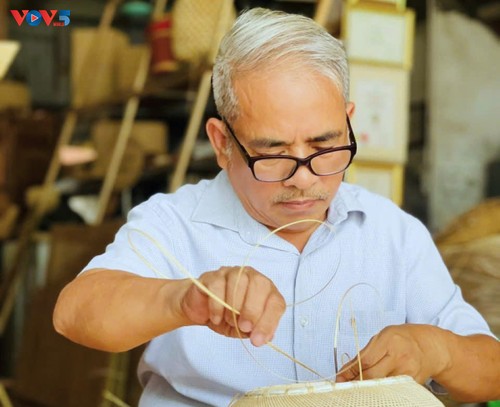
 Artisan Nguyen Van Tinh (Photo: Kim Lieu/ VOV5) Artisan Nguyen Van Tinh (Photo: Kim Lieu/ VOV5) |
Born and raised in Phu Vinh village in a family that has been involved in bamboo and rattan weaving for six generations, Nguyen Van Tinh began learning the craft at a young age from his father, artisan Nguyen Van Khieu, the first person in Vietnam to weave a portrait of President Ho Chi Minh from bamboo and rattan.
His pride in his father and in his ancestral craft nurtured Tinh’s passion for weaving. Tinh says he is not especially skillful, but his perseverance and deep love for the profession have been “supporting pillars” on his journey to develop the traditional craft passed down by his forefathers.
“We use unique techniques to weave and to treat raw materials. Our weaving styles are diverse, and 80% of our work uses rattan. The most distinctive technique is xau xien (interlacing), which demands precise coordination between the hands, eyes, and emotions,” said Tinh.
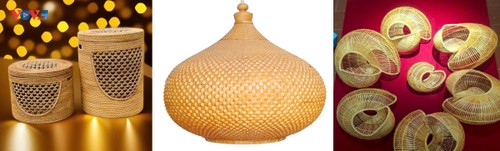 The products created by artisan Nguyen Van Tinh win many awards (Photo: Kim Lieu/ VOV5) The products created by artisan Nguyen Van Tinh win many awards (Photo: Kim Lieu/ VOV5) |
In 2006, Tinh’s piece ‘Hanging Lamp’ won First Prize at the Golden V Product Design Creativity Awards, organized by the Vietnam Chamber of Commerce and Industry. Two years later, his ‘Rattan Woven Flower Vase’ earned him another First Prize at the Vietnam Handicraft Product Competition held by the Ministry of Agriculture and Rural Development (now the Ministry of Agriculture and Environment).
These accolades inspired Tinh to continue his quest to put Vietnamese bamboo and rattan products on the world handicraft map. “When Vietnam opened up, integration brought tremendous commercial opportunities, and we had to adapt. We’ve always needed to create new products in response to changing customer demand.”
According to Tinh, sustainable development for craft villages means constant innovation and sensitivity to changing tastes, while still preserving traditional cultural identity. This attitude has enabled the bamboo and rattan products of Phu Nghia village to build a strong brand presence at cultural events and exhibitions in Australia, China, Thailand, and other countries.
“Only 20% of our products serve the domestic market. My family focuses on export goods. We fill orders from many countries,” said Tinh.
Not only has Tinh brought his village’s products to international markets, he has devoted considerable effort to teaching his craft to the next generation.
“Nguyen Van Tinh cares a lot about preserving and developing the village’s bamboo and rattan tradition. We’re very proud of him,” said villager Ho Huy Son
Another villager Tran Thi Linh said, “I’ve been working here for 10 years. Tĩnh has given me a lot of guidance and instruction. He’s helped me create many products.”
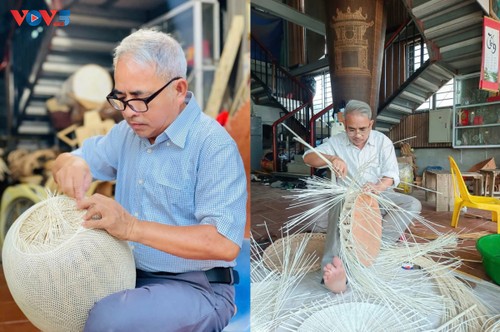 In 2025, artisan Nguyen Van Tinh is honored as one of 10 “Outstanding Citizens of the Capital.” (Photo: Kim Lieu/VOV5) In 2025, artisan Nguyen Van Tinh is honored as one of 10 “Outstanding Citizens of the Capital.” (Photo: Kim Lieu/VOV5) |
The dedication and effort of Nguyen Van Tinh have helped to sustainably develop Phu Vinh’s bamboo and rattan craft, create thousands of jobs, and boost the local economy. In recent years, the village’s products have attracted large orders from the EU, the US, and China, generating significant revenue, according to villager Nguyen Van Khuong.
“In peak years, our village earns 24-28 million USD annually, with profit margins of 10-15%,” said Khuong.
At a time when many craft villages are struggling to survive, Phu Vinh is thriving and growing, thanks to artisans like Nguyen Van Tinh. They’re the heart and soul of Vietnam’s craft villages and role models of adaptability, integration, and progress.