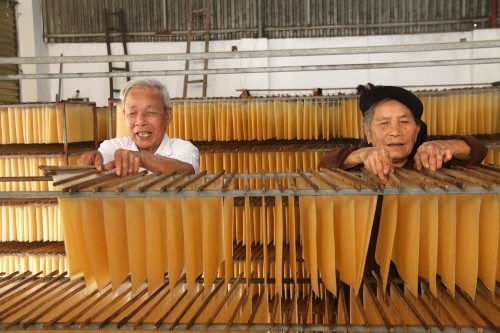
 Tien Thinh residents say they live on their traditional crafts. (Photo: langngheviet.com.vn) Tien Thinh residents say they live on their traditional crafts. (Photo: langngheviet.com.vn) |
Visitors notice right away the comforting aroma of rice flour wafting from trays of noodles and vermicelli laid out in household courtyards to dry under the sun. The village roads are free of traffic noise but full of the steady hum of grinding machines and the cheerful chatter of locals preparing their next batch of goods.
Tien Thinh resident Le Ngoc Thanh told VOV that the most crucial step in the process is to select the right type of rice. “Aged rice yields a finer, more delicate flour. First the rice must be rinsed and soaked for 15 to 18 hours. After draining, it’s ground into a fine paste, then mixed with water and pressed into thin strands. These strands are cut to the desired length and left to ferment before moving on to the next stage of production,” according to Thanh.
The villagers make vermicelli and rice noodles all year round, but the busiest time comes at the end of the year when orders flood in from all over the country. Each household specializes in a single stage of the process. Some grind the flour. Others create thin sheets. A number handle the drying. Each step requires precision, carefulness, and above all, an understanding of the ingredients.
The Tien Thinh villagers’ skilled hands and family secrets turn rice and arrowroot, the main raw materials, into delicate and distinctive products. Today Tien Thinh uses machines to make certain steps easier without changing the authentic flavor of their products.
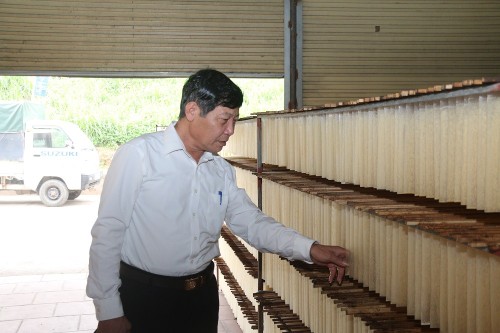 Le Ngoc Thanh, a Tien Thinh villager, is checking the quality of rice paper wrappers, in his workshop. (Photo: langngheviet.com.vn) Le Ngoc Thanh, a Tien Thinh villager, is checking the quality of rice paper wrappers, in his workshop. (Photo: langngheviet.com.vn) |
Thanh said that what sets the rice noodles and vermicelli of Tien Thinh apart from those produced elsewhere is their consistent adherence to market standards. “Local craftsmen say their products sell out as soon as they're made, with no surplus left over. Now the supply is limited. There are times when demand outpaces production and there’s not enough to meet the market demand,” Thanh noted.
In addition to its handmade rice noodles and arrowroot vermicelli, Tiến Thịnh produces other traditional crafts like peanut candy, sticky rice ginger cake, and rice paper wrappers. Multiple Tien Thinh products have been recognized as “One Commune, One Product” (OCOP) items, which encourages the commune to combine craft preservation with tourism development, offering visitors an authentic taste of rural Vietnamese culture.
Nguyen Van Luu, Deputy Chairman of the Tien Thinh commune People’s Committee, said, “Tien Thinh commune is developing rural and agricultural experiential tourism. In recent years, several urban schools have brought their students on field trips here, where they can observe and participate in making rice paper wrappers and producing vermicelli and rice noodles.”
This is a promising new direction for Tien Thinh commune. Luu says traditional craft villages like Yen Thi rice noodle and vermicelli village are gradually taking on a new, more dynamic identity for the rural area.
“To unlock our tourism potential, we’re building a brand that appeals to domestic and foreign markets across Asia and Europe. Our rice paper wrappers and vermicelli products have already found a foothold in Poland and Russia,” said Luu.
As modern life rapidly evolves, the traditional craft villages of Tien Thinh commune embrace the changes while continuing to preserve their rustic charm and the authentic flavors of the countryside.