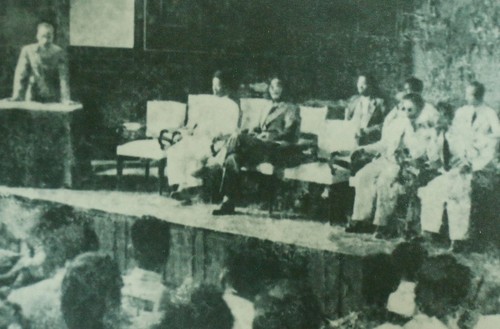
 President Ho Chi Minh attended the opening of the training course for mass education cadres (Ho Chi Minh course) in Hanoi on October 8, 1945. (Photo: Book Uncle Ho with education) President Ho Chi Minh attended the opening of the training course for mass education cadres (Ho Chi Minh course) in Hanoi on October 8, 1945. (Photo: Book Uncle Ho with education) |
On September 3, 1945, just one day after the Democratic Republic of Vietnam was declared, the nation’s Provisional Government held its first meeting. With more than 90% of the population unable to read or write, President Ho Chi Minh identified the eradication of illiteracy as one of the nation’s most urgent tasks.
Mass education movement
The campaign spread rapidly across the country. Historical records show that within a year 75,000 classes had been organized, engaging 95,000 volunteer teachers, to enable over 2.5 million people to learn to read and write. This was a remarkable achievement in educational mobilization that demonstrated the patriotism, unity, and thirst for knowledge of the Vietnamese people.
By 1959, illiteracy had been eradicated in all lowland and midland provinces of northern Vietnam for people between the ages of 12 and 50. By late 1965, illiteracy had been largely eliminated in the northern mountainous provinces as well.
The Bình dân học vụ campaign also raised intellectual standards, instilled national pride, and strengthened public trust in the Party’s leadership. It was a solid first step in the revolutionary education cause, laying the groundwork for the country’s educational progress over the next 80 years.
Nguyen Van Doan, Director of the National Museum of History, which is currently hosting the exhibition “Mass Education – Lighting the Future”, said: “The campaign was an awakening of civic consciousness and the spirit of self-reliance, and a testament to national solidarity. The philosophy of learning to be human, to serve the Fatherland, and to uphold the enduring value of education remains deeply relevant to Vietnam’s development today.”
 Some artifacts at the exhibition "Mass education - lighting up the future". (Photo: National Museum of History) Some artifacts at the exhibition "Mass education - lighting up the future". (Photo: National Museum of History) |
Building an education system for integration
From makeshift classrooms during wartime, Vietnam’s education system has evolved into a modern structure integrated with the world. Amid the Fourth Industrial Revolution and rapid social change, education continues to play a pivotal role in human development, raising intellectual capacity, and nurturing talent.
According to Minister of Education and Training Nguyen Kim Son, never before has education and training received as much attention and expectation from the Party and State as it does today. The Politburo has just issued Resolution 71 on breakthroughs in education and training development, providing a crucial political foundation for radical, comprehensive educational reform.
In addition, a national target program for education and training development is being formulated. Four key education-related laws—the Law on Teachers, the revised Law on Education, the revised Law on Higher Education, and the revised Law on Vocational Education—have been or will soon be enacted for a modern, efficient, and coherent education system.
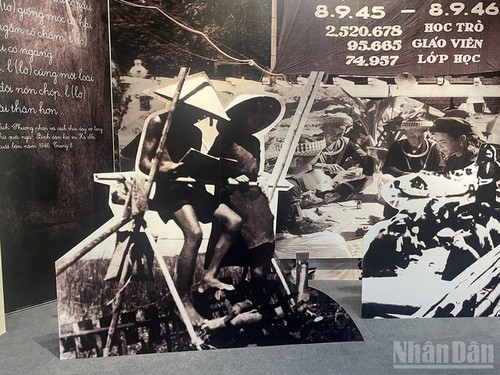 Image of farmers studying in the fields at the exhibition "Mass education - lighting up the future". (Photo: nhandan.vn) Image of farmers studying in the fields at the exhibition "Mass education - lighting up the future". (Photo: nhandan.vn) |
Digital transformation, artificial intelligence applications, and STEM/STEAM education (Science, Technology, Engineering, Arts, and Mathematics) are opening up opportunities for Vietnam’s education sector to enhance quality and drive innovation. This school year marks the first nationwide implementation of tuition fee exemptions for preschool and general education students.
The 2025–2026 academic year will pave new pathways for Vietnamese education. In his letter to the education sector on the occasion of the new school year, President Luong Cuong expressed confidence that Vietnamese students will nurture great aspirations to build a prosperous nation. He said the education system should continue to shape well-rounded individuals—equipped with knowledge, ethics, skills, resilience, and ambition—capable of meeting the demands of rapid and sustainable national development in this era of global integration.