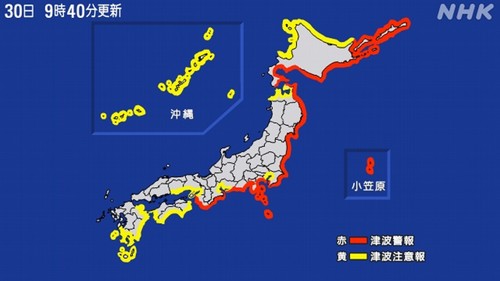
 Map of the tsunami-affected areas drawn by the Japan Meteorological Agency (Photo: NHK) Map of the tsunami-affected areas drawn by the Japan Meteorological Agency (Photo: NHK) |
Observatory data recorded by 4 p.m. Japan time on Wednesday showed that the first tsunami waves hit Japan reaching a height of 80 cm. Off the coast of Iwate prefecture, the waves rose as high as 130 cm.
Hokkaido and 21 prefectures in the affected zone ordered evacuations for over 1.9 million residents. Tokyo also ordered evacuations for 8 administrative districts. This marks the first time in 15 years that Japan has issued evacuation orders in the wake of an oversea earthquake. The Japan Meteorological Agency said that tsunami warning in Japan could be maintained for at least another day.
The US National Oceanic and Atmospheric Administration (NOAA) said that waves over 1.5 meters were recorded in Kahului, on the north-central coast of Maui. In Hilo, Hawaii, waves reached more than 1.3 meters above normal sea level. The Pacific Tsunami Warning Center (PTWC) issued an emergency alert urging immediate action to protect lives and property.
In Guam, tsunami waves approximately 30 cm high were also reported. Authorities noted that similar waves are expected to continue hitting the coast, though their intensity is expected to gradually decrease in the coming hours. Residents have been advised to stay away from coastal areas for safety. The US National Weather Service also reported that California recorded waves of about 30 cm and is expected to experience additional waves in the near future.
New images of tsunami damage in Russia’s Far East region are circulating on social media as the water begins to recede. Russian media reported that in the town of Severo-Kurilsk, located on the Kuril Islands, several houses were swept away when tsunami waves hit the area earlier on Wednesday.