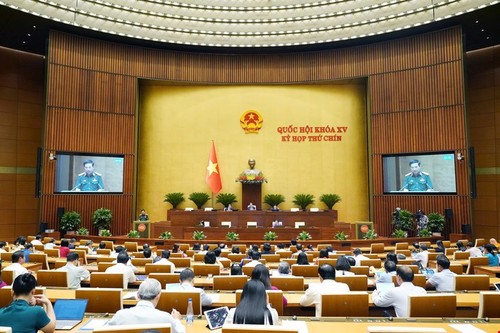
 Minister of National Defense General Phan Văn Giang presents the draft Law on Vietnam’s Participation in United Nations Peacekeeping Operations at the 9th session of the 15th National Assembly. (photo: quochoi.vn) Minister of National Defense General Phan Văn Giang presents the draft Law on Vietnam’s Participation in United Nations Peacekeeping Operations at the 9th session of the 15th National Assembly. (photo: quochoi.vn) |
Since first joining a UN peacekeeping mission in 2014, Vietnam has steadily improved its legal framework. To meet new requirements and align with Vietnam’s new role internationally, particularly within the UN, a comprehensive legal system governing its participation in the UN peacekeeping operations is needed.
A critical institutional landmark
Since 1996, Vietnam has made financial contributions to UN peacekeeping operations and organized numerous field trips to UN peacekeeping missions and to UN headquarters. Vietnam has sent 1,100 officers and soldiers to serve in UN missions and signed 10 cooperation memoranda with partners.
Drawing from 11 years of experience, the Law on Vietnam’s Participation in United Nations Peacekeeping Operations will enable Vietnam to contribute more effectively to world peace.
Minister of National Defense General Phan Van Giang said: “The law will institutionalize the Party’s guidelines and policies, refine the legal framework, and ensure compliance with the UN Charter and international treaties to which Vietnam is a signatory. Participating in UN peacekeeping operations promotes Vietnam’s international integration and enhances its prestige on the global stage.”
With 4 Chapters and 26 articles, the law specifies Vietnam’s peacekeeping forces, force deployment, and mechanisms for supplying and supporting those forces.
Colonel Le Quoc Huy of the Standing Office of the Ministry of Public Security on UN Peacekeeping Operations said: “The law pays attention to the policies for peacekeeping forces. Previous regulations have been amended with new provisions to create favorable conditions for all individuals participating in UN peacekeeping missions.”
With Vietnam expanding international cooperation, particularly within the UN, the new law expands the scope of eligible civilian participants in line the UN’s needs. Peacekeeping missions need, in addition to military forces, civilian experts in medicine, law, education, logistics, and other areas.
Senior Lieutenant Colonel To Long, Deputy Chief of the UN Peacekeeping Operations Office and Deputy Director of the Department of External Security of the Ministry of Public Security, said: “The law will provide a legal foundation for smoother and more lawful participation. Drawing from Vietnam’s peacekeeping experience, it encourages broader civilian participation, not just participation from the Ministry of National Defense and the Ministry of Public Security. It reflects Vietnam’s commitment to international responsibilities.”
Vietnam’s active participation, proactive contributions to global peacekeeping
The presence of civilians in UN peacekeeping missions reflects Vietnam’s role as a peace-loving, humane nation ready to make sacrifices for the global community.
During his visit to Vietnam from June 12 to June 14, Jean-Pierre Lacroix, UN Under-Secretary-General for Peace Operations, praised Vietnam’s active participation in the UN peacekeeping mission and the adoption of the Law on Vietnam’s Participation in the UN Peacekeeping Operation.
“Vietnam demonstrates a very strong commitment and support to the United Nations and the UN peacekeeping. The role that Vietnam is playing in peacekeeping, supporting the UN, supporting our efforts make a different for peace, the community, and the people affected by the conflict. Peacekeeping is very much about supporting people and peace effort. We’re very grateful to be able to count on Vietnam’s support,” said Jean-Pierre Lacroix.
Participating in UN peacekeeping in accordance with its national interests and capabilities, respecting other nations’ independence, sovereignty, equality, and territorial integrity, promoting gender equality, and protecting human rights, Vietnam has transitioned from an active participant to a key player in international peacekeeping.
The new law reaffirms Vietnam’s strong commitment to global peace and supports its strategy of safeguarding its national interests through peaceful means at an early stage and from afar.