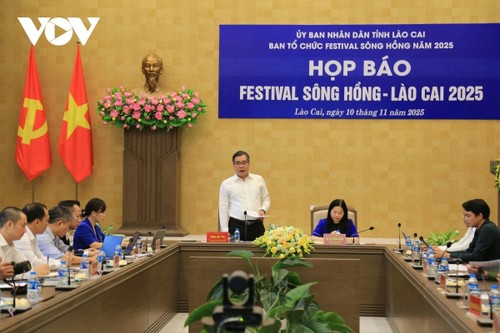
 At a press conference to introduce the festival (Photo: VOV) At a press conference to introduce the festival (Photo: VOV) |
The festival will include exhibitions of photographs and artifacts showcasing Red River culture, investment and tourism promotion events, and demonstrations of ethnic culture and performing arts. There will also be ethnic culture exhibitions, folk rituals, ethnic art performances, the 25th Vietnam–China International Trade Fair, the 2025 Red River Golf Tournament, sports exchanges between businesses and youth from Lao Cai and China’s Yunnan province, an international cycling race connecting Lao Cai and China’s Honghe, and the 2025 Lao Cai Shan Tuyet Tea Festival. The ancient Coc Leu market will also be recreated.
Nguyen Van Nhat, Chairman of the Lao Cai ward People’s Committee, said: “For the Coc Leu market, we have developed a detailed plan, designed each booth with care, and recreated the market gate exactly as it once was.”
Lao Cai hopes to make the festival a signature event that will strengthen the province’s tourism brand.
Duong Tuan Nghia, Deputy Director of the provincial Department of Culture, Sports and Tourism, said: “The Red River Festival is a major brand-promotion event. We hope to turn it into a flagship annual event.”
Lao Cai, located at the headwaters of the Red River, which is closely tied to the birth of the Vietnamese civilization, has a unique cultural and historical importance. The Red River, carrying rich alluvial soil that nourishes the fields of the northern provinces, flows through Vietnam for 510 kilometers before emptying into the East Sea.
The Red River–Lao Cai Festival 2025 will stimulate economic growth and expand cooperation between Lao Cai, Red River localities, and China’s Yunnan province.