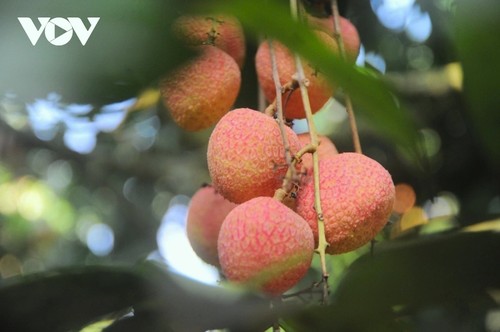
 The first lychees of the season are ripe and fragrant. (Photo: Truong Giang/VOV) The first lychees of the season are ripe and fragrant. (Photo: Truong Giang/VOV) |
In Thanh Lanh village, Thanh Quang commune, Nguyen Van Dao’s family is harvesting nearly 80 early-fruiting lychee trees. This season, his yield is higher than usual, estimated at about three tons. Mr. Dao said several varieties, such as the thorny lychee (gai), have already been harvested, while others like the white egg and pink lychee (trứng trắng and u hồng) will be ready in the coming days.
“Our family takes great care of the lychee trees to ensure the fruit is eye-catching, sweet, and of high quality when it enters the market. We frequently check the orchard for pests and diseases so we can treat them promptly and ensure a good harvest,” said Dao.
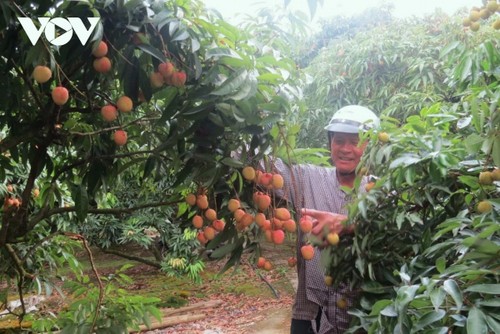 Lychee growers in Thanh Ha (Hai Duong) have begun harvesting lychees early. (Photo: Thanh Nga/VOV) Lychee growers in Thanh Ha (Hai Duong) have begun harvesting lychees early. (Photo: Thanh Nga/VOV) |
Bui Van Thang’s family, also in Thanh Lanh village, is harvesting more than 100 lychee trees. The thorny lychee is currently selling at 40,000 VND/kg (1.6 USD), while white lychees fetch between 80,000 and 100,000 VND/kg (3 to 4 USD). For several years, his family has been following VietGAP (Vietnamese Good Agricultural Practices) standards and using e-commerce platforms to market their produce.
“We've been following VietGAP practices for years for the highest quality and safety. This year’s yield is very good. Some households have harvested dozens of tons,” said Thang.
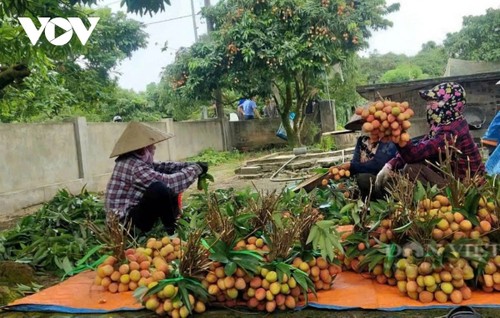 These days, people here are bustling and busy harvesting lychees. (Photo: Thanh Nga/VOV) These days, people here are bustling and busy harvesting lychees. (Photo: Thanh Nga/VOV) |
This season, Thanh Quang commune has more than 700 hectares of early-harvest lychees, with an estimated output of 10,000 to 12,000 tons. Across Thanh Ha district, nearly 3,300 hectares of lychee are under cultivation, with an expected yield of about 35,000 tons.
Thanh Ha plans to export 1,750 tons of lychees to Japan, the US, and Australia, and 21,000 tons to China. The rest will be consumed domestically.
Pham Duc Loc of the Hai Duong provincial Department of Crop and Plant Protection says farmers have been asked to comply with quarantine regulations, maintain cultivation logs, and complete documentation to meet the requirements of the buyers.
Loc said: “In recent years, farmers have adopted advanced cultivation practices, ensuring lychee quality and food safety. We have exported lychees to demanding markets like the US, Japan, and the EU.”
The first lychees of the season reflect a shift in of Hai Duong’s agricultural production. Local farmers are constantly innovating to bring Vietnamese agricultural products to global markets.