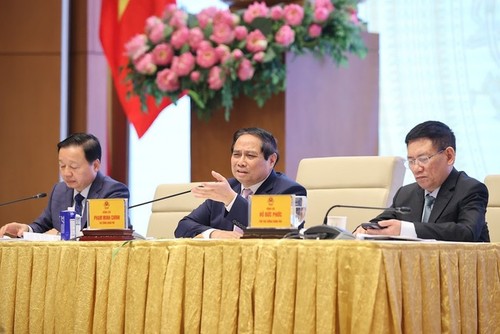
 The Prime Minister held a dialogue with businesses on the implementation of Resolution 68 (Photo: VGP/Nhat Bac) The Prime Minister held a dialogue with businesses on the implementation of Resolution 68 (Photo: VGP/Nhat Bac) |
According to research by economic organizations, a strong private sector will boost national productivity, enhance the national economy’s resilience to global shocks, and contribute to generating national wealth. Resolution 68 is not just an initiative to support businesses, but also a strategic roadmap for building a society in which every Vietnamese citizen can play a role in the national economy.
Unleashing the potential of the private sector
The dialogue sent a clear message about Vietnam’s determination to unlock the full potential of the private sector, not only major corporations but also small businesses and individual entrepreneurs.
At the dialogue, businesses expressed their commitment to supporting the resolution’s goals. Nguyen Trung Chinh, Chairman of the Board of Directors of CMC Corporation, highlighted the readiness of domestic enterprises to take on major infrastructure projects.
"It is time for businesses to participate more effectively in national development. The Government places trust in us and assigns key tasks in building the national infrastructure, including digital and transportation infrastructure. Major domestic firms like Hòa Phát, Vingroup, THACO, and technology enterprises are fully capable of handling large-scale projects," said Mr. Chinh.
Vinamilk CEO Mai Kieu Lien described Resolution 68 as a "new milestone" with a potential to elevate the private economy to a higher level. She said Vietnam has a unique opportunity to "leapfrog" by embracing modern technologies without having to spend decades on research, but that this will require a more responsive and efficient administrative system, just as businesses need to be responsive to catch up with market trends. Ms. Lien said businesses are ready to support the Government, provided that the institutional environment is transparent, consistent, and effective.
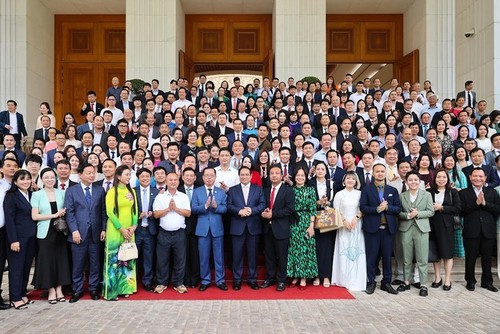 Prime Minister Pham Minh Chinh meets with businesses (Photo: VGP/Nhat Bac) Prime Minister Pham Minh Chinh meets with businesses (Photo: VGP/Nhat Bac) |
Government commitment to removing barriers
Prime Minister Pham Minh Chinh said it’s the responsibility of the Government, ministries, sectors, and leaders of localities to formulate strategies, frameworks, and policies to promote the private sector’s growth. He called for three strategic breakthroughs – institutional reforms, improved infrastructure, and stronger human resources – and a focus on simplifying administrative procedures, decentralization, and reducing compliance costs and time for businesses and citizens.
The Prime Minister said Vietnam needs new growth spaces, urban services, added value for lands, lower input costs, and greater product competitiveness. He called for breakthroughs in human resource development to meet the needs of businesses.
"The Government, ministries, and localities must ensure political stability, sovereignty, and territorial integrity to create favorable conditions for rapid and sustainable development. The Party, State and relevant agencies need to ensure equal access to capital, natural resources, land, human resources, and legal protection and the equal right to do business and own property," said the Prime Minister.
The Prime Minister asked all ministries and agencies to resolve business requests and proposals within two weeks and listen, consider, and respond to the needs of businesses, particularly in cases that require coordination with regulatory or legislative bodies. He also called for regular reviews of fiscal and monetary policies to ensure that they remain timely, flexible, and effective in supporting enterprise growth.
Vietnam is gradually shifting from an economy heavily reliant on foreign direct investment to one driven by domestic capital and internal capabilities. Vietnam now has nearly one million registered enterprises and five million household businesses. The private sector has evolved from being merely an "important component" to being officially recognized as "the most important driving force" of the economy.
With Resolution 68’s strong endorsement of the private sector’s role and the demonstrated willingness of businesses to contribute, Vietnam is poised to harness powerful resources to drive national development in the years ahead.