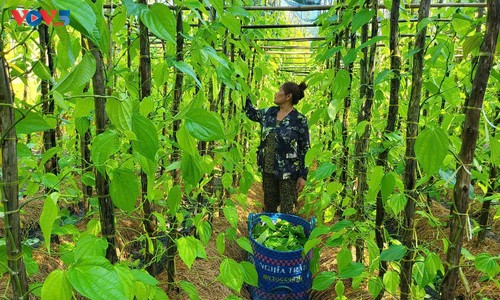
 Vi Thuy village has about 40 ha of land to grow betel. (Photo: Tan Phong) Vi Thuy village has about 40 ha of land to grow betel. (Photo: Tan Phong) |
According to local elders, betel vines have been cultivated in Vi Thuy for 60 years. Initially, betel was grown mainly for traditional ceremonies and to serve the custom older villages had of chewing betel and areca nuts.
Over time, betel leaves began to be sold to a wider market across Hau Giang province and in Ho Chi Minh City, and even exported to Cambodia and Taiwan (China), spurring an expansion of betel farming in Vi Thuy.
Betel has become a vital economic lifeline for Vi Thuy’s residents. It provides a stable income for local growers and creates jobs planting, tending, harvesting, and bundling the leaves.
Vi Thuy now has 200 households cultivating betel on 40 hectares, making it the largest betel-growing area in the Mekong Delta.
Blessed with fertile land and fresh water from the Hau River, Vi Thuy's betel vines are always verdant, with leaves known for their size, golden hue, and spicy aroma. It takes 3 to 4 months for the vines to mature. After that, leaves can be harvested three times per month, 10 days apart. A harvest is bundled into packs of 40 leaves.
Mai Van Van of Hamlet 5 in Vi Thuy commune says the locals can earn 4,000 USD per year on 1,300 square meters.
He told VOV, “My family has grown betel for decades. We cultivate more than 2,000 trellises. The income from my 1,300 square meters of betel, for example, is two to three times higher than from rice farming. Many local farmers have become rich from betel growing.”
In 2020, to improve market access, local growers formed the Trau Vang (Golden Betel) Cooperative, bringing together 30 members with 20 hectares under cultivation. The cooperative supplies 5,000 to 6,000 packs of betel per month.
In 2019, Vi Thuy betel village was officially recognized as a traditional craft village by the Hau Giang provincial People’s Committee.
According to Nguyen Van Doi, the Cooperative’s Director, “Joining the cooperative helps farmers improve their quality, which keeps prices stable. I grow 2,500 trellises. That’s enough to send my two children to university. I’m very happy about that.”
Hau Giang province includes Vi Thuy in its tourism development plans. Vi Thuy’s riverside orchard is set to be part of a network of eco-tourism destinations linking Vị Thanh city, Long My town, and Long My district and producing green tourism products.
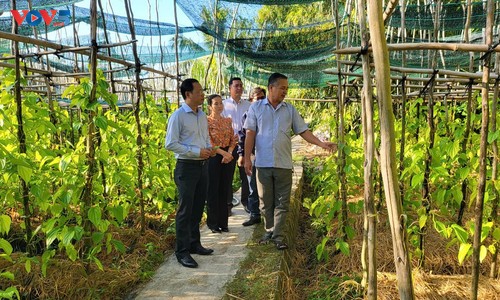 Vi Thuy betel village has been identified as a unique community-based tourism destination to help the locals increase income. (Photo: Tan Phong) Vi Thuy betel village has been identified as a unique community-based tourism destination to help the locals increase income. (Photo: Tan Phong) |
Promoted as “Vi Thuy, where betel love blossoms’, the Vi Thuy tourism product is one of eight featured in Hau Giang. It invites visitors to tour lush betel gardens, hear the story of the village’s origins, and relax with herbal products made from betel leaves.
Nguyen Cong Duy, Chairman of the Vi Thuy district People’s Committee, says Vi Thuy district is working to transform the betel village into a unique community-based tourism destination.
“We’ve invested in two new roads, upgraded village gates and signage, planted additional rows of areca palms and flower clusters, and set up scenic spots as highlights,” said Duy, adding, “Technical training workshops have been organized as well as study tours to other localities to learn from their experience. We’ve worked with investors to develop products like betel candy, essential oils, and hygiene products to diversify our income.”
Visitors are met with the unforgettable sight of glossy green betel vines stretching across the peaceful countryside of the largest betel-growing village in the Mekong Delta.