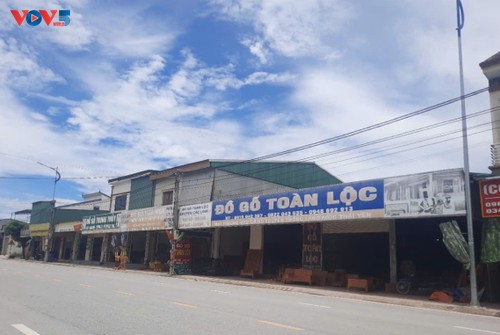
 Thai Yen is one of the oldest traditional carpentry villages in central Vietnam. (Photo: Kim Lieu) Thai Yen is one of the oldest traditional carpentry villages in central Vietnam. (Photo: Kim Lieu) |
Village elders say the carpentry craft has a history of almost 400 years. By the late 19th century, the craft was flourishing and reached its peak in the early 20th century. At first, the villagers focused on everyday items like trays and incense tables for worship.
Over time, young village craftsmen traveled far and wide to learn how to make tables, chairs, beds, cabinets, and sofas. Thai Yen artisans gained a reputation as masters of intricately carved furniture and altar pieces that feature the four sacred creatures – dragon, phoenix, turtle, and unicorn – used to decorate temples, communal houses, and royal tombs.
What distinguishes Thai Yen is its entirely manual production process, requiring meticulous attention to detail at every stage. Artisans carefully select high-quality, durable woods such as ironwood, canary wood, and peck wood sourced from western Ha Tinh and Nghe An province.
Every stage – cutting, sawing, carving, polishing, and varnishing – is done by hand, ensuring that each piece has a unique identity. Furniture and altar pieces are adorned with elaborately carved patterns and designs that reflect folk culture values, blending artistic beauty with practical function.
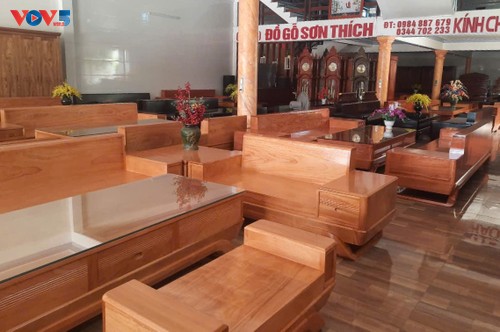 A number of furniture products in irreducible style made by Thai Yen carpentry village. (Photo: Kim Lieu) A number of furniture products in irreducible style made by Thai Yen carpentry village. (Photo: Kim Lieu) |
Phan Dang Luan, owner of a large woodworking facility in Thanh Binh Thinh commune, says Thai Yen brand has a special place in the minds of customers nationwide by using wood that not every craft village has. Luan told VOV, “Our wood is special, resistant to warping. Our craftsmen have over 10 years of experience of creating smooth, elegant lines. We also use advanced polishing techniques and modern machinery to enhance quality.”
The village’s 56 enterprises and cooperatives and 1,000 production households earn annual revenues of 35 million USD and employ 1,900 workers. Thai Yen’s wood products are sold domestically and exported abroad.
Tran Van Toan, owner of the Toan Loc workshop, said, “We focus on designing new models that meet consumer preferences. Modern machinery has been used to increase our productivity, and we collaborate with major distributors to expand our market.”
Facing strong competition from industrially manufactured wood products, Thai Yen craftsmen have diversified into souvenir wood products, says artisan Phan Dang Yen. “Products for tourists must be varied in design, small, and sophisticated. They prefer small, delicately carved items that reflect the village’s identity – teapots, incense holders, and carved toothpick cases. These are easy to carry and perfect as gifts,” said Yen.
Local authorities have adopted policies to encourage investment in infrastructure, including a 21-hectare industrial cluster that cost 4 million USD. Woodworking facilities are using new technology to improve product quality. Marketing and participation in international fairs and exhibitions is elevating the Thai Yen carpentry brand globally.
Nguyen Khac Chien, Deputy Chairman of Thanh Binh Thinh commune, said, “We are continuously improving product design, carefully selecting materials, and combining skilled craftsmanship with modern techniques to ensure products meet high standards of quality and aesthetics.”
Thai Yen carpentry village is a shining example of how traditional culture and economic development can harmoniously coexist. The village’s unique character and sensitivity to market trends and consumer tastes have boosted local incomes and fostered sustainable growth.