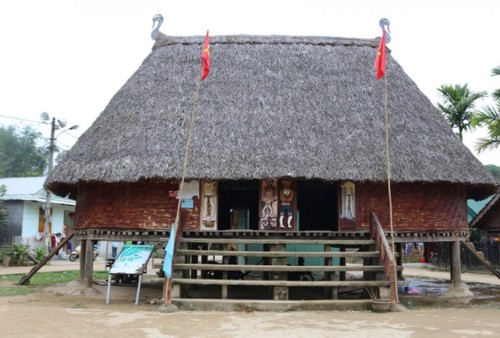
 Guol communal house in Ta Lang community-based tourism village (Photo: Tuyet Le/VOV) Guol communal house in Ta Lang community-based tourism village (Photo: Tuyet Le/VOV) |
The Ta Lang community-based tourism village, located on the legendary Ho Chi Minh Trail in Bha Lee commune, invites tourists to join the Co Tu ethnic villagers as they collect forest vegetables and bamboo shoots, fish in mountain streams, prepare meals, and enjoy traditional music and dances under the roof of their Guol communal house.
A village resident named A Lang Mit told us that in the past the Co Tu people depended solely on farming and often struggled with poverty and food insecurity. Things began to change in 2019 with the establishment of Ta Lang as a community-based tourism village. Since then, the local standard of living has improved.
Mit says he received a government grant of 1,600 USD and borrowed enough additional money to turn his home into a homestay where he charges guests about 3.9 USD per night. “Whenever we have guests, the villagers are happy. My homestay has welcomed many tourists. Community-based tourism is growing in my commune. In the past, if the harvest was poor, we had nothing to eat. Now, tourism has made our lives better,” said Mit.
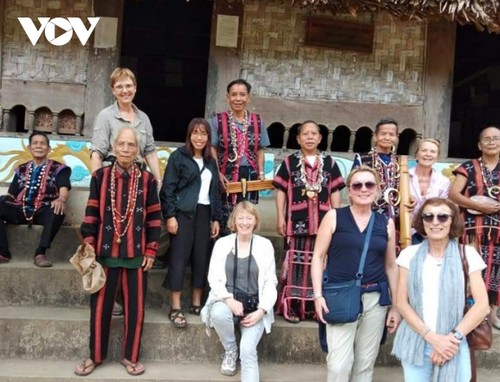 Foreign visitors enjoy tourism services in Dong Giang district. (Photo: Tuyet Le/VOV) Foreign visitors enjoy tourism services in Dong Giang district. (Photo: Tuyet Le/VOV) |
Since 2019, the Co Tu people have become more environmentally conscious. The locals have rebuilt the Gươl communal house, received food safety training, and formed culinary teams to prepare signature dishes for visitors. Traditional handicrafts such as bamboo and brocade weaving have been revived.
Visitors enjoy performances of tang tung and da da, traditional Co Tu dances, and ly, a traditional Co Tu singing and speaking style. They can also explore ancient forests filled with pơ mu (fokienia), ironwood, and rhododendron trees.
Mac Nhu Phuong, acting chairman of the Tay Giang district People’s Committee, said, “The district has helped locals develop tourism, especially community-based tourism, in Ta Lang village. Eco-tourism sites like Dinh Que and Loc Troi have also been established to boost economic development. We’re training residents in tourism to boost their incomes and reduce poverty.”
The ĐhRoong community-based tourism village in Ta Lu commune has been operating since 2019, with 35 households participating. Briu Thi Hanh, a member of the village’s brocade weaving team, said their brocade products, formerly just for the family, are now made for sale to tourists. This has improved their lives, she said. “A brocade scarf sells for about 11 USD. These are OCOP-certified products. I also make woven handbags, phone pouches, and pencil cases to sell as souvenirs,” said Hanh.
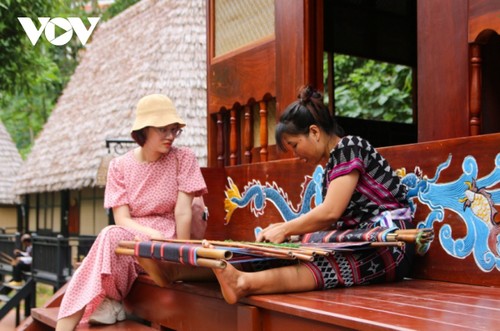 A tourist watches a local doing broadcade weaving. (Photo: Tuyet Le/VOV) A tourist watches a local doing broadcade weaving. (Photo: Tuyet Le/VOV) |
Today, dozens of villages in Quang Nam’s mountain districts are developing community-based, ecological, and craft village tourism. The provincial administration has introduced supportive policies to encourage tourism, including fostering partnerships with businesses, tour operators, and guides, and has promoted the villages through media and social networks.
Ho Quang Buu, Deputy Chairman of the Quang Nam People’s Committee, said that the locality places special importance on developing tourism in mountain areas and encourage community-based, craft village, and rural tourism models. “We have linked tours in world heritage sites of Hoi An and My Son with Quang Nam’s coastal destinations. I believe this connection will add value for those involved in community-based tourism in Quang Nam’s mountain regions,” said Buu.
The Co Tu people in Quang Nam, who once struggled to make a living through farming, now enjoy more stable incomes and improved living conditions thanks to community-based tourism. Looking ahead, they will diversify tourism products to meet evolving demand and turn mountains into a popular tourist destination.