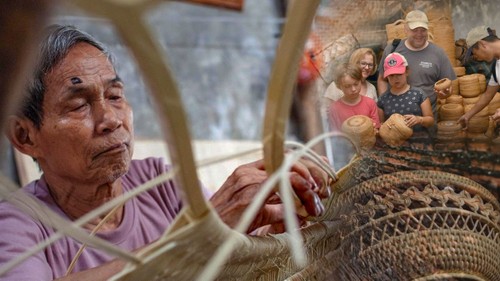
 Phu Vinh craft village in Chuong My district is considered the most typical among bamboo and rattan weaving villages in Hanoi. (Photo: Ha Nam/nhandan.vn) Phu Vinh craft village in Chuong My district is considered the most typical among bamboo and rattan weaving villages in Hanoi. (Photo: Ha Nam/nhandan.vn) |
Originally called Phu Hoa Trang, meaning "God blessed people with skillful hands", the village's inhabitants possess remarkable weaving skills. In 1841, the name Phu Hoa Trang was changed to Phu Vinh, symbolizing prosperity and honor. From one generation to the next they have maintained their connection to bamboo and rattan, understood the unique properties of those plants, and mastered the art of weaving.
Nguyen Van Tinh, part of the third generation of a family engaged in bamboo and rattan weaving, told VOV, “Phu Vinh craft village stands out from other weaving villages thanks to its unique weaving techniques and distinctive material processing methods. The village boasts a wide variety of weaving styles, with up to 80% of the products using rattan. The ‘threading’ technique requires precise coordination of hands, eyes, and emotion. This technique is used elsewhere, but in Phu Vinh it takes on an exceptional artistic form.”
Phu Vinh villagers who have mastered hundreds of intricate weaving techniques said the threading technique, originally used in embroidery, is the most delicate and elegant. It is uniquely adapted to create intricate, beautifully detailed patterns of rattan fibers. Phu Vinh is the only village in Vietnam that possesses such a high level of bamboo and rattan craftsmanship.
 (Photo: congluan.vn) (Photo: congluan.vn) |
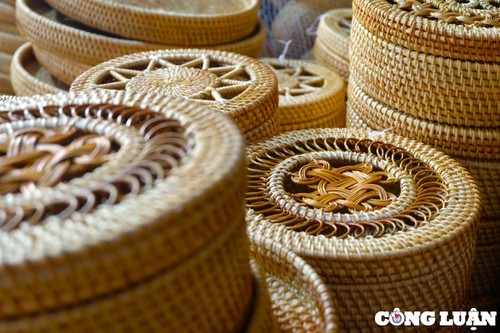
Phu Vinh’s traditional products were items intended for daily use – sieves, baskets, trays, bags, and boxes. Today’s artisans combine bamboo and rattan with other materials to produce new items like rattan-wrapped ceramics and decorative sculptures.
To keep pace with modern trends, Phu Vinh artisans have reinvented classic patterns like dragon-scale, fishnet, durian- and jackfruit-spike weaves to turn out a broader, more sophisticated product range that includes portraits, landscape wall art, calligraphy panels, horizontal plaques, and animal sculptures.
Nguyen Van Quang, an artisan from Phú Vinh, recalled, “In the past, most products were made entirely of rattan. A rattan vase could only hold dried flowers. By combining rattan and ceramics, we’ve created a product that can hold water and fresh flowers.”
According to Meritorious artisan Nguyen Van Trung, Chairman of the Phu Vinh Bamboo and Rattan Business Association, “In the past, our elders created products based on whatever ideas came to mind. Today, we research and design our products more systematically. The innovation process involves improving our weaving techniques so items can be produced more quickly without sacrificing beauty and quality.”
Meritorious artisan Hoang Van Hanh, Director of the May Viet Bamboo and Rattan Company, said, “Over time, our products have become more refined and sophisticated. Domestic and foreign tourists prefer newer, more advanced weaving styles and techniques, and that inspires and motivates the village’s artisans.”
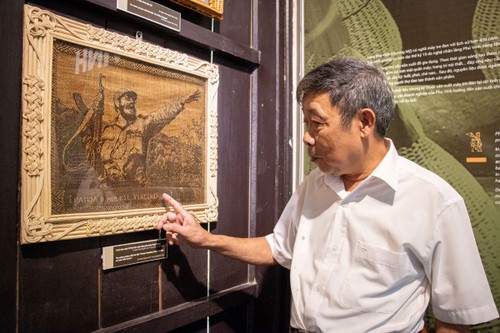 Artisan Nguyen Van Trung stands by his woven painting of Fidel Castro. (Photo: Ha Nam/nhandan.vn) Artisan Nguyen Van Trung stands by his woven painting of Fidel Castro. (Photo: Ha Nam/nhandan.vn) |
In recent years, the village has been receiving large orders from the EU, the US, and China, with better prices. This has given the local workers a good, stable income.
Nguyen Van Khuong, Deputy Chairman of Phu Nghia commune People’s Committee, said, “Each year, we make a significant economic contribution to the local economy. The peak for bamboo and rattan exports came in 2018, when our village’s craft businesses were generating between 24 and 28 million USD per year. Profit margins during that period were 10 to 15%, and products were exported around the globe.”
Meritorious artisan Trung recalled his first order that was a batch of interior decor items including hanging lamps, photo frames, and mirror frames. “The order was from a customer in Taiwan (China). We considered it a high-end product line, and it was quite demanding to make. But after the initial shipment, they began ordering regularly, one container a month. This gave local artisans peace of mind and confidence to keep producing," Trung noted.
While continuing to preserve its unique traditional identity, Phu Vinh craft village is catering to market demand and keeping up with the global trend toward eco-friendly products.