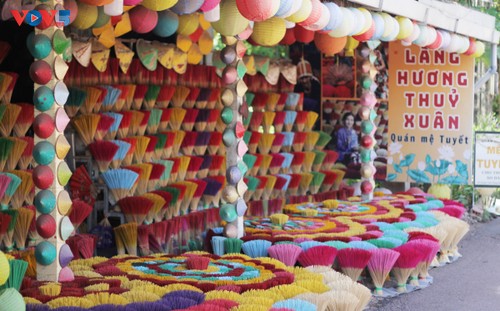
 Thuy Xuan incense village stands out as a destination that embodies the unique cultural identity of Hue. (Photo: VOV5) Thuy Xuan incense village stands out as a destination that embodies the unique cultural identity of Hue. (Photo: VOV5) |
The tradition of making incense here dates back 700 years to the Nguyen Dynasty, when the village supplied incense to the royal court, mandarins, and households in the Thuan Hoa-Phu Xuan region. Through centuries, generations of villagers have maintained the craft, eventually turning their livelihood into a popular tourism destination. Upon entering the village, visitors are welcomed by the fragrance of agarwood incense wafting through the air.
One of the village’s most respected artisans is Ho Ngoc Thu, whose family has produced agarwood products for four decades. Like many other households in Thuy Xuan, his preserves the traditional techniques while adapting to modern demands. Thu told us, “The process begins with raw materials ground into fine powder, then mixed with cold water and natural glue to form incense paste. The sticks are shaped by hand or foot-powered machines. Thuy Xuan makes incense in many scents – cinnamon, pine, herbs – but it’s agarwood that made a name for the village. In the past, bamboo sticks were split by hand, but today we rely on machines.”
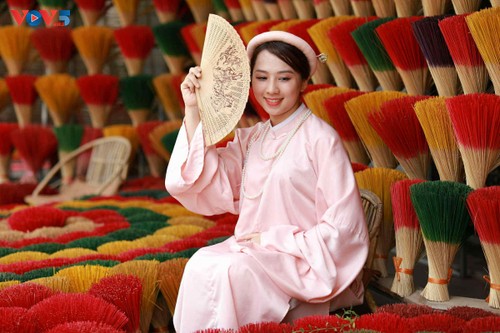 The traditional ao dai is preferred by visitors taking photos at Thuy Xuan incense village. (Photo: VOV5) The traditional ao dai is preferred by visitors taking photos at Thuy Xuan incense village. (Photo: VOV5) |
Mechanization has increased output to 50,000 incense sticks per household per day – ten times more than the traditional method produced. Yet the craft remains steeped in heritage, using time-honored formulas passed down through generations. Bui Van Thanh, owner of the Non Incense Workshop, recalls, “We use only natural ingredients sourced from agarwood forests. After processing, drying, and grinding, the powders are blended to create incense. Natural agarwood gives off a gentle, refined fragrance.”
What distinguishes Thuy Xuan incense is its blend of herbs and spices: cinnamon, cardamom, pine buds, clove, star anise, dried pomelo peel, pomelo blossoms, and eucalyptus’ bark. To make the incense even more eye-catching, villagers dye bamboo sticks in different hues. On sunny days, thousands of sticks are laid out to dry along village lanes, courtyards, and fields, arranged in circles, flowers, and symmetrical patterns. These colorful displays make Thuy Xuan one of Hue’s most photogenic check-in spots.
Craftswoman To Nu Bich Loan said proudly, “The red sticks are cinnamon incense, the pink ones are agarwood, and the purple ones are jasmine. Each scent is unique – they keep your home fragrant, ward off dampness, and repel mosquitoes.”
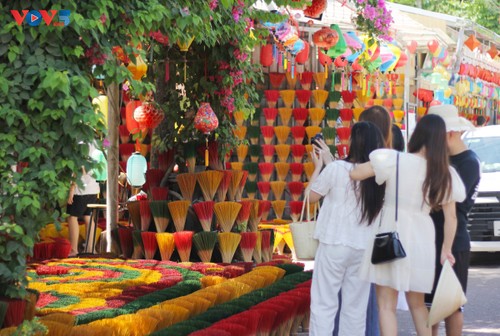 Eye-catching displays of five-colored incense bundles draw young travelers. (Photo: VOV5) Eye-catching displays of five-colored incense bundles draw young travelers. (Photo: VOV5) |
The villagers have now fully embraced tourism. They encourage visitors to try their hand at making incense, take photographs, and learn from local artisans about the heritage and significance of the craft.
“This village is unique. The people are warm and welcoming, and the scenery is stunning,” a visitor said. “Hearing the artisans explain their work and taking beautiful photos makes me, a Hue native, feel proud to see this tradition celebrated,” another tourist has this to say.
With its kaleidoscope of colors, soothing aromas, and immersive experiences, Thuy Xuan incense village is an unforgettable corner of the ancient capital of Hue.