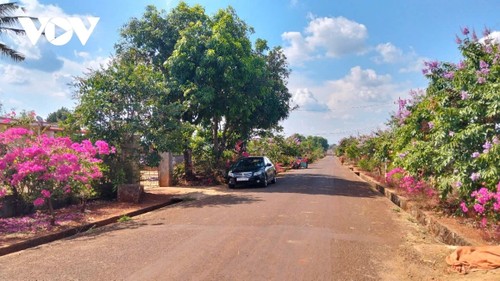
 The beautiful, green, and tidy road in O Ngol new-style rural village (Photo: Quoc Hoc) The beautiful, green, and tidy road in O Ngol new-style rural village (Photo: Quoc Hoc) |
On weekends, the village’s community cultural house comes alive with the sounds of gongs, folk songs, and joyful chatter. Activities organized to teach the villagers how to play gongs and sing traditional Jarai folk songs attract people of all ages.
Siu H’Biao, founder of the village’s women’s group, says, “Jarai folk songs include songs praising wartime heroes, such as ‘Hi uncles, brothers’, or ‘Hok kodok celebrating liberation day’. Some songs praise Uncle Ho and the revolution. Life is easier today. Smartphones allow me to communicate with my team via group chats.”
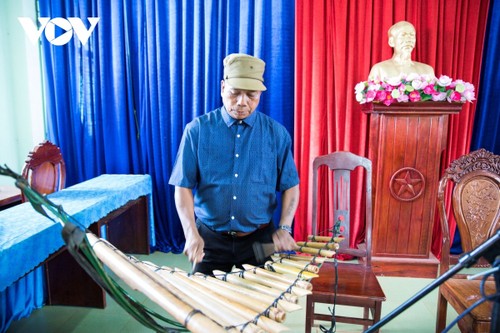 Village elder Siu Jo says he's glad to see the younger generation continuing the traditional culture. (Photo: Quoc Hoc) Village elder Siu Jo says he's glad to see the younger generation continuing the traditional culture. (Photo: Quoc Hoc) |
According to village elder Siu Jo, O Ngol people have stayed united. Over the past decade, the village has been recognized as provincial-level cultural village for its efforts to preserve and promote traditional values.
He expressed his pride to see the younger generation learning to play gongs and preserving our ancestral culture. “O Ngol has three gong troupes for different ages – children, teens, and adults. Artist Ama Nga and the village chief perform with them. Knowing the youth will carry on this tradition gives me peace of mind. Gongs are sacred to our spiritual life. They are essential at funerals, grave-leaving ceremonies, and village festivals,” said Siu Jo.
O Ngol, which has 120 households and 500 residents, mostly ethnic Jarai, was already certified as a new-style rural village seven years ago. Gong performances, ethnic musical instruments, xoang dancing, and folk singing – remain a part of everyday life.
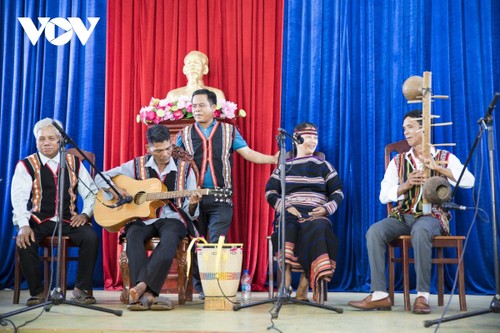 Party Secretary and head of O Ngol village Siu Huynh (standing) and artisans sing a folk song together. (Photo: Quoc Hoc) Party Secretary and head of O Ngol village Siu Huynh (standing) and artisans sing a folk song together. (Photo: Quoc Hoc) |
According to Siu Huynh, the village head, “As society modernizes, we must adapt. But our beautiful traditions should be preserved and upheld. I’ve been learning to sing Jarai folk songs, for example, including revolutionary songs. Everyone here, from elders to children, understands this. That’s why our village excels in new rural development.”
Siu Khlo, Party Secretary of Ia Ve commune in Chu Prong district, says O Ngol achieved all the ethnic minority rural development criteria by late 2018, making it one of Gia Lai’s standout new-style rural villages.
“Guided by the motto ‘The State and the people work together,’ O Ngol villagers have built clean, spacious well-lit inter-village roads. Houses are neat, with fenced gardens full of greenery. Many families grow coffee or pepper and now live in solid homes and own motorbikes and tractors,” Siu Khlo, said, adding, “The village has a cultural house, gong troupes, and traditional instruments like the goong and T’rung. Our artisans and other villagers cherish and preserve our heritage.”