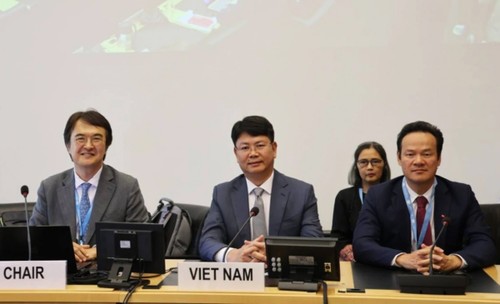
 Vietnam's inter-sectoral delegation led by Deputy Minister of Justice Nguyen Thanh Tinh at the Dialogue Session. (Photo: VOV) Vietnam's inter-sectoral delegation led by Deputy Minister of Justice Nguyen Thanh Tinh at the Dialogue Session. (Photo: VOV) |
The ICCPR, adopted by the United Nations General Assembly in 1966 and effective since 1976, is among the most important international treaties on human rights. Vietnam became a party to the Covenant in 1982 and, over the past 43 years, has consistently fulfilled its obligations and commitments under the ICCPR and the other human rights treaties to which it is a signatory.
Reaffirming human-centered approach
During the session, Vietnam conveyed a consistent message about placing people at the center of all development efforts and considering people as the goal and driving force of national progress. Vietnam has allocated its best resources to protecting the rights of its citizens, particularly the civil and political rights enshrined in the ICCPR.
The Human Rights Committee acknowledged Vietnam’s progress as it has ratified seven out of nine core international human rights treaties and strengthened its legal framework for preventing discrimination, combatting domestic violence, promoting gender equality, and fighting corruption. To address the Committee’s concerns, the Vietnamese delegation provided comprehensive updates on Vietnam’s progress in promoting civil and political rights since the previous review in 2019.
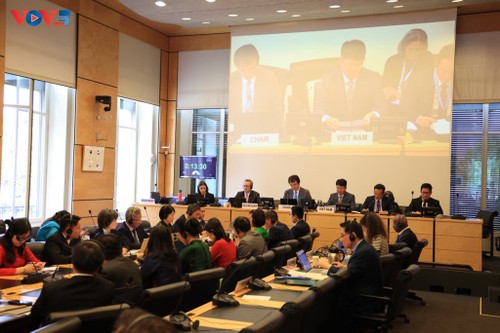 At the Dialogue Session. (Photo: Anh Thu/VOV1) At the Dialogue Session. (Photo: Anh Thu/VOV1) |
Members of the delegation, representing different sectors, outlined developments in legal and institutional reform, judicial improvements, and practical measures taken to protect human rights, as well as mapping out future directions.
Speaking to the media after the session, Deputy Minister of Justice Nguyen Thanh Tinh, who led the Vietnamese delegation, said: "All actions by the Party and State place the people at the center as the main stakeholders. The revolution of apparatus restructuring has clarified Vietnam’s strategy. Vietnam has eliminated intermediary administrative levels, downsized ministerial and sectoral agencies, and implemented a two-tier local government system. Vietnam has delegated authority to local levels and shifted from pre-inspection to post-inspection management to better serve the public and enhance state efficiency. This approach reflects Vietnam’s effort to address the Committee’s recommendations on enhancing law enforcement and bridging the gap between legislation and implementation. Our laws are already solid. The next step is effective implementation to ensure that the legal benefits reach the people, so that they enjoy in actuality the rights and values provided by the law.”
National Action Plan to implement the ICCPR
Deputy Minister Tịnh said the ICCPR has a broad scale and interpretation and comprehension of the rights enshrined in the Covenant is open and extensive. Implementation of the Covenant will require great effort and resources. Vietnam faces several challenges – uneven awareness of human rights across different regions and levels of government, and a legal framework that has not kept up with changing requirements. Localization of ICCPR provisions in Vietnam will require careful study to ensure alignment with Vietnam’s legal system.
Vietnam does have several advantages, including a strong political commitment and a consistent stance by the Party and the State, who regard human rights as a core objective of national development. This commitment is reflected in numerous strategies, policies, and concrete action programs. Vietnam’s legal system has been steadily improved to incorporate ICCPR provisions, thereby strengthening the protection of civil and political rights.
Deputy Minister Tinh said that following the dialogue session the Ministry of Justice will submit a proposal to the Prime Minister for a National Action Plan to effectively implement the ICCPR and the recommendations of the Human Rights Committee.
The plan will focus on raising awareness and accountability among officials to ensure that all policies and directives are people-centered, grounded in actual conditions, and based on the legitimate rights and interests of the people. It will incorporate into law all international human rights treaties that Vietnam is a party to, in order to ensure that Vietnam’s legal system is democratic, fair, comprehensive, timely, consistent, accessible, and most importantly centered on the lawful rights and interests of the people.