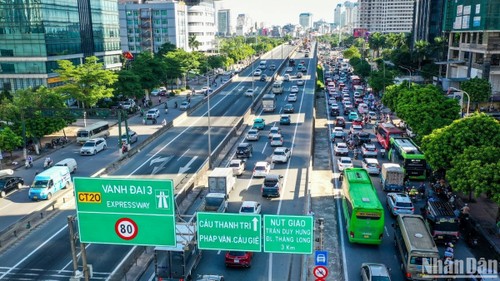
 Hanoi is to pilot low-emission zones, where polluting vehicles will be restricted. (Photo: Thanh Dat/nhandan.vn) Hanoi is to pilot low-emission zones, where polluting vehicles will be restricted. (Photo: Thanh Dat/nhandan.vn) |
Every morning at 6:45, Nguyen Cong Binh, a resident of Yen Nghia ward, begins his day by taking his child to school before heading to his office in Cua Nam ward, about 10 kilometers away. The commute through crowded, polluted streets takes him nearly an hour. Binh hopes the city will accelerate its plan to implement LEZs.
“When you’re on the road, the amount of exhaust fumes you inhale is massive, clearly affecting people’s health. Creating low-emission zones is very important, as well as raising public awareness. I think most people are still indifferent to the issue,” Binh told VOV.
Hanoi has 9.2 million registered vehicles, including 1.1 million cars and 6.9 million motorbikes, plus another 1.2 million vehicles regularly coming in from other provinces. To ease the pressure and reduce emissions, Hanoi has been expanding its public transportation network — such as the Cat Linh-Ha Dong and the Nhon-Hanoi Station metro lines — and rolling out more electric and clean-energy buses.
“Where does air pollution come from? First and foremost, it comes from transportation — the sheer number of cars and motorbikes. Construction is the second biggest contributor. And third is pollutants from factories and industrial facilities without proper treatment systems,” said Dr. Hoang Duong Tung, Chairman of the Vietnam Clean Air Network.
To improve air quality, the Hanoi People’s Committee is seeking public feedback on a draft regulation creating LEZs in areas with high air pollution. Vehicles must meet strict emissions standards to enter these zones. Non-compliant vehicles must pay a fee or will be restricted from entering.
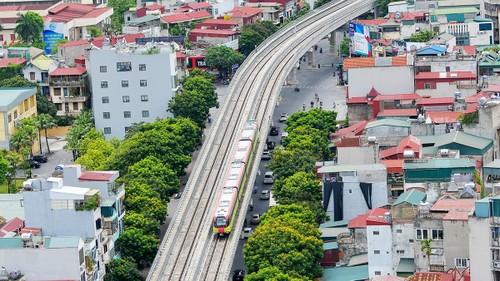 The operation of the Nhon-Hanoi Station urban railway helps ease traffic congestion on major roads in the western part of Hanoi. (Photo: Thuy Nguyen/nhandan.vn) The operation of the Nhon-Hanoi Station urban railway helps ease traffic congestion on major roads in the western part of Hanoi. (Photo: Thuy Nguyen/nhandan.vn) |
Under a new draft roadmap, Hanoi will shorten the timeline to five years and expand coverage. LEZs will take effect within Ring Road 1 starting July 1, 2026, extend to Ring Road 2 by January 1, 2028, and to Ring Road 3 by January 1, 2030. Wards and communes are being encouraged to establish their own low-emission zones.
According to Le Thanh Thuy, Deputy Head of Environmental Management at Hanoi’s Department of Agriculture and Environment, any new policy faces hurdles.
“Building low-emission zones has no precedent in Vietnam, so it’s unclear whether it will be fully enforceable. We still lack emission standards for motorbikes and monitoring infrastructure isn’t fully in place. But I see these challenges as opportunities. If we don’t act now, we may never start,” said Thuy.
Under the plan, heavy diesel trucks and fossil-fuel-powered motorcycles will be banned from LEZs. Cars that fail to meet emission standards may be restricted during specific times or in certain areas. In addition, Hanoi will impose fees on high-emission vehicles. Support policies to help residents and businesses switch to clean, zero-emission alternatives are being studied.
“Vietnam has pledged to reach net zero by 2050, which requires us to minimize emissions. Cutting emissions and improving air quality in urban areas is essential,” said Dr. Chu Manh Hung, former Director of the Department of Environment of the Ministry of Transport (now the Ministry of Construction).
Experts say Hanoi’s measures are timely and aligned with Prime Ministerial Directive 20 on urgent tasks to curb environmental pollution. To ban or restrict high-emission vehicles effectively, Hanoi needs to synchronize the rollout of LEZs with the rapid development of public transportation.