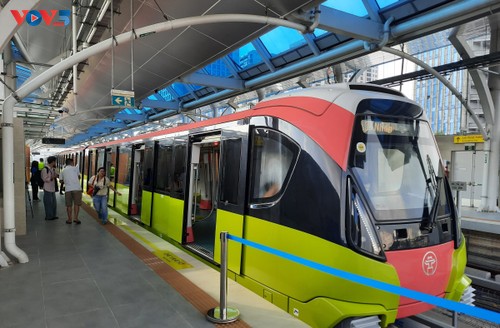
 Hanoi’s metro system will be part of a modern, civilized capital. (Photo: Kim Lieu) Hanoi’s metro system will be part of a modern, civilized capital. (Photo: Kim Lieu) |
TOD calls for extensive connectivity, pedestrian-friendly infrastructure, and integrated urban utilities. Together, these elements will improve accessibility and encourage residents to use public transportation. Each metro station will be a hub of transportation, commerce, tourism, and culture, shaping new urban areas that embody a “Live green – Move fast – Connect daily” lifestyle.
“TOD development means effectively linking the railway system with surrounding urban functions. Each TOD hub serves as a convergence point — connecting various modes of public transport and accommodating dense populations and passenger flows. That’s why we call it a transit-oriented model,” Dr. Le Chinh Truc, Deputy Director of the Hanoi Construction Planning Institute, explained.
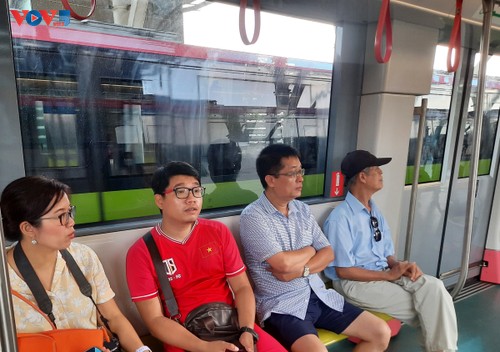 The metro will ease traffic congestion and reduce pollution. (Photo: Kim Lieu) The metro will ease traffic congestion and reduce pollution. (Photo: Kim Lieu) |
Do Viet Hai, Deputy Director of the Hanoi Department of Construction, says the agency is working to finalize the technical framework for implementing TOD across the city.
“We can immediately begin research on TOD models in the Gia Lam and Yen Vien areas. In particular, we are working closely with international partners to consider transforming the 25-hectare Gia Lam train factory into a TOD complex,” said Hai.
To make this model a reality, Duong Duc Tuan, Vice Chairman of the Hanoi People’s Committee, emphasized the need to revise the overall transport master plan to standardize the technical infrastructure of the urban railway network.
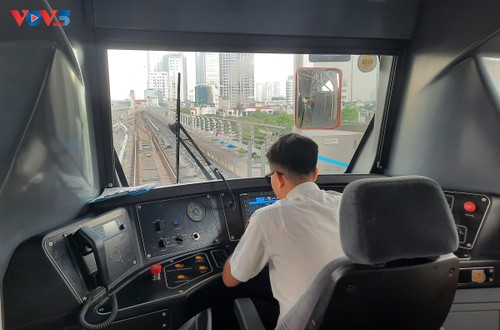 Metro drivers are well trained. (Photo: Kim Lieu) Metro drivers are well trained. (Photo: Kim Lieu) |
He underscored the importance of developing underground spaces, adopting multi-purpose planning, and identifying specific TOD zones to attract investors.
“When defining routes, we must determine where each TOD will be located and which stations will be part of it. A typical metro line is about 20 km long with roughly 20 stations. In urban redevelopment plans, some may integrate TOD elements while others may not,” Tuan noted.
According to the master plan, by 2030 Hanoi aims to complete eight metro lines with a total length of 130 km. Once operational, the network is expected to handle 25–30% of public transportation demand, equivalent to around 3 million passenger trips per day.
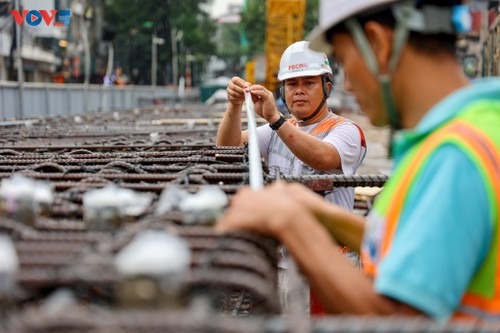 Construction workers on site at Hanoi’s metro projects (Photo: Kim Lieu) Construction workers on site at Hanoi’s metro projects (Photo: Kim Lieu) |
Luu Trung Dung, Deputy Head of the Hanoi Urban Railway Management Board, said that Hanoi envisions a modern urban railway system stretching 400 km to be completed by 2035.
“Achieving this target will transform the city’s transport landscape. It depends on political will, public support, and strong, breakthrough solutions from all stakeholders and, more importantly, drastic breakthrough solutions,” said Dung.
If realized as planned, Hanoi’s metro network will ease congestion, reduce pollution, and establish a smart, green, modern transportation system, that meets the growing mobility needs of its residents.