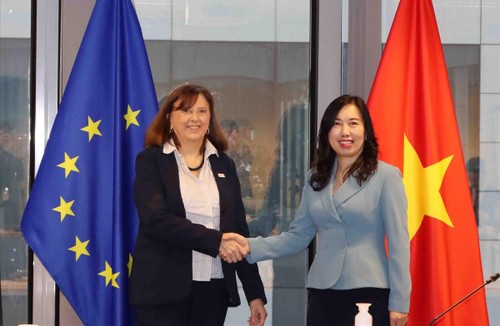
 Vietnamese Deputy Foreign Minister Le Thi Thu Hang (R) and Paola Pampaloni, Acting Director General for Asia and the Pacific at the European External Action Service (EEAS) (Photo: VNA) Vietnamese Deputy Foreign Minister Le Thi Thu Hang (R) and Paola Pampaloni, Acting Director General for Asia and the Pacific at the European External Action Service (EEAS) (Photo: VNA) |
The two sides agreed to step up exchanges of high-level delegations, coordinate to implement the EU–Vietnam Free Trade Agreement (EVFTA), and encourage the remaining 6 EU member states to quickly ratify the EU–Vietnam Investment Protection Agreement (EVIPA). They also reaffirmed plans to expand cooperation in trade and investment, the green economy, digital transformation, the circular economy, sustainable fisheries, clean energy, science and technology, and climate change response. The two sides emphasized that science, technology and innovation are a new pillar of cooperation.
Deputy Minister Hang updated the EU on Vietnam’s efforts to combat illegal, unreported and unregulated (IUU) fishing, and urged the EU to lift its “yellow card” soon. Ms. Pampaloni said she hopes Vietnam will take a more active role in projects under the Indo-Pacific Strategy and Global Gateway Initiative.
Both sides agreed to support multilateralism, the role of the United Nations, the resolving of maritime disputes peacefully and in line with international law, including the 1982 UNCLOS, and ensuring security and freedom of navigation and overflight in the East Sea.
Vietnam and the EU reiterated their commitment to strengthening the ASEAN–EU strategic partnership, boosting trade and investment, tackling global challenges like climate change and natural disasters, and promoting green and sustainable development in the Mekong subregion.