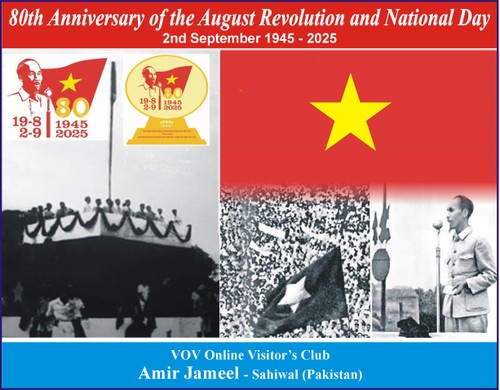
 We thank Amir Jameel for sending us this poster. We thank Amir Jameel for sending us this poster. |
B: Mr. Mahato said Letter Box is his favorite program, as it helps him learn more about other VOV listeners and their thoughts. He did note, however, that the program feels too short and suggested we include more listener messages.
A: We appreciate your suggestion, Mr. Mahato. At the moment, our program runs in a 28-minute time slot, so we’re unable to extend it. We’ll do our best, however, to better balance listener mentions with music.
B: Don’t forget to keep tuning in to VOV on 7220 kHz, beamed to India, for updates on Vietnam and the world.
A: Another Indian listener, Radhakrishna Pillai, told us that he was reassured to learn that his “What do you know about Vietnam?” contest entry had been received safely. Mr. Pillai uses the VOV app to listen to our programs every day at 15:30 local time. He said: “The content and presentation of the programs are consistent and informative. I’d like to extend my congratulations to the VOV team for sharing the unique cultural and historical aspects of Vietnam with such clarity.”
B: After listening to the program on July 27, he expressed his special appreciation for the story about Hang Duong Cemetery in Con Dao island, a final resting place for heroic martyrs. “This site is a powerful symbol of the Vietnamese people's struggle for independence, and the report was deeply moving. In the "Colorful Vietnam" segment, I found the discussion on rituals related to harvesting and weather to be incredibly interesting. This segment sparked my curiosity, and I’d appreciate learning more about the biggest harvest festival in Vietnam. What is the biggest harvest festival in Vietnam?”
A: Thank you so much, Mr. Pillai, for your thoughtful feedback and continued support. We’re glad to hear that the VOV app is working smoothly for you and that you're enjoying the content and presentation of our programs. Your kind words really motivate our team.
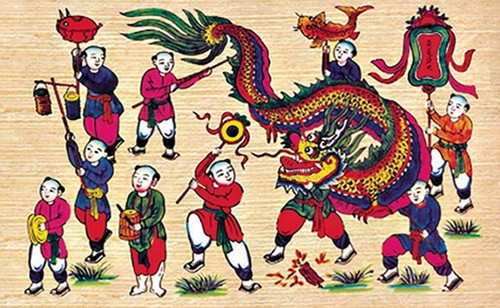 A Dong Ho folk painting depicting children playing with dragon dances and lanterns A Dong Ho folk painting depicting children playing with dragon dances and lanterns |
B: Thank you for your question about harvest festivals. Vietnam has 54 ethnic groups, and most of them depend on farming, especially wet rice cultivation. Each group celebrates the harvest in their own way, on different dates with different rituals.
A: Tet Trung Thu, the Mid-Autumn Festival, is the one most widely observed in Vietnam. It’s celebrated when the weather turns cooler and the main harvest season has ended. At that time farmers are less busy, and there’s plenty of fresh produce, fruits, grains, and all kinds of autumn specialties to enjoy.
B: It’s a time for families to relax, enjoy the results of their hard work, give thanks for the harvest, and pray for good weather and an even better crop in the next season.
A: A common impression is that the Mid-Autumn Festival is for kids, but actually, it has deeper meanings. For one, it’s a time to remember and honor the ancestors. People offer mooncakes, hold worship ceremonies, and release flower lanterns into the sky or water to show their respect for and gratitude to their predecessors. It’s a beautiful expression of the Vietnamese tradition of “drinking water, remembering the source.”
B: Family reunions are one of the most important aspects of the festival. It’s a time for grandparents, parents, and children to come together, enjoy mooncakes, and admire the peaceful moments of the full moon season. After months of hard work, it’s a moment to reconnect and strengthen family bonds.
A: The Full-Moon Festival is a time to show love and care for kids. They receive gifts like lanterns, masks, and toys, and they get to join in fun activities that help them connect with and appreciate their cultural heritage.
B: For farmers, it’s a time to celebrate their production, and pray for good weather and a bountiful harvest. Offerings to the gods are made, such as young sticky rice and seasonal fruits, symbolizing their gratitude to nature and hope for future abundance.
A: The Mid-Autumn Festival carries a lot of meanings, but mainly it’s a joyful pause after months of hard work.
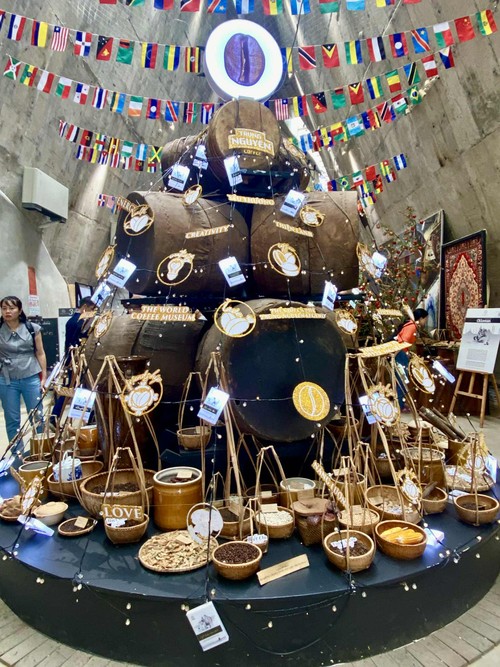 Display of coffee varieties at Trung Nguyen Coffee Museum, Dak Lak province (photo: Cam Thi) Display of coffee varieties at Trung Nguyen Coffee Museum, Dak Lak province (photo: Cam Thi) |
B: We’ve received messages of congratulation from many of our listeners around the world on the 30th anniversary of Vietnam’s official accession to ASEAN.
A: One came from Vicentiu Daniel Gheorghe, Founder and President of the Romanian VOV Club, who wrote: “Over the past three decades, Vietnam has grown into a proactive, responsible, and respected member of ASEAN, contributing significantly to the bloc’s unity, stability, and shared prosperity.”
B: He added: “As the voice of Vietnam to the world, VOV has played an essential role in highlighting these achievements. Through your dedicated programming, multilingual reporting, and cultural outreach, you have helped connect global audiences to Vietnam’s progress and vision within ASEAN. I wish you continued success in your important mission and look forward to seeing VOV5 shine even brighter in the years to come.”
A: Ashik Eqbal Tokon, a longtime listener in Bangladesh, shared his thoughts after tuning in to a special report titled “Vietnam’s Integrity and Development with ASEAN” on our Sunday Show aired on July 27.
B: He commented: “It was a well-crafted program that offered deep insights into Vietnam’s evolving role in ASEAN. I appreciated the inclusion of historical highlights, especially the fact that Vietnam chaired ASEAN in 1998, 2010, and 2020, as correctly mentioned. The interviews, commentary, and tone of the report reflected Vietnam’s ongoing commitment to regional peace, cooperation, and economic growth.”
A: Mr. Tokon praised the way the show blended political analysis with cultural elements. “Programs like this are why I’ve remained a devoted listener of VOV English all these years,” he said.
B: We appreciate your comments and are glad that our programs continue to connect with you. Your feedback is a great encouragement to the VOV team.
A: Listener Lutz Winkler of Schmitten, Germany, asked about Vietnam’s coffee productivity.
B: Vietnam is the world’s second-largest coffee producer, after Brazil. Most of the production comes from the Central Highlands provinces of Dak Lak and Gia Lai, which account for 90% of Vietnam’s coffee output. Vietnam grows mostly Robusta (about 95% of total production) and a relatively small amount of Arabica.
A: According to the Ministry of Agriculture and Environment, Vietnam’s total coffee cultivation area in 2025 is around more than 700,000 hectares, with an estimated output of 1.95 million tons. Since the beginning of the year, 737,000 tons of coffee have already been exported.
A: Trung Nguyen, probably our best-known coffee company, exports coffee to 60 countries. Their G7 instant coffee is especially popular. Then there’s King Coffee, which is available in more than 120 countries. Vinacafé, another long-standing brand, has been around since 1969.
B: Europe is our biggest market, and exports to Japan, Russia, China, Indonesia, and the US are also growing.
A: If any of you have ever tried Vietnamese coffee, we’d love to hear what you have to say about it.
A: We hope someday you’ll come to Vietnam to experience our coffee culture and enjoy our many other specialties.
B: We welcome your feedback at English Service, VOVWORLD, the Voice of Vietnam, 45 Ba Trieu street, Hanoi, Vietnam. You can email us at [englishsection@vov.vn](mailto:englishsection@vov.vn). Once again, thank you all for listening. Goodbye!