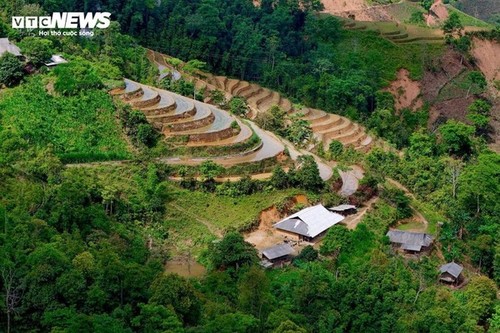
 -The terraced fields in Lao Cai Province are tourist magnets during the pouring-water season. The flooded fields don’t just make for stunning photos but also signals the beginning of a new growing season for highlanders. -The terraced fields in Lao Cai Province are tourist magnets during the pouring-water season. The flooded fields don’t just make for stunning photos but also signals the beginning of a new growing season for highlanders. |
B: Over the past week, VOVWORLD’s received more than 540 emails, letters, and phone calls from listeners across all continents. We truly appreciate your continued support and messages.
A: Bidhan Chandra Sanyal of India sent early greetings on the 80th anniversary of the Voice of Vietnam, on September 7, 2025. "The Voice of Vietnam, one of the world's most popular radio stations, is about to enter its 80th year. I would like to extend my warmest greetings and congratulations to all the journalists at the Voice of Vietnam, a very popular radio station among listeners around the world. The Voice of Vietnam always tries to maintain objectivity in presenting news and has been playing an uncompromising role in presenting the truth and introducing listeners to Vietnam. I believe that the Voice of Vietnam will continue this trend in the future. I wish you all-round success.”
B: Thank you, Mr. Sanyal, for sending us several letters during the week and thanks for the early greetings. At the Voice of Vietnam, we’re busy preparing for this grand anniversary which coincides with Vietnam’s 80th National Day. We will deliver the full coverage of these activities to our listeners around the world, hoping that you will celebrate the anniversary with us.
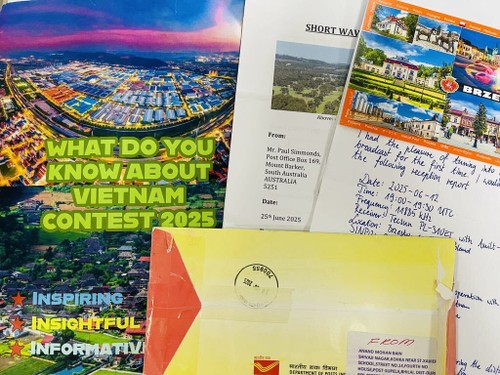
A: Though our “What do you know about Vietnam?” contest closed, we continued to receive entries from our listeners, with those having the postmark by June 30, 2025 to be accepted. Today, we’d like to acknowledge a beautifully illustrated entry from Radharkrishna Pillai of India who has been listening to VOV for more than 10 years. In the introduction of his entry, Pillai wrote: “What do you know about Vietnam contest stands out as a platform that seamlessly blends knowledge and entertainment, facilitating a deeper understanding of Vietnam among listeners like me. With each question, I gain a greater appreciation for the incredible diversity and richness of Vietnam.”
B: Thank you Mr. Pillai for listening to VOVWORLD for such a long time and for participating in our contest. With your carefully prepared entry, we hope you will win a prize trip to Vietnam.
A: About the contest, Juan Diez of Spain, told us: “I’m excited to hear the results and wish all the winners a fantastic journey in Hanoi!”
B: Another dedicated listener, José Ignacio Cos Lezama, wrote: “The 2025 edition of ‘What do you know about Vietnam?’ is a great success. The growing number of participants each year reflects the increasing global interest in Vietnam. Congratulations to the people and government of Vietnam on the 80th anniversary of the Voice of Vietnam and its overseas service.”
A: From Támesis Valley, Colombia, Diego Echeverri wrote: “Thank you for the great opportunity this contest provides. I join with pride, bringing the name of my hometown to the world, hoping to act as a ‘cultural ambassador’ of my beloved land. I dream of one day visiting Vietnam, the country I hold so dear.”
B: Thank you all for joining the contest with excitement. The juries are working on the entries and the results will be announced soon. Wining a trip to Vietnam or not, we hope that the contest gives you a chance to learn more about Vietnam, its land and people and share your insight and love for our country.
 VOVWORLD’s received more than 540 emails, letters, and phone calls from listeners across all continents. VOVWORLD’s received more than 540 emails, letters, and phone calls from listeners across all continents. |
A: This week, Anand Mohan Bain of India sent us a letter with several gift cards and told us about the activities of his Pariwar Bandhu Listeners’ Club, which aim to promote exchanges between Dxers around the world.
B: We’re very impressed with your club, Mr. Bain, and hope that it will contribute to spreading interests in shortwave listening.
A: Next, we’d like to acknowledge a letter from 60-year old Paul Simmonds of Australia, who sent us a reception report on our broadcast, on the frequency 9840 kz with SINPO of all 4s.
B: In his letter, Mr. Simmonds told us about the various wildlife on his property and the surrounding countryside saying “this includes Western Grey kangaroos, koalas, and various birdlife.”
A: Mr. Simmonds, we found your wildlife photography to be very impressive. We hope to have a chance to visit Australia and explore its nature. Anyway, thanks for listening to VOV and sending us feedback.
B: In their correspondence, many listeners share their interests in learning more about Vietnamese architecture. In particular, Subyarno Triyanto of Indonesia asked about Japanese architectural influences in our country.
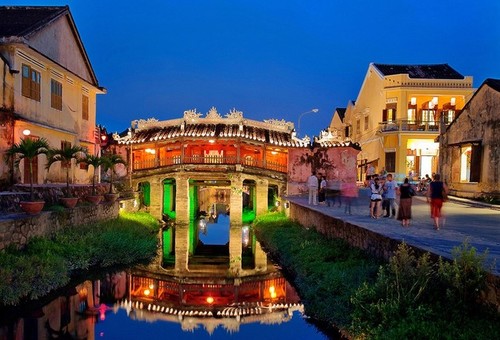 The Bridge pagoda at night The Bridge pagoda at night |
A: Well, an iconic Japanese-styled structure in Vietnam is Chua Cau or Bridge Pagoda, located in the heart of UNESCO-recognized Hoi An ancient town, spanning a small canal flowing into the Hoai River.
B: In the late 16th and early 17th centuries, this area thrived as a bustling international trading port. The bridge marked the boundary between the Chinese and Japanese merchant quarters. To facilitate trade and cultural exchange, Japanese merchants living in Hoi An at the time built the bridge along with a small temple in the middle as a place to pray for peace and prosperity for both residents and traders.
A: In 1719, Lord Nguyen Phuc Chu named the bridge Lai Vien Kieu, meaning “Bridge to Welcome Guests from Afar.” Its architecture is a unique blend of Japanese, Vietnamese, and Chinese influences. The bridge stretches 18 meters long and is made entirely of wood. The roof, featuring yin-yang curved tiles, resembles the shape of a boat’s hull, reflecting traditional aesthetics. The structure is supported by robust wooden pillars and adorned with intricate carvings, combining elegance with durability to withstand the weight of foot traffic and environmental changes over centuries.
B: At the western entrance stand two stone monkey statues, representing the year of the Monkey when construction began, and at the eastern entrance, two dog statues signify its completion in the year of the Dog. In line with Hoi An’s historic charm, the bridge features the prominent colors of red and yellow—red symbolizing luck and prosperity, and yellow representing royalty and nobility.
A: An image of the bridge was chosen to print on the back of Vietnam’s 20,000 VND banknote, ensuring the special meaning of this famous place to Vietnamese people.
B: Unlike other temples, the Bridge Pagoda does not worship Buddha, but venerates the northern deity Tran Vo Bac De, the god of happiness, wealth and health in Hoi An. So it is not only a prominent tourist attraction, but also a religious site for local people to ease their minds and pray for best wishes.
A: Seeing is believing. We hope you can arrange a visit to Vietnam one day and explore its many attractions. That wraps up this week’s Letter Box. Thank you for your warm messages, thoughtful questions, and lasting support. We’ll see you next week. Until then, stay safe and keep tuning into the Voice of Vietnam.