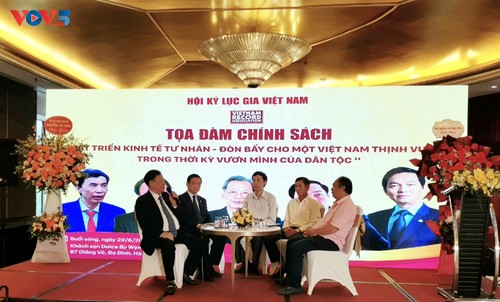
 Speakers at the policy forum (Photo: Ngoc Anh/VOV5) Speakers at the policy forum (Photo: Ngoc Anh/VOV5)
|
With nearly 1 million enterprises and 5 million individual business households, the private sector now accounts for 51% of Vietnam’s GDP, contributes 30% of the state budget, generates 40 million jobs, and employs 82% of the total workforce.
In its strategy, the Vietnamese government has transformed its approach from managing enterprises to serving them. This change is embodied in the Politburo’s Resolution 68, issued on May 4, which aims to unlock the full potential of the private sector as a critical national resource.
Dr. Vo Tri Thanh, former Deputy Director of the Central Institute for Economic Management, said, “Resolution 68 recognizes private businesses as the most important growth driver. In a market economy, the private sector is the heart. Growth must be sustainable and inclusive. Green economy and digital transformation are essential.”
Le Viet Hai, Chairman of Hòa Bình Construction Group, praised Resolution 68 on private economic development as the right policy that needs to be implemented resolutely. “South Korea’s experience is particularly instructive for Vietnam to learn how the Korean government supported Hyundai during its crisis, for example. The government should adopt support policies for leading enterprises,” said Hai
Trinh Ba Dung, CEO of Sao Da Lat Company, highlighted the readiness of Vietnamese private enterprises to compete on the global stage once they are given a favorable environment. According to Dung,“Enterprises don’t need direct financial aid but require government’s support with favorable conditions and mechanisms. Small and medium-sized enterprises have tremendous potential. In fact, many successful global corporations started small.”
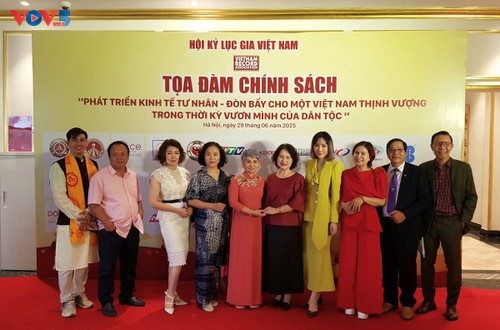 Delegates pose for a group photo at the forum. (Photo: Ngoc Anh/VOV5) Delegates pose for a group photo at the forum. (Photo: Ngoc Anh/VOV5) |
Several Vietnamese private companies, including Vingroup, VinFast, Sungroup, Thaco, and Vinamilk, have already built strong regional and global brands. Together with the state and collective sectors, they form the backbone of an independent and self-reliant economy.
Professor Dr. Nguyen Mai, Chairman of the Foreign Investment Cooperation Association, said that tTo build an independent economy, it’s essential to boost both state-owned and domestic private economic sectors, aiming for them to contribute up to 55% of GDP. “Today’s Vietnamese private enterprises are capable of carrying out major infrastructure, technology, and service projects, a task that, 15 years ago, were mostly handled by foreign-invested companies,” said Mai.
In the context of the Fourth Industrial Revolution and the growing influence of artificial intelligence (AI), digital transformation has become critical. Professor Nguyen Dinh Thang, Deputy President of the Vietnam Digital Communication Association, said, “Digital transformation is the key to improving business competitiveness, especially for the private sector. Private companies are developing comprehensive strategies with clear goals, gradually changing their operational models, investing in appropriate technologies, and building their own digital infrastructure.”
Vietnam aims to have 2 million active enterprises with at least 20 large companies integrated into global value chains, contributing 55% to 58% of GDP by 2030. By 2045, the vision is to develop a rapidly growing, strong, and sustainable private sector that leads integration into global production and supply chains, achieving high competitiveness in regional and global markets. Vietnam aspires to have at least 3 million enterprises contributing 60% of GDP by then.