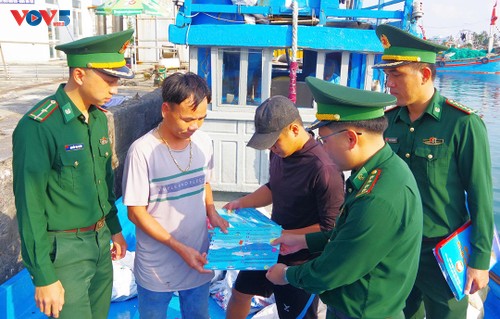
 Officers from Ly Son Border Guard Station inform fishing boat owners about vessel registration, inspection, and compliance with regulations on combating IUU fishing. (Photo: Thanh Long) Officers from Ly Son Border Guard Station inform fishing boat owners about vessel registration, inspection, and compliance with regulations on combating IUU fishing. (Photo: Thanh Long) |
Vietnam is taking aggressive, coordinated measures to combat IUU fishing and develop a sustainable fisheries industry. These include vessel registration and licensing management through the national VNFishbase database, voyage monitoring, electronic traceability, and transparent origin tracking—fully compatible with international traceability systems.
In addition, the database for controlling imported seafood from foreign catches is now connected to the National Single Window, ensuring strict monitoring and preventing IUU-related products from entering Vietnam, in line with the Agreement on Port State Measures (PSMA), the first binding international agreement to specifically target IUU fishing.
Ngo Van Vuong, a fisherman from Quảng Ngãi province, said, “Fishing boats must keep their monitoring devices running 24/7 and notify the port an hour before arrival for unloading. Logbooks must be fully completed — without them, we’re not allowed to fish. Fishermen are committed to saying no to violations in foreign waters.”
The rollout of the electronic catch documentation and traceability system (eCDT) ensures transparency, prevents fraud, and aligns with global electronic traceability systems. Vu Duyen Hai, Deputy Director of the Directorate of Fisheries and Fisheries Surveillance at the Ministry of Agriculture and Environment, said that to date, international organizations and fisheries dialogue partners have recognized that Vietnam’s legal framework effectively and sustainably addresses IUU fishing.
“Our regulations are harmonized with international standards as well as with those of our major trade partners. Anti-IUU measures are implemented comprehensively from the central to local level, with the IUU Steering Committee meeting weekly on Tuesdays,” said Hai.
“We’ve built a connected database ensuring transparent traceability, ready for global integration. Every fish or seafood product caught in Vietnamese waters can be traced—from the fisherman’s catch to consumers around the world—by origin, time, and location. Vietnam is digitalizing its entire fisheries sector.”
The Viettel Group and the Vietnam Posts and Telecommunications Group (VNPT) have jointly finalized the integration of the national vessel monitoring system, including a VMS connection loss alert platform that manages, monitors, and stores video data from onboard cameras. The system was completed by the end of last month.
 Da Nang has 4,100 fishing boats, 1,200 of which are high-capacity vessels. (Photo: Vinh Thong) Da Nang has 4,100 fishing boats, 1,200 of which are high-capacity vessels. (Photo: Vinh Thong) |
To modernize, legalize, and make fisheries more responsible, Vietnam is focusing on three key strategies: reducing exploitation, expanding aquaculture, and strengthening marine conservation. These measures aim to protect natural resources, improve people’s livelihoods, safeguard biodiversity, and adapt to climate change. Vietnam has already established 16 national marine protected areas.
According to Associate Professor Dr. Nguyen Chu Hoi, Deputy Chairman of the Vietnam Fisheries Society, to elevate the fisheries globally, Vietnam must pursue sustainability and responsibility. “The key lies in restoring and protecting marine resources. Marine protected areas are vital reserves for fish stocks and breeding grounds—they must be maintained and expanded. Selective fishing, seasonal closures, and rotational harvesting are essential for long-term ecological balance,” Hoi noted.
Pham Van My, Deputy Director of the Department of Agriculture and Environment of Da Nang city, said, “We will conduct new surveys to establish marine protected zones and resource regeneration areas. That way Da Nang can ensure that today’s exploitation does not compromise future generations. Only then can fisheries be truly sustainable.”
Vietnam continues to take decisive action against IUU fishing, reaffirming its determination to get the IUU “yellow card” lifted and build a modern, sustainable, and responsible fisheries sector that contributes to marine economic growth and global integration.