 The construction site of Long Thanh Airport (Photo: Duy Phuong/VOV–HCMC) The construction site of Long Thanh Airport (Photo: Duy Phuong/VOV–HCMC) |
Covering approximately 8,200 hectares, the Dong Nai FTZ will be strategically linked to Long Thanh Airport and Phuoc An Port. The 16 billion USD funding comprises 5% public investment, 40% domestic private capital, and 55% foreign direct investment. Once operational, the zone is expected to form a multimodal logistics network that optimizes costs, increases competitiveness, and stimulates provincial GRDP growth—attracting international investors and creating high-income jobs.
Dong Nai aims to develop the FTZ into a sustainable, future-oriented economic ecosystem with a 50-year vision, fostering open, dynamic, and inclusive growth. The development of urban areas connected to the FTZ and synchronized infrastructure projects is expected to further strengthen the province’s investment appeal.
Architect Ngo Viet Nam Son said Long Thanh Airport will emerge as one of Southeast Asia’s major aviation hubs, and the Dong Nai FTZ will maintain a close, strategic linkage with it. He said the expanding infrastructure networks in Dong Nai and Ho Chi Minh City are creating synergistic momentum for the FTZ to reach its full potential. “In order to develop the FTZ, it needs to be connected with major infrastructure. I believe the FTZ proposal should emphasize integration with surrounding urban areas and key infrastructure networks,” said Son.
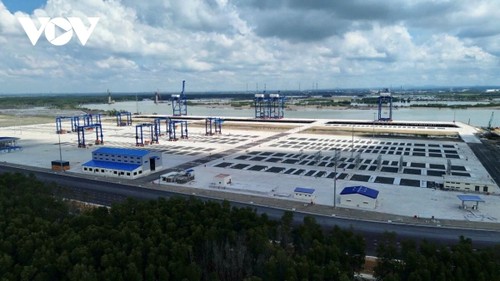 Phuoc An Port is located in the development corridor of the Dong Nai Free Trade Zone. (Photo: Duy Phuong/VOV–HCMC) Phuoc An Port is located in the development corridor of the Dong Nai Free Trade Zone. (Photo: Duy Phuong/VOV–HCMC) |
Within the 5,000-hectare Long Thanh Airport master plan, the Airports Corporation of Vietnam (ACV)—the investor in the passenger terminal—envisions Long Thanh as an international air logistics hub connecting Vietnam to global supply chains. To that end, the Dong Nai FTZ will require appropriate incentives and policies to form a duty-free logistics and manufacturing zone, where goods can be imported, processed, stored, and re-exported without taxation—unless moved into the domestic market.
This could position Dong Nai as a pioneering “logistics special zone,” creating policy-driven spillover effects across the region. The FTZ would include transshipment, distribution, processing, re-export, and air logistics services, supported by favorable tax, customs, investment, and financial frameworks—competitive or even superior to regional standards.
Dr. Tran Du Lich, a member of Dong Nai’s Socio-Economic Advisory Group, said the locality has strong advantages to establish an FTZ and now is the right time to develop it to participate in global supply chains and maximize the potential of Long Thanh Airport and Phuoc An Port.
But he underlined the need to revise the overall planning framework to fit new conditions and to prioritize breakthrough projects and regional connectivity infrastructure. “With the FTZ’s institutional advantages, we expect to attract significant investment flows, especially as Vietnam gradually becomes a key link in global supply networks for goods and services,” according to Lich.
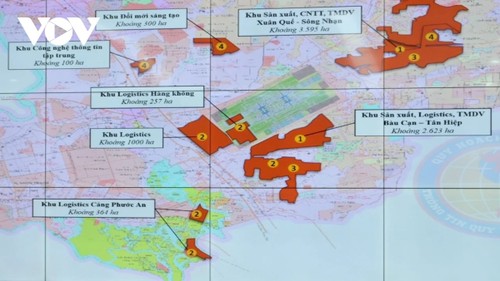 Proposed zoning plan for the functional areas of the Dong Nai Free Trade Zone (Photo: Duy Phuong/VOV–HCMC) Proposed zoning plan for the functional areas of the Dong Nai Free Trade Zone (Photo: Duy Phuong/VOV–HCMC) |
Dr. Truong Minh Huy Vu, head of Dong Nai’s Socio-Economic Advisory Group, said the FTZ model should follow a “green, digital, and smart” orientation, aligned with institutional reform and regional coordination.
Given its strategic position, Dong Nai could become the core of the proposed Southeast Free Trade Zone (SEFZ)—an integrated economic model linking the Long Thanh Airport-Industrial-Logistics Hub, the Cai Mep–Thi Vai Port, and the Can Gio International Financial and Commercial Zone in Ho Chi Minh City. Vu said, “Long Thanh Airport may be located in Dong Nai, but it’s not just Dong Nai’s airport. The region’s key development axis is the Long Thanh–Tan Son Nhat–Lower Cai Mep–Can Gio corridor.”
For Dong Nai, the FTZ promises major economic benefits—driving local development, attracting investment, and boosting trade activities. With effective implementation, Dong Nai is poised to become a leading international logistics and aviation hub, advancing Vietnam’s deeper integration into global value chains.
Dong Nai FTZ is designed to comprise four main functional areas: a manufacturing zone on 3,095 hectares; a logistics zone on 2,244 hectares; a financial–commercial–service zone on 1,500 hectares; and an innovation, IT, and digital economy zone on 1,419 hectares.
The project’s first phase, spanning 3,700 hectares and requiring 9.2 billion USD, will be implemented over five years.
Dong Nai FTZ will prioritize 18 key sectors, including digital logistics, electronics, precision engineering, IT, pharmaceuticals, food processing, and workforce training.