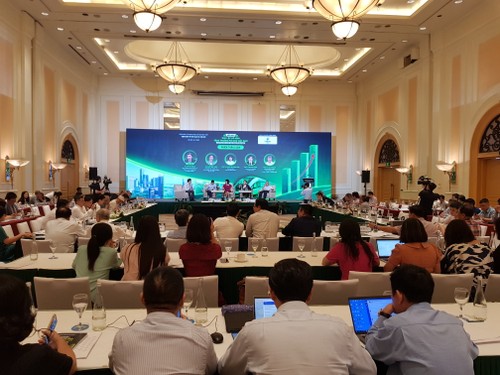
 Experts discuss a new growth model for Vietnam in the 2026-2030 period, with a vision to 2045. (Photo: Ngoc Anh) Experts discuss a new growth model for Vietnam in the 2026-2030 period, with a vision to 2045. (Photo: Ngoc Anh) |
Over the next five years, Vietnam must effectively shift investment from quantity to quality, improve development, and focus more on science and technology.
Urgency to change the growth model
Forum participants said the old growth model, which is based on input factors like capital, labor, and natural resources, has contributed significantly to Vietnam's remarkable achievements over the past three decades, lifting the country out of poverty, maintaining stable economic growth, and improving people’s living standard. But growth drivers like cheap labor, large-scale investment, and deep integration are weakening.
Vietnamese enterprises are finding it difficult to participate in global value chains, said Dr. Dang Xuan Thanh, Vice President of the Vietnam Academy of Social Sciences.
“The three growth drivers of the past 3 decades, cheap labor, high investment capital, and global market integration, are gradually losing their effectiveness. While growth still relies heavily on investment, capital use efficiency is slowing. Vietnam’s labor productivity is low compared to that of countries like Singapore, Malaysia, and Thailand. We participate mainly in the low-value segment of global value chains. As a result, the economy has yet to make a breakthrough,” said Thanh.
Vietnam needs a new model to break out of these limitations and achieve a breakthrough in the coming period. The new model must be a long-term direction realized by feasible policies and clear action programs.
Science, technology, innovation, and digital transformation are the pillars
The new growth model should be a complex, multi-dimensional structure, encompassing economic, technological, environmental, and social factors. The core of the new growth model will be productivity, science, technology, innovation, digital transformation. Three key sectors expected to drive growth are digital technology and artificial intelligence (AI), green energy and green transformation, and advanced manufacturing and processing industries.
“Green growth and a green economywill be new drivers for the growth model. A green economy is one of the pillars of sustainable development, integrating social, environmental, and institutional factors. Green growth and the green economy imply digital transformation, scientific and technological advancement, and innovation,” Associate Professor Dr. Bui Quang Tuan, Vice President of the Vietnam Economic Science Association, said.
Vietnam also needs to focus investment in digital transformation and the data economy, and restructure supply chains to capitalize on shifting global trends.
“Vietnam’s growth approach must be based on digital growth and science and technology. It’s essential to develop a modern, synchronized, and secure digital infrastructure and narrow the digital gap between regions, enabling inclusive and comprehensive development of the digital economy. The most important indicator of digital growth is the digital economy’s share of GDP, which was 13.7% last year. It must reach 20% this year and 30% by 2030,” Professor Dr. Tran Tho Dat, Chairman of the Science and Training Council of the National Economics University, said.
In the new growth model, the State plays a guiding role through national-level science and technology programs.
“Vietnam has identified science and technology as the primary driving force for growth model transformation. In some fields, we can leapfrog by investing strategically to catch up, move alongside, or surpass others. It’s necessary to identify the key sectors in economic restructuring and growth model shifting, and build a solid foundation for the new growth model,” Associate Professor Dr. Nguyen Hong Son, Deputy Head of the Party Central Committee’s Policy and Strategy Commission, said.
Vietnam is expecting a new growth model integrating economic, technological, environmental, and social elements to help it achieve its goal of rapid, sustainable development by 2045.