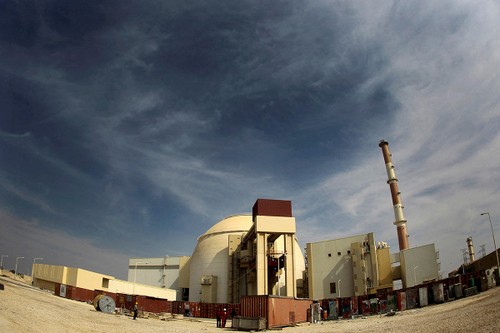
 Iran's Bushehr nuclear plant (File photo: REUTERS/IRNA/Mohammad Babaie) Iran's Bushehr nuclear plant (File photo: REUTERS/IRNA/Mohammad Babaie) |
Oman’s Foreign Minister Sayyid Badr Albusaidi conveyed the US proposal to Iran on May 31. On June 1, US media reported that the White House had instructed US agencies to pause all new sanctions against Iran.
A new approach
The proposal is to accept uranium enrichment at surface-level facilities for purposes of civil nuclear energy production, with enrichment concentration capped at 3% in accordance with guidelines from the International Atomic Energy Agency (IAEA). The US wants Iran to close underground enrichment sites during the negotiation period, halt research and development of new centrifuge technologies, and transfer all enriched uranium abroad. The US is also proposing a strict monitoring and verification mechanism, including automatic implementation of the IAEA's Additional Protocol. The easing of sanctions on Iran would occur after Tehran proves its compliance to the US and the IAEA.
The proposal came immediately after the fifth round of indirect negotiations between the US and Iran, mediated by Oman in Rome, Italy. Observers say that accepting Iran’s uranium enrichment at a low level is a significant change from the previous “maximum pressure” policy and public statements of many senior US officials, including Secretary of State Marco Rubio, that Washington would not accept any uranium enrichment activities by Iran.
The new proposal is the first official move by the Trump administration toward direct negotiations with Iran.
Iranian Foreign Ministry spokesperson Esmaeil Baghaei said Monday that Tehran has not agreed to the US proposal due to the lack of clear guarantees for sanctions relief. However, observers say the US’s acceptance of Iran’s low-level uranium enrichment may satisfy a “red line” set by the Chairman of the Atomic Energy Organization of Iran (AEOI), Mohammad Eslami, that uranium enrichment is the foundation of Iran’s nuclear industry and that Iran has the right to develop civil nuclear energy.
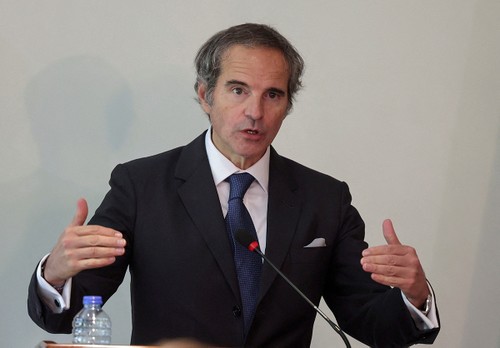 IAEA General Director Rafael Grossi speaks at the press conference in Cairo, Egypt on June 2, 2025. (Photo: REUTERS) IAEA General Director Rafael Grossi speaks at the press conference in Cairo, Egypt on June 2, 2025. (Photo: REUTERS) |
Risks remain high
The US’s change in approach has raised hopes for a breakthrough in negotiations between Iran and the US in the coming days. Observers say both the US and Iran are eager to reach a new agreement to replace the 2015 Iran Nuclear Deal, known as the P5+1 Agreement, which was terminated in Trump’s first term.
A new agreement could help Iran reduce economic damage, while resolving one of President Trump’s stated foreign policy priorities.
Sanam Vakil, Director of the Middle East and North Africa Program at Chatham House (UK), said: “For Iran it's important to delay the use of snap-back sanctions which European countries have made clear that they intend to use against Iran should the talks not advance. And of course president Trump is looking to obtain some sorts of positive arrangement sooner than later to demonstrate that he is in fact a deal maker and a leader that can bring peace to the Middle East. There are some interests and in a fast timeline but of course obstacles in arriving at a quick deal.”
Some experts believe that, although both sides are eager to reach a deal soon, time is running out. Trump has repeatedly said he does not want to resort to scenarios proposed by Israel and some hardliners in his administration of launching preemptive strikes to destroy Iran’s nuclear program, but warned that the US will not hesitate to do so if negotiations fail.
Yassamine Mather, a Middle East researcher at the University of Oxford (UK), said this warning should not be taken lightly, especially after the IAEA reported last weekend that Iran continues to enrich uranium at weapons-grade levels in growing quantities. Iran has denied that report.
The IAEA, Iran, and Egypt held a trilateral meeting in Cairo on Monday to discuss ways to ease tensions and promote negotiations.
IAEA Director General Rafael Grossi proposed giving the agency a greater role in the talks. “When there is any negotiation, when there are proposals on the table that can embody a way forward which avoids conflict in a region that has suffered too much already, the IAEA has a role to play not as a negotiator but as a facilitator, an enabler, and a guarantor of any agreement.”
It is expected that, once Iran officially responds to the new US proposal, the two sides could hold the next round of negotiations as early as the end of this week.