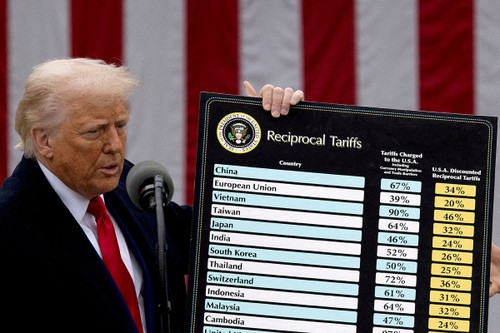
 US President Donald Trump announces reciprocal tariffs at the White House in Washington, D.C., on April 2, 2025. (File photo: REUTERS/Carlos Barria) US President Donald Trump announces reciprocal tariffs at the White House in Washington, D.C., on April 2, 2025. (File photo: REUTERS/Carlos Barria) |
From July 12-17, President Trump sent letters informing more than 30 major trade partners of new tariffs, including the European Union, Japan, South Korea, Mexico, and Canada. He said he plans to send letters to over 150 other countries soon.
What will the EU do?
According to the letters, the US will impose a 30% tariff on the EU and Mexico and 35% on Canada starting August 1 if no new trade agreement is reached before that date. A tariff of 25% will be imposed on South Korea and Japan, two major trade partners and key political allies of the US in Asia. To more than 150 other countries, mostly small nations in Africa and the Caribbean who do little trade with the US, Trump will send letters detailing new tariffs rather than engaging in any negotiations.
The US announced a new tariff of 30% for the EU, 10% higher than the tariff of 20% announced in April. EU Trade Commissioner Maros Sefcovic said this tariff will “prohibit” trade between the two economies.
For now, the EU will continue to push negotiations, delaying retaliatory tariffs on US steel and aluminum, which were originally scheduled to take effect on July 14, until after August 1. The big question for the EU right is whether to adopt a hard or a soft approach in the final stages of negotiations with the US.
Jacob Funk Kirkegaard, an expert at the Bruegel Institute in Brussels, said the EU must take a stronger stance. Cyrus de la Rubia is Chief Economist at Hamburg Commercial Bank in Germany.
“If you look at the trade issue in an isolated way, I would very much recommend to take a hard stance because in my view, and this is also confirmed by economic models, the United States might even suffer more than the European Union from those tariffs which are implemented by or planned to be implemented by the European Union,” said Rubia.
Some economists say President Trump's repeated delays in imposing new tariffs indicate that he still seeks an agreement with the EU. Carsten Brzeski, Chief Economist at ING Bank, the Netherlands, suggests that the EU might offer to purchase additional US goods, such as soybeans, liquefied natural gas, and weapons, given that the EU is increasing defense spending.
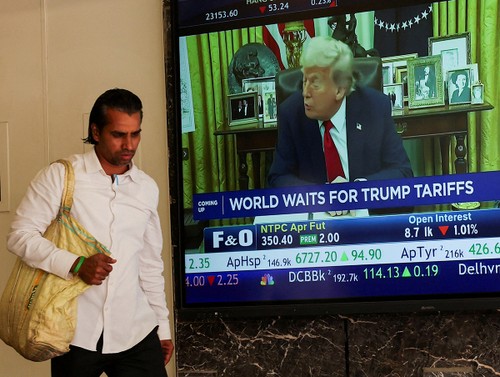 A TV screen displays news about US President Donald Trump's tariffs at the Bombay Stock Exchange (BSE) in Mumbai, India, on April 2, 2025. (File photo: REUTERS/Francis Mascarenhas.) A TV screen displays news about US President Donald Trump's tariffs at the Bombay Stock Exchange (BSE) in Mumbai, India, on April 2, 2025. (File photo: REUTERS/Francis Mascarenhas.) |
Impact of geopolitical tensions
President Trump said Thursday that the US could soon reach agreements with many major economic partners, including India, the world’s fourth-largest economy and most populous country. But geopolitical tensions are challenging tariff negotiations.
Earlier this week, Trump threatened heavy sanctions on Russia and its economic partners if Russia fails to agree to a deal to end the Ukraine conflict within 50 days.
Observers say deals with India and China could be undermined if the US carries out its threat to impose a 100% tariff on them to put indirect economic pressure on Russia, a key economic partner of both. Trump’s threat to impose a 50% tariff on Brazil is seen as primarily driven by non-economic factors.
"There is still too much uncertainty, and it’s the biggest bottleneck. I think people can accept high tariffs, though they won’t be happy about it, but the important thing is to have some sort of safety planning, which we currently don’t have. Everything is constantly changing. Certainty and the lowest possible tariffs all depend on the coming negotiations," Jochen Stanzl, Head of Market Analysis at CMC Markets in the UK, said.
Professor Alan Sykes of the US’s Stanford Law School said resolving all global trade conflicts before the August 1 deadline is highly unlikely.