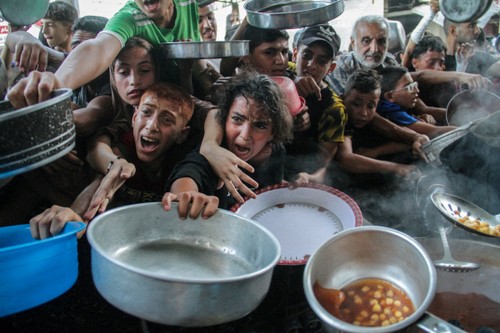
 Palestinians gather to receive food cooked by a charity kitchen, amid the Israel-Hamas conflict, in the northern Gaza Strip, September 11, 2024. (Photo: REUTERS/Mahmoud Issa) Palestinians gather to receive food cooked by a charity kitchen, amid the Israel-Hamas conflict, in the northern Gaza Strip, September 11, 2024. (Photo: REUTERS/Mahmoud Issa) |
On October 7, 2023, Israel’s military launched an offensive into the Gaza Strip, which was under Hamas’s control, in retaliation for Hamas’s deadly attacks against several Israeli villages and abduction of Israeli soldiers and civilians.
A catastrophic reality
Two years later, Gaza is experiencing one of the most severe humanitarian crises in decades. Data from the Gaza Health Authority show that as of October 6, more than 67,000 Palestinians had been killed and nearly 170,000 injured in the Gaza conflict, about 80% of them civilians, and a majority of them women and children.
Israel has also reported several thousand casualties. During the Hamas attacks on October 7, 2023, approximately 1,200 people were killed and hundreds were taken hostage, many of whom later died in captivity. Besides the human toll, Gaza’s infrastructure, including electricity, water, and schools, has been almost completely destroyed.
The World Health Organization has reported that only 14 of Gaza’s 36 hospitals remain, partially operational and facing severe shortages of medical supplies. On September 22, the UN declared a famine in Gaza, the first such crisis in the Middle East, with half a million people suffering “catastrophic hunger.” By the end of September, the number had risen to nearly 650,000, about one-third of the territory’s population.
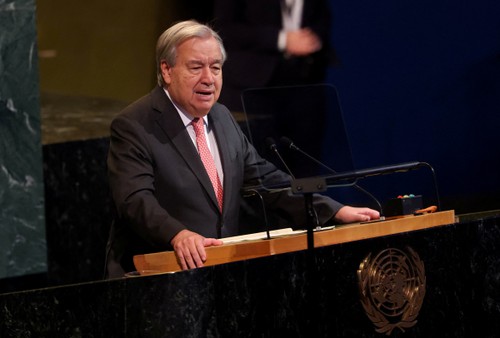 United Nations Secretary-General Antonio Guterres. (Photo: REUTERS/Mike Segar) United Nations Secretary-General Antonio Guterres. (Photo: REUTERS/Mike Segar) |
UN Secretary-General António Guterres said: “What happens in Gaza today is horrendous. We are seeing massive destruction of the neighborhoods, now the systematic destruction of Gaza City. We are seeing massive killing of civilians in a way that I do not remember in any conflict since I am Secretary General. This is something morally, politically, and legally intolerable.”
The Gaza conflict has also deeply undermined regional security and transformed international relations. The violence in Gaza has sparked other serious clashes in the Middle East, most notably between Israel and Hezbollah in Lebanon, and the 12-day confrontation (June 13–25) between Israel and Iran, which drew US military involvement.
Growing outrage over Israel’s hardline policies and the humanitarian disaster in Gaza has prompted several Western allies to recognize the State of Palestine, leaving Israel increasingly isolated. Sanam Vakil, Director of the Middle East and North Africa Program at the UK’s Chatham House, said: “A consequence of its militaristic approach, that appears to have no end in sight and is very unyielding, is the blowback Israel has experienced internationally and regionally, where Israel is more isolated today than it has been a decade.”
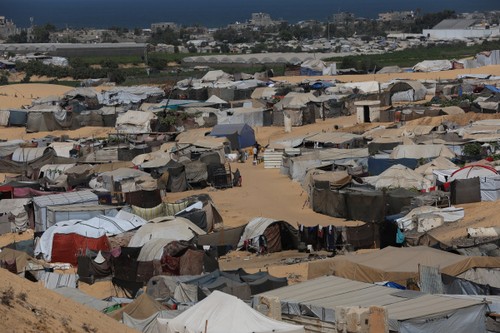 Displaced Palestinians shelter in a tent camp in Mawasi area in Khan Younis in the southern Gaza Strip, October 4, 2025. (Photo: REUTERS/Ramadan Abed) Displaced Palestinians shelter in a tent camp in Mawasi area in Khan Younis in the southern Gaza Strip, October 4, 2025. (Photo: REUTERS/Ramadan Abed) |
Light at the end of the tunnel
As the Gaza conflict enters its third year, pressure to end it immediately is mounting on all sides. The US and many European countries allied with Israel are seeing growing public outrage over Gaza’s humanitarian catastrophe, threatening domestic instability and forcing governments to take stronger action.
In Israel, large-scale protests have demanded that the government reach a hostage-release deal with Hamas and end the conflict immediately. Many Israeli politicians and scholars have voiced their concerns about what is happening in Gaza, saying that Israel has crossed multiple “red lines” morally and legally.
On September 29, US President Donald Trump announced a 20-point Peace Plan for Gaza, proposing Israel’s military withdrawal from Gaza, Hamas’s disarmament, and the temporary transfer of Gaza’s administration to an International Peace Committee. President Trump said that if all parties agreed, a ceasefire would take effect immediately and comprehensive reconstruction of Gaza could begin.
Observers say President Trump’s Gaza Plan is the best opportunity so far to end the conflict. However, Amjad Iraqi, a senior analyst on Israel and Palestine at the International Crisis Group (ICG) in Brussels, said that, for the plan to be sustainable, all parties must clarify the role of the Palestinian Authority in Gaza’s political future. He said Arab countries must persuade the US to take a more balanced approach instead of aligning with Israel’s position of excluding the Palestinian Authority unequivocally from Gaza’s future.
While cautious, the initial responses from Israel and Hamas have sparked hopes that might be a “light at the end of the tunnel.” Israel has agreed to an initial withdrawal boundary in Gaza, and Hamas has accepted several key points, including a hostage exchange. Representatives of Israel and Hamas held indirect talks on the 20-point Peace Plan in Cairo, Egypt, on Monday, feeding hopes that there will be further progress in the coming days.