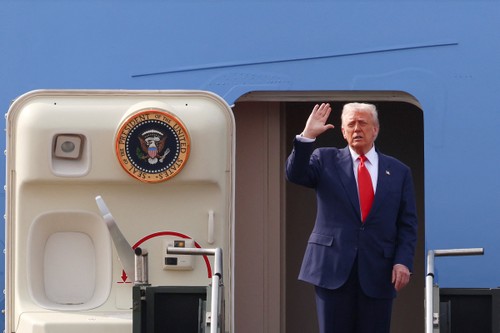
 US President Donald Trump embarks on an Asian tour from October 26-30, 2025. (REUTERS/Evelyn Hockstein) US President Donald Trump embarks on an Asian tour from October 26-30, 2025. (REUTERS/Evelyn Hockstein) |
President Trump’s Asia tour began with a series of activities in Malaysia on the occasion of the 47th ASEAN Summit and concluded with a meeting with Chinese President Xi Jinping in the Republic of Korea on Thursday.
A new direction for US-China relations
Trump and Xi reached remarkable agreements during their meeting in Busan, which is seen as one of the most important global events of the year. After nearly two hours of direct talks, they reached consensus on the framework agreement achieved a few days earlier in Kuala Lumpur.
Accordingly, the US will cut fentanyl-related tariffs on China from 20% to 10% and suspend the reciprocal 24% tariff on Chinese goods for another year. China will make corresponding adjustments to its countermeasures.
Both leaders also agreed to extend certain tariff exemptions. The US will suspend for one year the 50% export quota regulation announced on September 29, while China will pause its export controls on rare earths announced on October 9 for one year and will continue to refine related plans.
They reached consensus on cooperation in fentanyl control, agricultural trade expansion, and the settlement of specific business-related cases. China also agreed to work with the US to properly address issues concerning TikTok. Trump said that on the scale from zero to 10, with 10 being the best, he’d say the meeting was a 12.
“We have not too many major stumbling blocks. We have a deal. Now every year we'll renegotiate the deal. I think the deal will go on for a long time, long beyond the year. We'll negotiate at the end of the year. But all of the rare earth has been settled. And that's for the world, I mean, worldwide. I guess you could really say this was a worldwide situation, not just a US situation,” said Trump.
He also said that the US and China agreed to cooperate in the Ukraine conflict, their first coordinated diplomatic move on this issue. Observers say that although it’s not a comprehensive deal, the US-China summit sent positive signals, reflecting their desire for stability rather than confrontation.
“I wouldn't say it's a technical pause. As you rightly point out, US-PRC relations, since the mid 2010s has been, going up. It has its ups and downs. Right now, things seem to be on a somewhat positive track. Whether that will change in the near future, that's anybody's guess. But this is the pattern that we've seen in US-China relations,” said Professor Chong Ja Ian from the National University of Singapore.
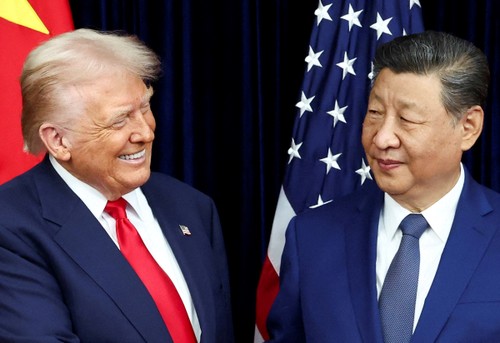 US President Donald Trump and Chinese President Xi Jinping hold a bilateral meeting at Gimhae International Airport, on the sidelines of the APEC Economic Leaders’ meeting, in Busan, the Republic of Korea, October 30, 2025. (Photo: REUTERS/Evelyn Hockstein) US President Donald Trump and Chinese President Xi Jinping hold a bilateral meeting at Gimhae International Airport, on the sidelines of the APEC Economic Leaders’ meeting, in Busan, the Republic of Korea, October 30, 2025. (Photo: REUTERS/Evelyn Hockstein) |
Strengthening security alliances
Alongside trade agreements with China, President Trump’s Asia tour also gained important achievements in diplomacy and security.
In Malaysia, Trump and Malaysian Prime Minister Anwar Ibrahim co-chaired the signing ceremony of a peace deal between Thailand and Cambodia, a formal step toward restoring peace along the border between the two neighbors after this summer’s armed clashes. This event has reinforced Trump’s image as an effective mediator in international conflicts, following his role in brokering the Gaza ceasefire earlier this month.
During his visit to Japan, discussions with the new Prime Minister Sanae Takaichi on Tuesday have further strengthened US leadership in the US-Japan alliance. Both sides announced the start of a “golden era” in bilateral relations, pledging enhanced defense and economic cooperation.
The two leaders signed an agreement on securing and supplying essential minerals, including rare earths, to ensure supply chain stability. Japan’s new government committed to increasing defense spending to 2% of GDP by March 2026 as requested by the US, two years earlier than the original target of fiscal year 2027. Japan pledged to invest about 550 billion USD in key US industries such as semiconductors, essential minerals, and shipbuilding, and increase imports of American goods and farm produce.
Professor of Politics and International Studies at the International Christian University, Stephen Nagy, said these agreements hold great significance for the Trump administration amid ongoing uncertainties in US-China relations.
“They're aligned in terms of economic security. That means supply chain diversification, dealing with alternative semiconductor supply chains, working on food security, and generally deleveraging from the liabilities that are associated with being part of the Chinese production,” he said.
With another key East Asian ally, the Republic of Korea, President Trump and President Lee Jae Myung finalized an agreement to maintain reciprocal tariffs on Korean exports at 15% and reduce tariffs on automobiles and auto parts from 25% to 15%.
The RoK pledged to invest 350 billion USD in the US, including 200 billion USD in cash installments and 150 billion USD earmarked for shipbuilding cooperation. This is considered a major “win” for the US administration, as Korea had previously expressed concerns over the heavy burden of such a large-scale direct investment.