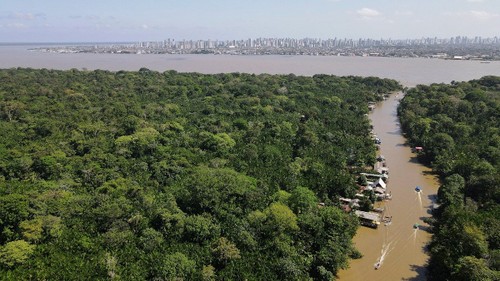
 The Amazon rainforest and the city of Belem in the back ahead of COP 30, at Ilha do Combu, in Belem, Para state, Brazil August 10, 2025. (Photo: REUTERS/Anderson Coelho) The Amazon rainforest and the city of Belem in the back ahead of COP 30, at Ilha do Combu, in Belem, Para state, Brazil August 10, 2025. (Photo: REUTERS/Anderson Coelho) |
A Climate Summit to be held on Thursday and Friday in Belém, gathering representatives from 143 countries, including 57 presidents and prime ministers, aims to give momentum to the coming COP30.
Mounting challenges
Carbon dioxide (CO2) levels in the atmosphere soared by a record amount to new highs in 2024, committing the planet to more long-term temperature increase, according to a new report from the World Meteorological Organization (WMO). From 2023 to 2024, the global average concentration of CO2 saw its largest increase since modern measurements started in 1957. The agency warned that the heat trapped by CO2 and other greenhouse gases is turbo-charging global climate change and will lead to more extreme weather.
WMO data indicate that the global fight against climate change is losing ground. As greenhouse gas emissions reach record highs, national commitments are being questioned. At the Climate Summit held in New York last September within the framework of the 80th UN General Assembly, the UN reported that only around 50 countries had submitted new Nationally Determined Contributions (NDCs) outlining their climate commitments for the next five years.
Climate finance is another big problem. The UN Environment Programme (UNEP)’s Adaptation Gap Report, released on October 29, showed that financial contributions from developed countries to help developing nations adapt to climate change fell from 28 billion USD in 2022 to 26 billion USD in 2023. Meanwhile, UNEP estimates that developing countries need between 310 and 365 billion USD annually for adaptation projects. The actual figure would be much higher if other climate-related actions, such as emission cuts and energy transitions, are included.
At COP29 last year in Baku, Azerbaijan, wealthy nations pledged to channel at least 300 billion USD a year to developing countries starting in 2035. However, UN research shows that developing countries will need at least four times that amount.
UN Secretary-General António Guterres said, “The science is clear that we must be much more ambitious. In Brazil, leaders must reach a credible plan to mobilize 1.3 trillion USD per year for developing countries by 2035 to finance climate action.”
To reach this ambitious goal at COP30, a group of 35 finance ministers proposed scaling up global climate finance to 1.3 trillion USD per year. The group, led by Brazil, suggested reforming credit ratings, insurance interest rates, and lending priorities at development banks to expand financial resources for climate change actions.
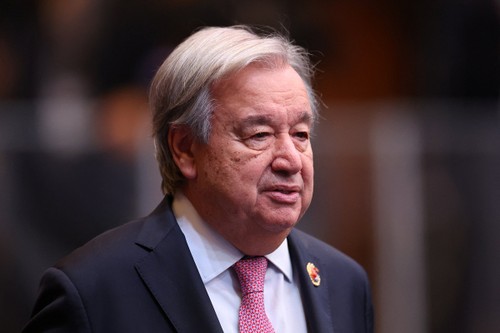 UN Secretary-General António Guterres (Photo: REUTERS/Chalinee Thirasupa) UN Secretary-General António Guterres (Photo: REUTERS/Chalinee Thirasupa) |
A question about US policy
Policy changes in several countries, particularly the United States, the world’s second-largest emitter, have raised concerns. Upon returning to office earlier this year, President Donald Trump withdrew the US from the 2015 Paris Climate Agreement and he has repeatedly criticized international climate initiatives. Domestically, he rolled back several incentives for green industries.
Observers warn that the US withdrawal could negatively affect global climate efforts, given America’s position as the world’s leading economy and its influence in driving other countries’ NDCs and large-scale energy transitions.
Professor David J. Hayes of the Stanford Doerr School of Sustainability said the US faces power shortages for AI development and data centers, so American corporations will need to boost the production of clean energy, which has already become cheaper and more reliable than fossil fuels. For that reason, Trump’s policies may slow progress but are unlikely to reverse the broader global shift toward sustainability.
“It will create a counter-push to reinforce the importance of zero-carbon energy. That's the side of the history that is going to win out, is already winning out. And to some extent, pushing as hard as the president has against investment in clean energy is going to redouble, I think , when the opportunity arises," said Hayes.
Another positive sign is that other major economies remain committed to climate action. At the end of October, the European Union agreed on a new target – to reduce carbon emissions by 90% by 2040, earlier than its previous schedule. China, the world’s largest emitter and second-largest economy, reaffirmed its commitment to a green and sustainable industrial strategy in its newly announced five-year plan.
Although the fossil fuel phase-out roadmap adopted at COP28 in Dubai in 2023 has yet to be clearly defined, renewable energy is booming worldwide. According to Ember, a global energy think tank, renewable sources in the first half of this year surpassed coal for the first time to become the world’s leading power source.