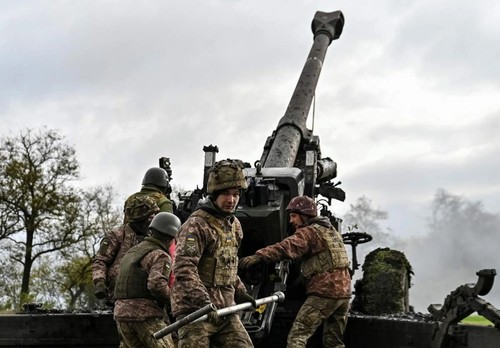
 Ukrainian soldiers in Zaporizhzhia region (Photo: REUTERS) Ukrainian soldiers in Zaporizhzhia region (Photo: REUTERS) |
Russia launched a “special military operation” in Ukraine on February 24, 2022, following a prolonged period of strong disagreements between the two sides over strategic security and geopolitics.
Mounting losses
The conflict has had tragic consequences and has profoundly reshaped international relations and the socio-economy of both countries.
The greatest loss for both Russia and Ukraine has been the human casualties. Although neither country has released official figures, independent studies by research institutes around the world estimate that millions of Russian and Ukrainian soldiers have been killed or wounded. Civilian deaths have reached tens of thousands.
For Ukraine in particular, human losses from the conflict, combined with the displacement of millions of people to other countries, could make it difficult for the country’s population to recover. Ukraine’s population, about 42 million before the military operation, is predicted to have fallen below 30 million by 2050.
The conflict has also triggered other serious social consequences. Christian Lindmeier, a spokesperson for the World Health Organization, said: “Since February 2022, 390,000 to 400,000 disabilities were added, which could be attributed to the war. But the figures alone don’t do it because it’s the support that is missing, the freedom of movement for people, the lack of supplies, the lack of any necessary support for people with disabilities is decreasing. The number is one thing. The story behind it is a much bigger one.”
The prolonged conflict has caused heavy losses to the two economies. In Ukraine, energy and transportation infrastructure has been severely damaged. The World Bank figures released on Monday estimate the cost of rebuilding Ukraine to be 588 billion USD over the next decade, up 12% from its prediction a year ago.
For Russia, the conflict has resulted in sweeping sanctions imposed by Western countries. Although its economy has remained resilient over the past four years, pressure is steadily increasing. The clearest example is the energy sector: exports of oil, gas, coal, and refined petroleum products, Russia’s main source of revenue, totaled 228 billion USD over the past 12 months, down 27% compared with before the conflict. In the long run, sanctions pose a barrier to Russia’s growth.
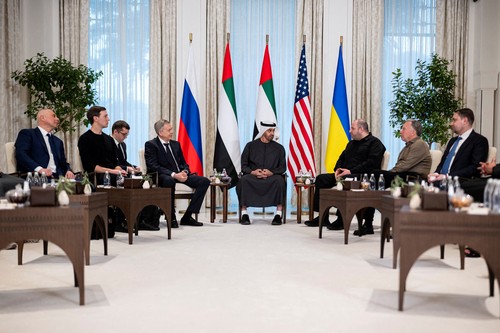 Trilateral talks of the US, Russia, and Ukraine in the UAE on Jan 23, 2026 (Photo: Hamad Al Kaabi/UAE Presidential Court/Handout via REUTERS) Trilateral talks of the US, Russia, and Ukraine in the UAE on Jan 23, 2026 (Photo: Hamad Al Kaabi/UAE Presidential Court/Handout via REUTERS) |
Question of timing
As the conflict marks its fourth anniversary, one question persists: when will it end? Samir Puri, a political analyst and war studies expert at King’s College London, says no one can provide a precise answer. Recent trilateral talks involving the United States, Russia, and Ukraine in Abu Dhabi and Geneva offered some hope, as they marked the first time trilateral and bilateral mechanisms (Russia–US, Russia–Ukraine) were held in parallel. Special negotiating teams on political, security, and military issues were established. However, no breakthrough agreement was reached after three rounds of talks, and there is still no end in sight.
Puri said: “In terms of the distance between the negotiating positions of the two sides, the Americans, if you’re to believe them at face values in term of what they are putting out as commentary is that the gap is narrowing. It’s narrowing to a few difficult to resolve issues, some of which we can well assume would relate to the territorial status of the Donbass region. But I think the reality is that if you ask the two sides, the answer might be very different. The Ukrainian President has put out a number of tweets that have indicated that there is a lot of daylight between the two sides, between his negotiating team and the Russian negotiating team.”
Ruslan Bortnik, Director of the Ukraine Institute of Politics, said the current talks are largely exploratory, and whether Russia and Ukraine can reach a direct agreement with each other remains a question.
“Unfortunately, there is still no concrete agreement on any strategic issue. Political questions have not yet been addressed. Territorial control and military-political-security guarantees remain confidential matters for the heads of state. Ukraine has made it clear that even if these issues are resolved, they still need to be settled within a framework similar to the grain deal, namely agreements between Ukraine and the United States, and between the United States and Russia,” said Bortnik.
With negotiations having failed to make any breakthrough, observers say the key to resolving the Russia–Ukraine conflict may lie in how the US, Russia, and China shape their future relations.
Oleh Saakian, a political analyst in Kyiv, said President Donald Trump’s scheduled visit to China from March 31 to April 2 will be highly significant for the settlement of the conflict, as China is Russia’s most influential ally. Some analysts believe the US administration aims to end the Russia-Ukraine conflict by June of this year.