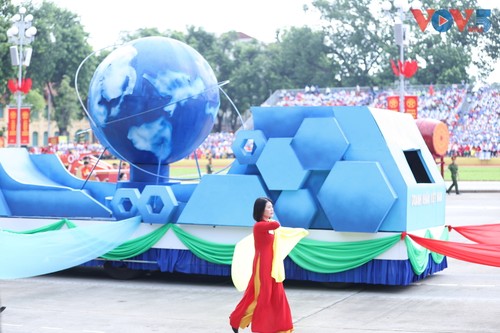
 At the 80th anniversary of Vietnam's August Revolution and National Day September 2nd (Photo: VOV5) At the 80th anniversary of Vietnam's August Revolution and National Day September 2nd (Photo: VOV5) |
Spring of Integration
As Vietnam steps into a new year, the spirit of renewal is not only felt in families and communities, but also in the choices of a new generation. Across the country, many young people are asking the same question: how can my knowledge contribute to my homeland? For some, the answer begins with staying, returning, and turning technology into practical solutions for everyday life. Let’s come to Ho Chi Minh City, where one young engineer is using innovation to make public transport smarter, simpler, and more accessible.
At the start of the new year, many buses in Ho Chi Minh City have gone paperless. Passengers can now board with a simple tap of their phone, making daily travel more convenient.
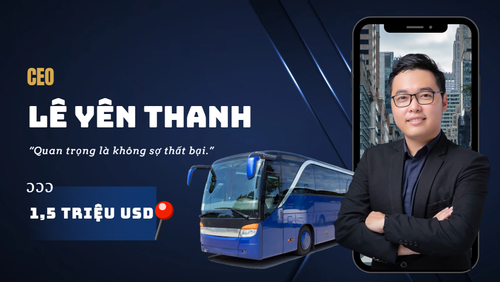 Engineer Le Yen Thanh (Photo: VGP) Engineer Le Yen Thanh (Photo: VGP) |
The technology was developed by young engineer Le Yen Thanh. Despite opportunities to work at Google and being named in Forbes Asia’s 30 Under 30 list in 2022, he chose to stay in Vietnam to launch a startup using AI in public transport. His company, GoLabs, is working to make AI part of smart urban transit.
Thanh said: "I wanted to use my passion for technology to serve the community, so I focused on solutions for buses to help make public transport more convenient."
For this young engineer, giving back means bringing global knowledge home to improve essential services.
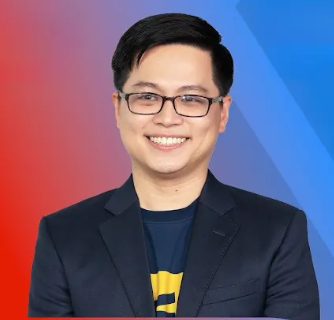 Dr. Tran Tuan Anh, CEO of Solano Energy (Photo: VNA) Dr. Tran Tuan Anh, CEO of Solano Energy (Photo: VNA) |
With the same mindset, Dr. Tran Tuan Anh, CEO of Solano Energy, returned to Vietnam after years in the UK and the US. While young engineer Thanh tackles traffic and pollution, Tuan Anh is focused on solar energy and building a “green passport” for Vietnam.
Tuan Anh said: "The world sees Vietnam as a place of economic opportunity. Each of us has a role in bringing more international partners here and helping overseas Vietnamese stay connected. National pride and the desire for global recognition are strong motivations to keep moving forward."
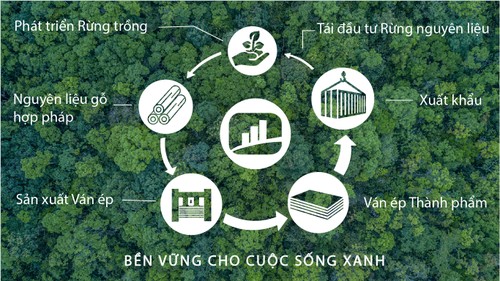 Fomex's green ecosystem (Photo: fomexgroup) Fomex's green ecosystem (Photo: fomexgroup) |
For many young people, contribution is not just about giving something big. It can be quiet, practical efforts, like Le Minh Quan, who developed an app to help people with disabilities access public services, or Tran Van Hoa, a fisheries engineer who left his office job to work directly with local communities on protecting the marine environment through sustainable farming models.
"Technology can close social gaps. When people have equal access to digital services, they can find better opportunities.”
“To contribute to driving the socio-economic development in their hometown by using local resources, young people need to lead, embrace responsibility, and use their knowledge.”
Wherever they are, young people share one common goal of pushing integration forward in every field. By integrating with Vietnamese identity and knowledge, they can confidently go globally.
While young innovators like Yen Thanh and Tuan Anh are using knowledge as a lever to reshape urban life, integration is also happening in factories. The export journey of wood products by Fomex Global is a vivid example.
On the production line, plywood panels are prepared for shipment to global markets. For Fomex Global, this export order is part of the company’s journey to affirm its foothold with its own capacity and a global outlook.
Fomex Global CEO, Nguyen Cong Danh, said: "We don’t just export our products, we bring Vietnam’s reputation and a new business mindset globally. Since the beginning, Fomex Global determined that exporting does not only mean selling products overseas but engaging in the global supply chain with our capability."
As Fomex Global entered international markets, meeting strict US and EU standards shows that effort is not enough, products must meet the rules.
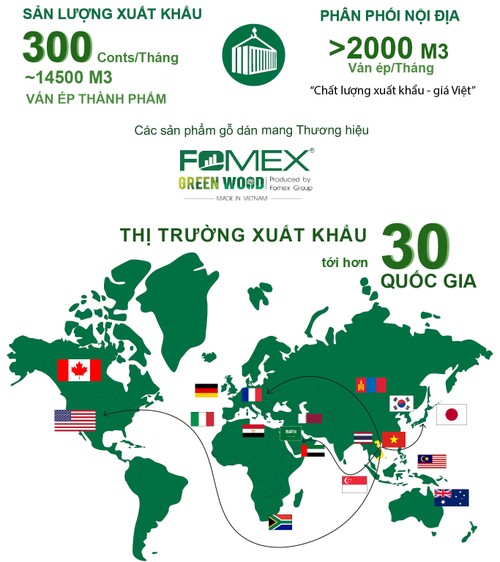 After more than 10 years of diligently searching for business direction, Fomex Global's plywood products are now exported to nearly 20 countries in Europe, Asia, and America. (Photo: fomexgroup) After more than 10 years of diligently searching for business direction, Fomex Global's plywood products are now exported to nearly 20 countries in Europe, Asia, and America. (Photo: fomexgroup) |
Nguyen Quang Vinh, Head of the Sales Section, said: “International markets require transparency, clear traceability and legal sourcing of raw materials. Companies must also prove batch consistency, and long-term quality. In production, international customers look closely at technical standards and market-specific requirements. They are not just buying products, they are buying reliability. That means companies must act as supply chain partners, not just sellers.”
To compete globally, Fomex Global has had to meet Forest Stewardship Council certification and strict formaldehyde emission standards. In today’s global market, transparency and environmental responsibility are the real passports.
Fomex Global CEO, Nguyen Cong Danh, said: “Going global means we must compete globally. It is like playing on a World Cup field. We are competing with China, Malaysia, Indonesia, and others. We have to be ready for that level.”
After more than a decade, Fomex Global now exports to nearly 20 countries, with revenue up seven to eight times.
"We want ‘Make in Vietnam’ to stand for international standards and long-term trust. We aim to create an identity for Make in Vietnam products that foreign partners can trust. Vietnamese companies can go global through quality, credibility, and sustainability,” said Danh.
Fomex Global’s success story shows how Vietnamese businesses are using their own strength, determined to claim a place on the global economic map.
 (Illustrative photo: VOV) (Illustrative photo: VOV) |
The transformation in a nation’s worldview
From technological applications on urban buses to Fomex Global’s consignments crossing oceans, international integration has become an integral force permeating every sector of the economy. Those young people and enterprises exemplify Vietnam’s internal strength in a new era. Unleashing this strength requires a fundamental shift in national thinking and an active approach to position and affirm Vietnam’s identity on the global stage. In today’s Special Edition celebrating the Lunar New Year, we talk with Professor Vu Minh Giang about Vietnam’s shifts in the time ahead.
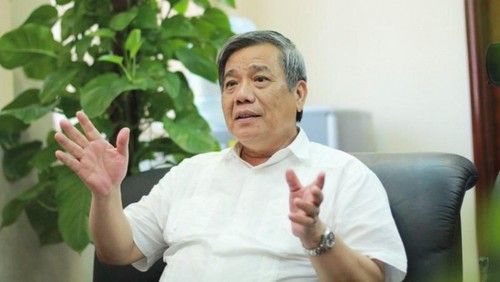 Professor Vu Minh Giang (Photo: VOV) Professor Vu Minh Giang (Photo: VOV) |
Reporter: Professor, after 40 years of renewal and opening up, what would you consider the most significant achievement in Vietnam’s international integration process?
Professor Vu Minh Giang: Integration is not merely about official visits, signed agreements, or import–export figures. What matters most is how a country defines and positions itself within the global strategic landscape. To date, it can be said that Vietnam has clearly identified its place on the global chessboard. While our capabilities can be measured and quantified, Vietnam’s current strategic standing is assessed by major powers as a country whose voice carries significant weight in international affairs. On issues at the regional level, such as Southeast Asia, or the continental level in Asia, and even on global matters, Vietnam’s views are consistently listened to and also generate great impacts. This, indeed, represents an exceptionally significant achievement in Vietnam’s international integration.
Reporter: Many people are concerned that international integration could erode national identity. How do you view this issue at the present?
Professor Vu Minh Giang: Vietnam is not a nation that can be easily assimilated. Vietnamese people are resilient and self-reliant. At this stage, we should not be concerned about losing our identity. Strategically, when we effectively spread our own values, there is no need to fear losing our identity, as others will help preserve and spread it. When pho is enjoyed worldwide, it no longer needs protection, world people would help safeguard it.
Reporter: In the context of a new industrial revolution and deepening global integration, what “assets” or “strategic strengths” does Vietnam possess to achieve a breakthrough?
Professor Vu Minh Giang: Vietnam is widely recognized for pursuing an independent and self-reliant path, neither aligning with major powers nor isolating itself. Its flexible approach aims to maximize opportunities while fully leveraging national strengths. The principle of turning what we have into competitive advantages has proved both sound and effective. Although Vietnam is not rich in natural resources, it enjoys a strong geopolitical position. Above all, its greatest asset is its people who are resilient, determined, and remarkably adaptable. This flexibility and capacity for adaptation align well with global trends in science and technology. With this approach, Vietnam is well placed to secure a distinctive position on the international stage in the near future.
Reporter: What expectations do you have for Vietnam’s future in the period ahead?
Professor Vu Minh Giang: Our current aspiration is clearly: to stand on a par with strong nations. This goal is deeply rooted in the Vietnamese mindset, from ordinary people to those in leadership positions, all seeking deeper integration and a firm place in the international community. In a sense, this is a moment when national fortunes are aligning. I believe Vietnam will develop at a very rapid pace in the coming period. Challenges will be significant, but the Vietnamese people have repeatedly shown an ability to overcome difficulties and grow stronger. It seems that after the 14th Party Congress, the country is entering such a phase of development.
Reporter: Integration brings benefits to Vietnam and helps secure a distinctive position for Vietnam on the international stage. Through integration, what contributions can Vietnam make to the world, Professor?
Professor Vu Minh Giang: Vietnam is almost a symbol of two values: peace and humanism. Having experienced the heavy losses of war, the Vietnamese people deeply understand the value of peace. Therefore, when Vietnam speaks about peace, that message carries special weight. The world sees Vietnam as a peace-loving nation and a builder of peace, and this is a meaningful contribution to the international community. The second value is humanism which is reflected in village culture and the spirit of compassion, of caring for others as oneself , which is a quality that the world today is greatly lacking.
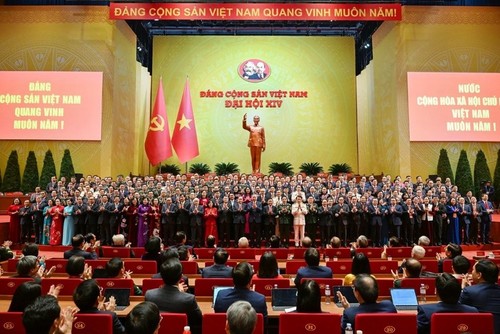 The 14th National Congress of the Communist Party of Vietnam (Photo: VNA) The 14th National Congress of the Communist Party of Vietnam (Photo: VNA) |
Shifting from receiving to creating
Vietnam’s integration into the world embodies not only its aspiration for national development, but also a commitment to serving humanity. Integration means sharing responsibility for the common challenges of the global community.
The 14th National Congress of the Communist Party of Vietnam concluded successfully, where Vietnam’s diplomatic message into a new era was delivered globally. At the event, Party General Secretary To Lam underscored Vietnam’s position as a creator, ready to engage in resolving global issues.
Party leader To Lam said President Ho Chi Minh always regarded Vietnam as an integral part of the world, believing that “everything happening globally was connected to Vietnam”.
According to the General Secretary, President Ho Chi Minh said that Vietnam is part of the world, and everything happening in the world is related to Vietnam. At a time of mounting instability driven by conflicts, natural disasters, and epidemics, the General Secretary emphasized that no nation, regardless of its power, can address today’s challenges alone. He stressed Vietnam will no longer stand on the sidelines to observe global issues but engage in global problem-solving, drawing on the credibility it has built over 40 years of renewal.
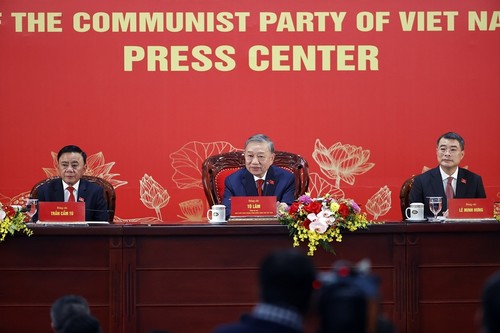 General Secretary To Lam presides over the international press conference announcing the results of Vietnam's 14th National Party Congress (Photo: VGP) General Secretary To Lam presides over the international press conference announcing the results of Vietnam's 14th National Party Congress (Photo: VGP) |
The Party leader said: “Vietnam’s policy is to deepen its integration into global politics, the international economy, and human civilization. As a responsible member of the United Nations, Vietnam believes that all countries, large or small, share a common responsibility for addressing global and cross-border challenges, including climate change, natural disasters, epidemics, non-traditional security threats, food security, cybersecurity, wars, and conflicts. No single nation can resolve these issues alone, they require international cooperation and collective action.”
After 40 years of renewal, reform, and development, Vietnam’s capacity has been significantly strengthened. Vietnam now has the credibility and responsibility to engage more actively in regional and global affairs. Regarding international security, Vietnam continues to participate in peacekeeping operations, humanitarian assistance, disaster relief and rescue missions, responses to humanitarian crises, and peace-building efforts.
In terms of development, Vietnam stands ready to share its experience and achievements in renewal, contribute to global poverty reduction efforts, and continue fulfilling its commitments to the Sustainable Development Goals, ensuring food security, responding to climate change, and promoting green and digital transformation.
Mr. Lam said: “Vietnam regards international integration as a vital driving force for national development. To secure peace and prosperity, the country remains committed to openness and cooperation with the international community. Vietnam advocates a transition from receiving support to making active contributions, from partial engagement to comprehensive integration. In the past, amid wars and hardship, Vietnam received international assistance. Today, with enhanced credibility and capacity, Vietnam is ready to contribute to peace-building efforts, share its renewal experience, and work alongside multilateral institutions to address humanitarian challenges worldwide.”
When Party General Secretary To Lam affirmed that Vietnam no longer stands on the sidelines as an observer, it marked the country’s official transition from a recipient to an active contributor in international affairs. Vietnam’s election to the United Nations Human Rights Council for the 2026–2028 term, with an overwhelming 180 votes in favor, together with positive international assessments of its efforts, provides compelling evidence of Vietnam’s standing as a trusted partner, ready to share responsibility for the common cause of humanity.
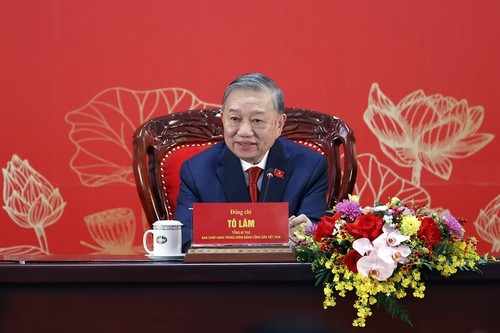 General Secretary To Lam presides over the international press conference announcing the results of Vietnam's 14th National Party Congress (Photo: VGP) General Secretary To Lam presides over the international press conference announcing the results of Vietnam's 14th National Party Congress (Photo: VGP) |
On October 14, 2025, at a session of the United Nations General Assembly in New York, Vietnam was re-elected to the UN Human Rights Council for the 2026 - 2028 term, securing 180 out of 190 votes, the highest number among Asia–Pacific countries. The result reflects the international communities’ strong confidence in and acknowledgement of Vietnam as a reliable and responsible partner.
Ambassador Dang Hoang Giang, Head of the Vietnamese Permanent Delegation to the United Nations, said: “This is the international community’s positive recognition of Vietnam’s efforts to contribute to the United Nations’ common work, including the protection of human rights. Vietnam consistently maintains that ensuring human rights is first and foremost the responsibility of each country toward its own people.”
Amid current global instability and division, Vietnam steadfastly chooses dialogue over confrontation, cooperation over conflict, respect for international law, and the promotion of multilateralism. This choice demonstrates that Vietnam is not standing outside common challenges, but is proactively working with the international community to maintain peace and build trust.
Vietnam’s responsibility in integration is reflected through concrete and substantive contributions. In peacekeeping operations, security assurance, and the promotion of multilateralism, Vietnam is increasingly recognized as an active and responsible partner within international mechanisms.
Foreign experts share their views on Vietnam's contribution to global issues:
“Well, I think the quality of the contribution is high. So, as far as I know, there has not been any major complaints. I think there were engineering units that were also trying to contribute. Certainly, the UN will be very happy with Vietnamese contributions.”
“We see Vietnam not only with the capacity, the competence to deal with it and to contribute for a global response to cyber security, but Vietnam as a country that is respected and a country that has today a growing role in international relations.”
“Vietnam has actively participated in multilateral forums and demonstrated its role in shaping regional norms and strengthening a rules-based order.”
As global challenges grow ever more interconnected, the responsibility of international integration now extends beyond peace and security. Climate change and sustainable development have emerged as shared imperatives that demand collective commitment and action from all nations.
“Vietnam is demonstrating that attracting investments even in these challenging times is not only possible but achievable. With FDI reaching impressive new levels of two to three billion dollars every month, Vietnam stands as a powerful example for others to follow on climate and sustainable development into real investments in people's lives.”
“Vietnam is impressive in having the largest renewable energy capacity of any Southeast Asian nation. It's impressive that more than 50 percent of Vietnamese capacity is solar, wind or hydropower. And that’s the highest percent of any Southeast Asian countries.”
Vietnam’s implementation of international commitments on emissions reduction, energy transition, and the strong development of renewable energy provides powerful evidence of its proactive contribution to global solutions to protect the environment and the future of coming generations.
In a world full of volatility and uncertainty, Vietnam’s integration orientation remains consistent and steadfast. From a country seeking its place, Vietnam is gradually becoming an active, proactive, and responsible member of the international community, working together with others to address the shared challenges of humanity toward a peaceful, sustainable, and inclusive future.
A new year marks a new beginning. Vietnam continues its journey of international integration with a renewed mindset that cherishes peace and aspires to contribute more actively to addressing global challenges.