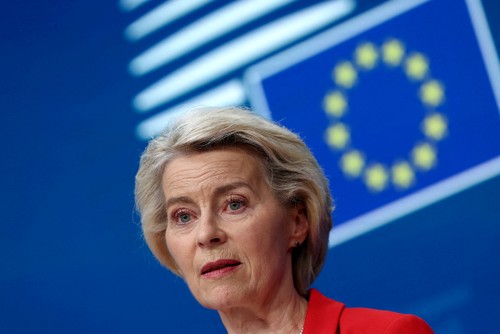
 European Commission President Ursula von der Leyen (Photo: REUTERS/Yves Herman) European Commission President Ursula von der Leyen (Photo: REUTERS/Yves Herman) |
European Commission President Ursula von der Leyen on June 26 said the EU had received the latest draft proposal from the US to resume negotiations on tariffs and that Europe was preparing for both success and failure.
Concession or confrontation?
The EC President did not disclose the details of the US’s demands but said she had briefed EU leaders to reach a unified stance before providing a final response to Washington by the July 9 deadline. Reaching consensus on how to negotiate with the US remains a major point of division within the EU. Countries disagree on whether to strike a quick deal or continue negotiating for a better outcome, even if it takes more time.
Germany and France, the EU’s two largest economies, represent opposing views. At the EU Summit held in Brussels last weekend, German Chancellor Friedrich Merz advocated for a “quick and simple” agreement, citing threats to many of Germany’s industries from the US tariffs. Currently, EU goods are subject to US import tax of 50% on steel and aluminum, 25% on automobiles and parts, and 10% on most other goods. President Donald Trump has threatened to raise tariffs on more EU goods to 50% if no deal is reached.
French President Emmanuel Macron has opposed excessive concessions to secure a swift agreement, calling for a tougher stance, even countermeasures against US tech services. “We will not accept being taxed without responding. I support the Commission's efforts to rebalance the EU-US relationship, as Europe could face up to 60 billion euros in additional tariffs each year, and this clearly demands a response," Macron said.
Von der Leyen has also shown signs of favoring a tougher approach. At the EU Summit, she said the EU was ready to sign a trade deal with the US but also was prepared for a failure scenario involving countermeasures if the US imposes more tariffs on EU goods.
One of the biggest sticking points in the talks is the EU’s tariffs on American tech giants under the Digital Services Act (DSA) and the Digital Markets Act (DMA), something strongly opposed by the Trump administration. The EU considers the management of multinational tech firms a matter of sovereignty and has no intention of backing down.
Von der Leyen said: "Everything is negotiated. We discuss tariff lines, we discuss non-tariff barriers like standards and norms, for example, we discuss strategic purchases, we discuss all these topics. But I'm very clear on some topics that touch the sovereignty of the decision-making process in the European Union. This is for us absolutely untouchable."
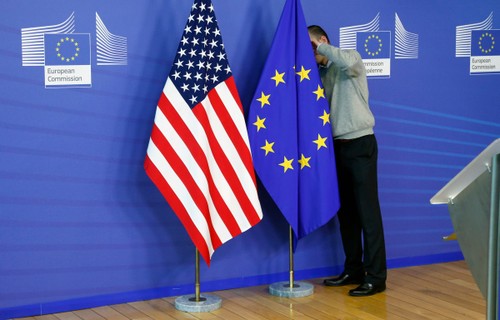 (Illustrative photo: REUTERS/Francois Lenoir) (Illustrative photo: REUTERS/Francois Lenoir) |
Scenario of extension
With divisions persisting within the EU, President Trump has ramped up his rhetoric, saying on June 28 that the EU is a difficult negotiation partner and he has no intention of extending the 90-day tariff freeze beyond the July 9 deadline.
Some US officials have cited Canada’s suspension of digital tax plans following Washington’s threat to walk away from talks on June 28 as a precedent, suggesting similar pressure could be applied to the EU.
However, many economists believe the US is unlikely to exert enough pressure to force the EU to abandon or pause the DSA and DMA, which are viewed as key to Europe’s technological sovereignty. An extension of the negotiations beyond July 9 is seen as a likely scenario despite Trump’s firm “no extension” stance.
Oliver Roth of Paris-based Oddo BHF Financial group, said: “In the tariff dispute with the US, we increasingly believe that things are normalizing. In the end, Trump still wants a deal, despite all the recent tough words. This was evident in the negotiations between the US and Canada, where significant progress was made."
Several EU officials have mentioned the possibility of extending the deadline. On Sunday, French Finance Minister Eric Lombard called for prolonging negotiations beyond July 9 to secure a better agreement. Lombard said both sides are showing goodwill, so delaying the talks could lead to “a better deal, rather than a bad one on July 9”. He said energy might play a key role in easing tensions in other areas, if the EU pledges to increase gas imports from the US.