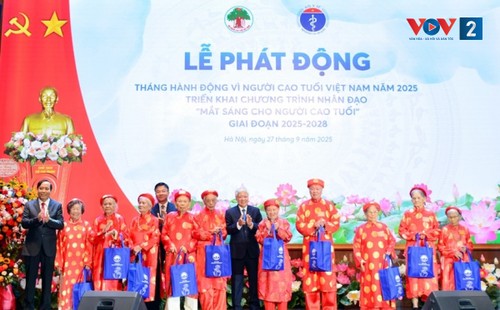
 The launching of the Action Month for the Elderly 2025 (photo: VOV) The launching of the Action Month for the Elderly 2025 (photo: VOV) |
According to the National Population Database, Vietnam has more than 16 million elderly people, accounting for over 16% of the population. More than 1 million of them participate in community work in villages, hamlets, and residential groups, and over 9 million continue to work. Many elderly persons are awarded the title of Labor Hero by the Party and the State each year. They constitute Vietnam’s “silver-haired economy in the new era.”
The elderly are an important resource of the nation
In his call in 1941 to unite all the elders, President Ho Chi Minh said: “The country prospers thanks to the elders. The country exists thanks to the elders’ help. If the country is lost, the elders save it. If the country declines, the elders sustain it.”
The 7th Party Central Committee’s Secretariat adopted Directive 59 on caring for the elderly, emphasizing that “The elders are a precious resource of the nation, a force with rich experience and an important role in family and society.”
At a meeting with influential elderly cadres in 2024, General Secretary To Lam, then serving as State President, called the elderly a national treasure.
“Throughout history, Vietnamese elders have deserved to be called the backbone of the nation. They have sacrificed themselves for the country and served as eternal flames that light up the spirit of independence, self-reliance, and resilience. Our nation’s glorious achievements and high international stature today cannot be separated from the important contributions of the elderly.”
In Vietnam, many elderly people continue to participate in production, scientific research, business management, and passing down traditional crafts to younger people. Age does not diminish their value; it only affirms their irreplaceable role.
Many people at 70 or 80 still participate in programs to teach and promote culture and art. In Hanoi’s Cau Giay ward, there’s a class on “Digital Transformation and AI” for people aged 65 to 85, organized by retired lecturer Dinh Ngoc Son, former Deputy Head of the Radio and Television Faculty of the Academy of Journalism and Communication.
“This class aims to inspire the community, especially the elderly, to keep learning because we have so many tools to learn, including artificial intelligence and digital transformation. I want to help the elderly become more confident in using technology to make digital transformation benefit their daily lives,” said Mr. Son.
Promoting the role of the elderly in the new era
In recent years, Vietnam has adopted many policies on healthcare, insurance, and social security for the elderly, with a new approach of treating them as an important resource for socio-economic development and cultural preservation and promotion.
At its 6th Plenum, the 12th Party Central Committee adopted Resolution 20 on strengthening public health in the new situation, calling for the improvement of healthcare services for the elderly, including preventive healthcare, rehabilitation, and long-term community-based care. Article 37 of the 2013 Constitution stipulates that the elderly are respected, cared for, and their roles promoted by the State, family, and society in the cause of national construction and defense.
To further promote the role, experience, and wisdom of the elderly in socio-economic development, on February 20, 2025, the Prime Minister approved the project “Elderly people participate in digital transformation, green transition, entrepreneurship, and job creation.” Entrepreneurship for the elderly is one of the solutions to ensure social security, enabling them to continue contributing and living happily and healthily.
During the Action Month for the Elderly, the elderly associations across the country will organize sports and cultural activities, such as soft volleyball, Chinese chess, swimming, badminton, sports festivals, art performances, exercise, and folk dances, creating networking and learning opportunities for the elderly. The campaign also includes medical check-ups and consultations, gift-giving, and free legal advice to protect the rights of the elderly.