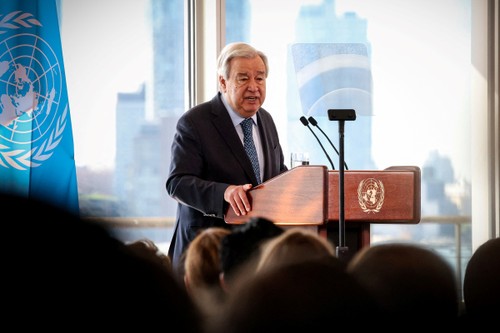
 UN Secretary-General Antonio Guterres (photo: REUTERS/Brendan McDermid) UN Secretary-General Antonio Guterres (photo: REUTERS/Brendan McDermid) |
President Donald Trump announced on Tuesday that the US is withdrawing from the United Nations Educational, Scientific and Cultural Organization (UNESCO). The move is the latest blow to multilateralism centered on the UN.
Multifaceted challenges
Shortly after returning to office earlier this year, President Trump withdrew the US from the World Health Organization (WHO), the UN Human Rights Council (UNHRC), and the 2015 Paris Climate Accord, arguing that these institutions don’t match the US's new global agenda.
As the world’s largest economy and the biggest financial contributor to the UN and its affiliated organizations, the US's growing disengagement from international cooperation poses a serious problem for multilateralism.
At a UN Security Council session on “Peace, Security, and Multilateralism” on Tuesday, UN Secretary-General Antonio Guterres admitted that multilateralism, which has been a driver and guarantor of international peace and security since World War II, is facing unprecedented difficulties.
“Around the world, we see disregard for, if not violation of, international law, including international human rights law, international refugee law, international humanitarian law, and the UN Charter itself, without any accountability,” said Guterres.
The core values of multilateralism are being ignored, and the basic conditions necessary to ensure the smooth functioning of multilateral institutions, especially the UN, have also been under strain in recent years.
The UN reported in March that it’s facing a severe budget crisis due to delayed or incomplete contributions from member states. As of March, only 75 of 193 member countries had fulfilled their financial obligations for 2025. As of early May, member countries had contributed 1.8 billion USD of the UN’s 3.7 billion USD annual budget. Accumulated unpaid dues from previous years have reached 2.4 billion USD, of which 1.5 billion USD is owed by the US and 600 million USD by China. The UN’s peacekeeping operations reported 2.7 billion USD of unpaid contributions as of April 30. Financial strain has forced the UN to consider cutting expenses and staffing.
Guy Ryder, UN Under-Secretary-General for Policy and Head of UN80, the group tasked with preparing for UN reforms at its 80th anniversary (1945–2025), said: “We have to look at our revised budget for 2026, which will involve substantial cuts in both budget and in posts. That's the reality we’re in. But it's not one thing or another. It's not just downsizing and job reductions or effectiveness. We have to reconcile the two objectives of making ourselves financially sustainable in the difficult circumstances we find ourselves in, but also be attentive, as always, to the impact that we have in delivering on our responsibilities under the Charter.”
 (Illustrative photo: REUTERS/Dado Ruvic) (Illustrative photo: REUTERS/Dado Ruvic) |
Enhancing role through results
Many countries and organizations have strongly defended multilateralism, calling for comprehensive reforms to restore the UN’s operational capacity, central role, and legitimacy.
On Monday leaders of Spain, Brazil, Colombia, Chile, and Uruguay, at a summit on democracy in Santiago, Chile, called for stronger protection of multilateralism by jointly tackling rising inequality, disinformation, and the impacts of digital technology and artificial intelligence.
Bob Rae, President of the UN Economic and Social Council (ECOSOC), said the current global landscape is witnessing alarming similarities to the early 20th century, before the UN’s current structure was established. Economic crises, the rise of extreme nationalism, and trade fragmentation have led to out-of-control geopolitical conflicts. The UN and its members must learn from history and build a new form of multilateralism to handle current challenges.
“We need to reaffirm the relevance of the UN through results, by showing that multilateralism delivers real tangible benefits for people at every level of society. This means we have to work more closely with civil society, more closely with the private sector, with youth, indigenous peoples, and especially more closely with national and local governments, because that's where the goals we've set out are in fact implemented,” said Rae.
Observers say that despite limitations in certain peace and security areas due to the UN’s internal power structure, the UN continues to play a critical role in global governance, economic, social, and environmental development at the national level, and coordination at regional and global levels.
The UN’s role in advancing the 17 Sustainable Development Goals (SDGs) and addressing the global climate crisis is irreplaceable. Protecting and promoting multilateralism, centered on the UN, continues to serve the interests of the world’s countries.