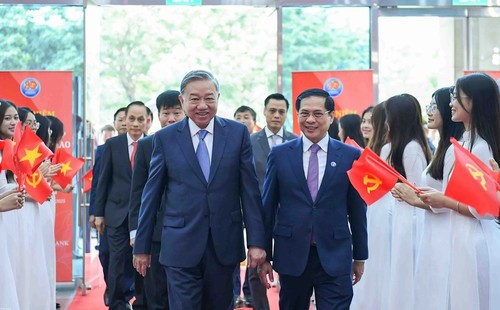
 General Secretary To Lam and Deputy Prime Minister and Foreign Minister Bui Thanh Son attended the ceremony to celebrate the 80th anniversary of the establishment of Vietnam's diplomatic sector (August 28, 1945 - August 28, 2025) (Photo: VGP/Hai Minh) General Secretary To Lam and Deputy Prime Minister and Foreign Minister Bui Thanh Son attended the ceremony to celebrate the 80th anniversary of the establishment of Vietnam's diplomatic sector (August 28, 1945 - August 28, 2025) (Photo: VGP/Hai Minh) |
Vietnam has steadfastly pursued a foreign policy of independence, peace, friendship, and development, a guiding principle that has been continuously upheld throughout each stage of the revolution and adapted to the requirements of the modern era.
The consistency of Vietnamese revolutionary diplomacy
If the Declaration of Independence of September 2, 1945, marked the birth of a new state, then the Foreign Policy Communiqué, published in Cứu quốc (National Salvation) newspaper on October 3, 1945, can be seen as Vietnam’s “second declaration.”
In the document, President Ho Chi Minh affirmed Vietnam’s wish to befriend the allied nations and readiness to cooperate with France, provided that France respected Vietnam’s sovereignty and independence. Professor Vu Duong Huan is former President of the Diplomatic Academy of Vietnam.
Huan said: “The four-point communiqué, outlined Vietnam’s stance toward partners and objects of struggle. First, with the allies, Vietnam affirmed the will to maintain cooperative and friendly relations on the basis of respect for the independence, sovereignty, and territorial integrity of the Democratic Republic of Vietnam, all for the cause of world peace. Second, with France, Vietnam expressed the wish to build a long-term relationship based on respect for Vietnam’s sovereignty and interests.”
This was more than diplomacy. It marked the dawn of soft power, an art of statecraft grounded in peace and wisdom. Ho Chi Minh’s foreign policy became the lodestar guiding Vietnam to revolutionary triumphs. For three decades, following the motto “Steadfast in objectives, flexible in actions” and upholding a spirit of justice, resilience, and peace in diplomacy, Vietnam won through to an ultimate victory.
From presence diplomacy to proactive diplomacy
During national development and integration, Vietnam’s diplomacy has undergone a profound transformation, moving from presence diplomacy to proactive engagement, pursuing comprehensive and extensive international integration, pioneering in peace-building, mobilizing resources for national development, and elevating its global standing.
In the first eight months of this year, Vietnam carried out 50 high-level diplomatic activities, more than in the same period last year and nearly equal to all of 2024. The pace and scale of these activities demonstrate the Party and State’s aim to use diplomacy to raise national prestige and create new opportunities for development.
Foreign Minister Bui Thanh Son said: “Vietnamese diplomacy has strictly adhered to the Party and State’s foreign policy, maintained its distinct character, closely followed global and regional dynamics, and applied the principles of ‘know oneself, know others,’ and ‘understand the timing and the circumstances’. With flexible and creative strategies, we have devised timely responses, seized opportunities, and mitigated challenges to successfully fulfill our missions.”
In just eight months, Vietnam elevated relations with 13 countries, signed more than 300 bilateral and multilateral agreements, twice as many as in the same period last year. Economic diplomacy helped boost GDP growth to 7.52% in the first half of this year, the highest in 15 years. These achievements reflect a shift toward a more substantive diplomacy, focused on long-term, feasible commitments.
Vietnam has emerged as a strategic meeting point in intercontinental cooperation corridors, where major powers and middle-sized partners seek stability, opportunities, and a balanced voice in an increasingly polarized world.
In the new era, Vietnam’s diplomacy continues to uphold its pioneering role and harmoniously address relations between the nation and the rest of the world, aiming for the ultimate goal of ensuring national interests.
Party General Secretary To Lam said: “We must firmly maintain independence, self-reliance, and resilience in foreign affairs. National interests must come above all. We neither depend on others nor allow ourselves to be swayed by external trends. Vietnam’s tradition is to make friends with as many nations as possible, drawing strength from friendship, whether countries are big or small, near or far.”
For 80 years, the lessons of Vietnamese diplomacy on being steadfast in principle, flexible in actions, and rooted in peace and conciliation have been constantly applied and creatively adapted to meet the demands of the new era.