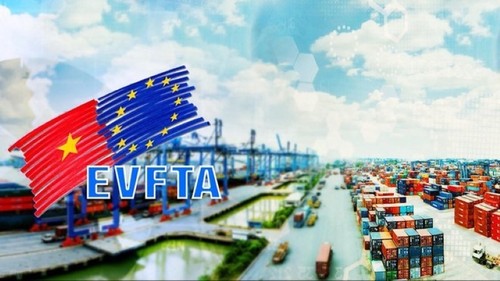
 (Illustrative photo: VGP) (Illustrative photo: VGP) |
The EVFTA, which took effect on August 1, 2020, immediately eliminated 70% of the tariffs on trade between the two sides while 99% of the remaining tariffs have been gradually phased out. The EVFTA have also raised standards for the environment and labor market.
Significant growth
Statistics from the Ministry of Industry and Trade show that trade between Vietnam and the EU rose from 55.4 billion USD in 2020 to nearly 70 billion USD in late 2024. Vietnam’s export turnover to the EU over the last five years was an estimated at 270 billion USD, making Vietnam one of the EU’s top trading partners in ASEAN and its 16th-largest global trading partner. Meanwhile, the EU is Vietnam’s third-largest export market and fourth-largest import source.
A report by the European Chamber of Commerce in Vietnam (EuroCham) on the fifth anniversary of the EVFTA showed that the agreement has positively contributed to improving bilateral trade, enhancing institutional reform, and raising Vietnamese business standards and competitiveness. EuroCham’s Business Confidence Index (BCI) for Q2/2025 shows that 66% of businesses are actively trading with Vietnam, and 98.2% are familiar with the EVFTA.
 Nguyen Hai Minh, Vice Chairman of EuroCham (photo: EuroCham) Nguyen Hai Minh, Vice Chairman of EuroCham (photo: EuroCham) |
Nguyen Hai Minh, Vice Chairman of EuroCham, said: "A highlight perspective of European businesses is the highly effective implementation of the EU-Vietnam Free Trade Agreement (EVFTA) over the past five years. The Ministry of Industry and Trade has worked effectively with the EU and the business community to resolve institutional bottlenecks and eliminate trade barriers."
The EVFTA has boosted European investment and elevated Vietnam's position in global supply chains. With 35 billion USD of registered FDI as of mid-2025, the EVFTA has become a “plus point” for attracting investment from the EU to Vietnam. Many major projects have been implemented in high-tech, renewable energy, pharmaceuticals, and logistics. This new generation of high-quality investment is a foundation for Vietnam to establish new supply chains and integrate more deeply into global supply networks.
A driver for reform
EVFTA has become an important driver of reforms for both sides. Lin Goethals, Director of the European Institute for Asian Studies (EIAS) in Brussels, said that in a volatile global economy, Vietnam and the EU share the strategic goals of sustainable development and green growth. The EVFTA also fosters strategic dialogue between the EU and Vietnam.
“I think one of the main things is that tariffs have been going down. I think also the aspect of the dialogue and the other aspects related to trade, the non-trade barriers. These dialogues have been much more on the radar than before. And besides that, I think also the aspect of keeping sustainability really on the agenda on both sides,” said Goethals.
Luliu Winkler, Vice Chairman of the European Parliament’s International Trade Committee, said the EVFTA is a roadmap for tariff reductions across strategic sectors including green energy and emerging technologies for both Vietnam and the EU. In order to maximize the benefits of the agreement, both sides need to accelerate institutional reforms and streamline regulations to give businesses more flexibility to capitalize on cooperation opportunities.
“I think we need regulatory simplification. The European Union is in a process of regulatory simplification, of having lesser rules and better rules. I hear very gladly that also the government of Vietnam is embarked on a route of simplification, better laws, less laws and less rules,” said Winkler.
The EVFTA is pushing Vietnamese businesses to adopt greener and more sustainable practices. They have to comply with new regulations concerning green production, social responsibility, and supply chain transparency, especially in traditional export sectors like footwear and wood products. While this poses challenges, it also creates opportunities for businesses to raise their product standards and internal capacity and enhance their competitiveness in other demanding markets.
To help Vietnamese enterprises comply with the EU’s green regulations such as the Carbon Border Adjustment Mechanism (CBAM), which will take effect in early 2026, and the EU Deforestation Regulation (EUDR), which will take effect at the end of this year, the Ministry of Industry and Trade has developed the CBAM Portal to localize EU regulations and help Vietnamese businesses understand the rules in the simplest way.