 (Photo: baskl.com.my) (Photo: baskl.com.my) |
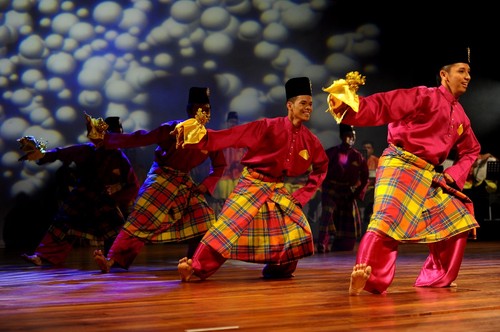
The Zapin dance’s defining feature is intricate footwork, a series of measured steps, often performed in pairs, mirroring one another in symmetry. The dancers move gracefully back and forth, creating geometric patterns on stage that evoke balance and harmony. The dance is both playful and precise, sometimes resembling a friendly game, sometimes evoking solemn ritual.
Shafirul Azmi bin Suhaimi, a member of Performing Arts from Malaysia, told VOV, “Zapin is aggressive, a dance for men, strongly influenced by Islamic culture. The significance of the dance is in the leg movement, forward and back, and in the old Islamic music.”
Performances are usually accompanied by the violin, a pear-shaped plucked lute called gambus, a two-headed drum called gendang, the accordion, and the rebana drum.
The origins of Zapin stretch back to the 15th century, when Arab traders and Islamic missionaries arrived in the Malay world. Along with their religion, they brought music and dance and spiritual reflection.
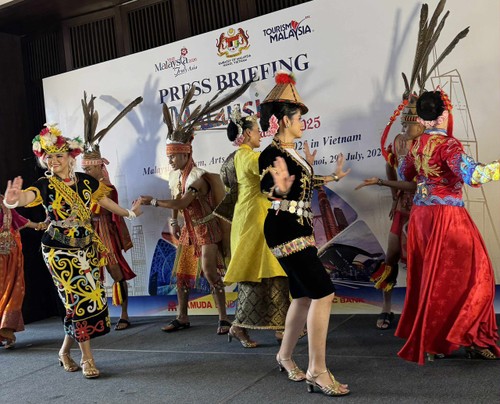 The Zapin dance’s defining feature is intricate footwork, a series of measured steps. (Photo: Hong Nhung) The Zapin dance’s defining feature is intricate footwork, a series of measured steps. (Photo: Hong Nhung) |
In its earliest form, Zapin was a religious performance, practiced primarily by men in mosques and at Islamic gatherings. It was secularized by Malay communities over time. The sacred blended with the celebratory, and the dance transitioned from a spiritual expression to a cultural art form. Malay aesthetics, instruments, and storytelling styles enriched the original Arabic form, giving birth to a uniquely Malaysian tradition.
This cultural hybridity is what gives Zapin its distinct character: Islamic in its rhythm, Malay in its expression, and Malaysian in its identity.
As Zapin spread across Malaysia, it evolved into many regional styles. From Zapin Johor in the south, to Zapin Sarawak and Zapin Brunei in East Malaysia, the dance reflects the cultural landscape of each state.
“Because it's a Malay culture, Malay always involves how to play the character and then how to play the game in the performance. …That's why in some parts, some places in the state, it's a different style of dance,” said Suhaimi.
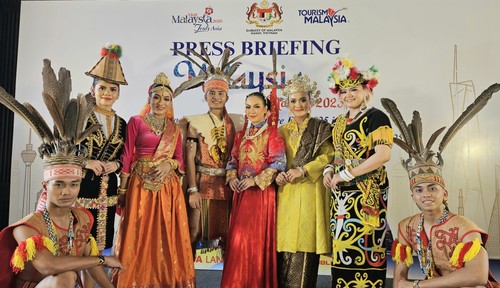 Malay dancers participating in Madani Festival 2025 in Hanoi (Photo: Hong Nhung) Malay dancers participating in Madani Festival 2025 in Hanoi (Photo: Hong Nhung) |
This adaptability has made Zapin a symbol of unity among Malaysia’s diverse communities. Zapin is woven into daily life, from cultural festivals and weddings to state ceremonies and school events. This, Suhaimi said, is how cultural preservation should work - thriving alongside social and economic growth.
“Some countries are more advanced and economically developed, but we must balance the economic with the social because the social is the heart of the country’s people,” Suhaimi explained.
From its spiritual origins to its place in modern celebrations, Zapin has evolved into a vibrant symbol of Malaysia’s cultural heritage, preserving tradition while embracing change.