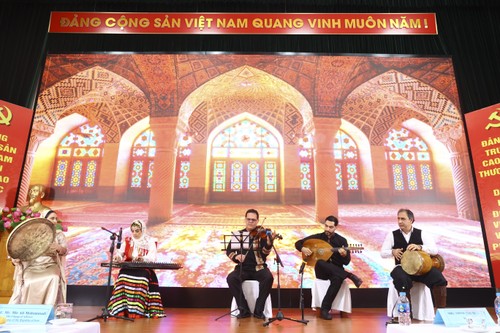
 The Sar Afshan band performs at the College of Commerce and Tourism of Hanoi (Photo: Iranian Embassy) The Sar Afshan band performs at the College of Commerce and Tourism of Hanoi (Photo: Iranian Embassy) |
“It's not just a concert; it is the celebration of two ancient civilizations from East and West Asia coming together in harmony. Music is one of the most powerful bridges and bonds that ties two cultures. It speaks a universal language that goes beyond borders, geographical borders or political borders, or even the world.”
Mr. Ali Mohammadi, Chargé d’Affaires of the Iranian Embassy in Vietnam, said that when Iranian traditional music is performed in Vietnam, it opens a window into the emotions and values of the Iranian people.
“It allows Vietnamese audience to feel the soul of Iranian people, not just to hear them,” said Mr Mohammadi, adding, “By sharing musical traditions, we create moments, moments of connection and empathy. These performances foster curiosity, respect, and dialogue. They remind us that while our instruments and melodies may differ, the emotions they evoke – love, joy, and hope – are not different, they are deeply shared.”
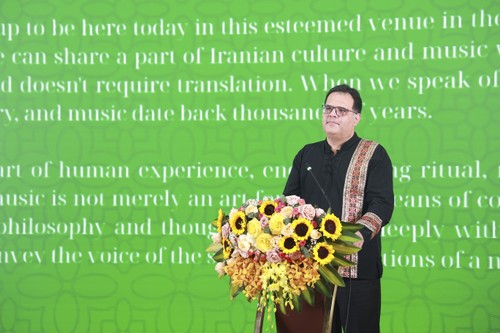
 Mr. Ali Mohammadi, Chargé d’Affaires of the Iranian Embassy in Vietnam (Photo: Iranian Embassy) Mr. Ali Mohammadi, Chargé d’Affaires of the Iranian Embassy in Vietnam (Photo: Iranian Embassy) |
Iranian traditional music, or Radif, is among the oldest and most refined musical systems in the world. Built on a complex structure of melodic modes known as Dastgah and Maqam, it expresses the philosophical depth and emotional richness of Persian culture.
Mr. Iman Rostamian, Sar Afshan band’s violinist and representative, told VOV, “Our music is nourished by emotion, woven from moments of improvisation, and connects people with nature and the divine through an invisible thread. Every note in Iranian music is a silent dialogue between the artist’s soul and the listener’s heart.”
According to Rostamian, in the system of Dastgah, the musical modes that form the foundation of Persian classical music, each Dastgah represents a different emotion. The Shur mode evokes nostalgia while Homayoun carries a meditative tone, and Mahour is bright and majestic, together reflecting the four seasons of human life, each telling its own story of love, sorrow, and hope.
Mr. Mohammadi said Iranian music has historically interacted with the music of Vietnam, particularly through Cham culture and exchanges with China and India. “Both traditions”, he said, “are rooted in local heritage, value improvisation, and maintain a close relationship with poetry and literature.”
Echoing this idea, Rostamian explained the meaning behind the concert’s symbolic title, “This title symbolizes two ancient and enduring cultures. The phoenix in Iranian culture represents wisdom, knowledge, and divine blessings, and the Almighty.”
“The dragon in Vietnamese culture symbolizes the soul, strength, prosperity, and vitality. What we want to say is that, though geographically distant, the spirits of our two cultures are in harmony. And music is the shared language where these two souls meet,” Rostamian noted.
 Reza Hosseinzadeh Machak Poshti, the band's leader (Photo: Iranian Embassy) Reza Hosseinzadeh Machak Poshti, the band's leader (Photo: Iranian Embassy) |
For the artists of Sar Afshan, performing in Vietnam carried deep emotion and a sense of kinship, said Rostamian.
“We feel an extraordinary closeness to the people and culture of Vietnam — perhaps because both nations share a deep historical consciousness and an Eastern spiritual essence. This stage is a magical bridge where, through music, a language without borders — we can share our most sincere emotions and the simple beauty of Iranian culture with our Vietnamese friends.”
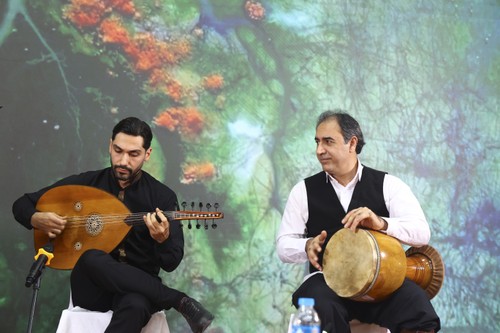 Roozbeh Akbarian, an Oud player (L), and Reza Hosseinzadeh, a Tombak drummer (Photo: Iranian Embassy) Roozbeh Akbarian, an Oud player (L), and Reza Hosseinzadeh, a Tombak drummer (Photo: Iranian Embassy) |
Ms. Fatemeh Abdollahi, the band’s Qanun player, said, “Music for me is both pride and mission, a sacred duty to preserve and share our cul tural heritage, and a bridge connecting kindred spirits across all differences.”
The five-member Sar Afshan ensemble includes Reza Hosseinzadeh, the leader and Tombak drummer; Iman Rostamian, vocalist and player of the violin and Kamancheh; Roozbeh Akbarian, the Tar and Oud player; Fatemeh Abdollahi, a Qanun artist; and Fatemeh Sharifi, a Daf drummer.
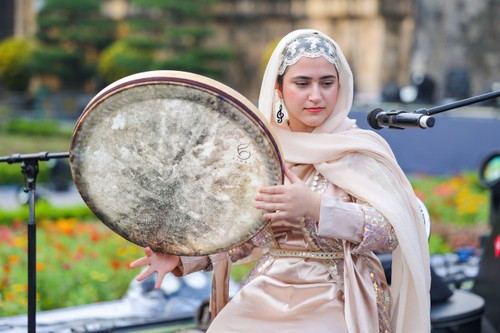 Fatemeh Sharifi, the band's Daf player, performing at the first Cultures of the World Festival in Hanoi (Photo: Iranian Embassy) Fatemeh Sharifi, the band's Daf player, performing at the first Cultures of the World Festival in Hanoi (Photo: Iranian Embassy) |
In their skillful hands, these instruments brought the deep, enchanting sounds of Persia to Vietnamese audiences. The resonant beat of the Daf drum and the delicate tones of the Qanun, reminiscent of Vietnam’s 36-string zither, particularly fascinated the audience.
According to Rostamian, during the performance in Vietnam this time, they brought several traditional Iranian instruments, such as the Qanun, the Oud, the Daf, and the Tombak. All of them harmonize to create the unique character of Iranian traditional music.
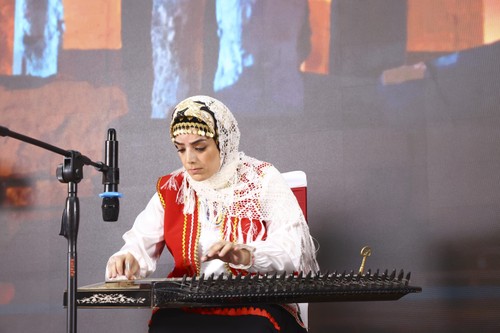 Fatemeh Abdollahi, the Sar Afshan’s Qanun player (Photo: Iranian Embassy) Fatemeh Abdollahi, the Sar Afshan’s Qanun player (Photo: Iranian Embassy) |
Through music, Iran and Vietnam rediscovered their spiritual kinship across time and geography.