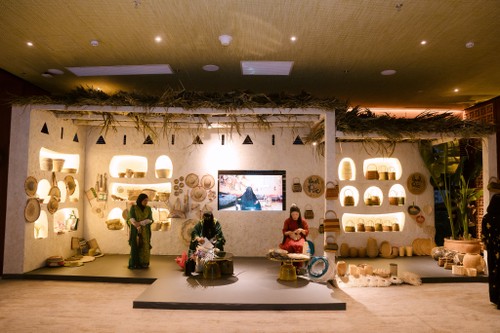
 The Khoos pavilion at the National Day celebration recently hosted by the Embassy of Saudi Arabia in Hanoi. (Photo courtesy of the Embassy of Saudi Arabia) The Khoos pavilion at the National Day celebration recently hosted by the Embassy of Saudi Arabia in Hanoi. (Photo courtesy of the Embassy of Saudi Arabia)
|
Artisan Fatima Al-Ghamdi, who has devoted 35 years to the craft, showcased the craft of Khoos weaving at Saudi Arabia’s 95th National Day celebration in Hanoi. She told VOV that she has loved handicrafts since childhood, gradually developing her skills and learning different crafts such as wool weaving and basketry.
“But palm frond weaving is my true passion, because it allows me to promote and introduce the heritage of Saudi Arabia. I’ve showcased my crafts in several countries, from Europe to Russia, India, Turkey, China, Japan, and now Vietnam,” said Fatima.
For Fatima, Khoos is a lifelong commitment. “I faced no difficulties at the beginning, as it was truly my passion. My only challenge has been the constant travel, to appear on TV and demonstrate the craft abroad. But it doesn’t matter.”
 (Photo courtesy of the Embassy of Saudi Arabia) (Photo courtesy of the Embassy of Saudi Arabia) |
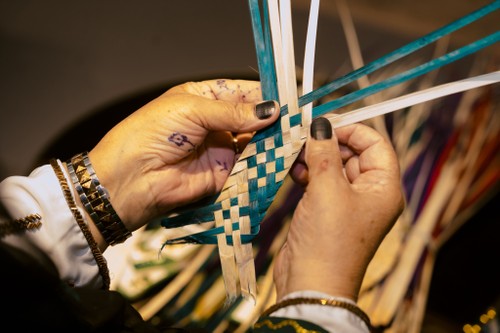
Khoos begins with lush green date palm leaves. Craftspeople carefully harvest, dry, and soak the fronds before the weaving begins. With skilled hands, they transform the rough leaves into baskets, mats, food containers, and agricultural tools. Fatima says the heart of Khoos lies in its creativity.
“First, we weave circular shapes and then sew them into handbags of various designs, or flower baskets. That’s creativity—transforming simple forms into practical items. A single braid can become a hat, a headband, or a decorative item. Today, people still use these products frequently, especially for weddings, Ramadan, or National Day celebrations—to carry food, hold flowers, or as decorative wear,” Fatima recalled.
Another artisan, Masouma Al-Hamdan inherited the craft from her mother and has practiced Khoos for more than 17 years.
“I learned wickerwork when I was about nine years old. I started by helping my mother cut the palm leaves, and later I learned the old weaving methods. My first products were traditional items like baskets and mats. Over time, I developed the old techniques and explored new products, such as flowers, artwork, and handbags made from palm fronds.”
Masouma was the first woman to turn palm fronds into rose bouquets. “One of my proudest innovations was transforming palm fronds into bouquets of roses. These wicker rose bouquets became very popular because of their uniqueness,” Masouma said.
Her creativity extended to crafting Ramadan lanterns from palm fronds to hang in Safwa City’s historic Al-Shiriyah neighborhood. Today, she dedicates more than eight hours a day to her craft and is training young women to continue the tradition.
 Saudi and Vietnamese artisans showcase traditional weaving at the celebration of Saudi Arabia’s 95th National Day. (Photo courtesy of the Embassy of Saudi Arabia) Saudi and Vietnamese artisans showcase traditional weaving at the celebration of Saudi Arabia’s 95th National Day. (Photo courtesy of the Embassy of Saudi Arabia)
|
Jawaher Saleh Al-Qaz’at, an advanced trainer in palm frond weaving, says Khoos is both art and discipline.
“The process begins by selecting the right type of palm fronds. We then cook them for two hours, refine them for two days, dry them, and then dye them. The weaving stage follows, using different methods such as one-angle, two-angle, and four-angle weaves,” Jawaher said, adding, “Each style creates a distinct product—wallets, handbags, decorative boxes. My advice to trainees is never to stop practicing; continuity is the key to mastering this craft.”
Another artisan reflected on the legacy of her ancestors, “I even think about my craft when I go to sleep. This craft has been part of my life for 35 years. My grandmothers were strong women who taught us that this craft is essential. From a young age, I worked with them, learning to cut, clean, and braid palm leaves. We made baskets, mats, and accessories, even tables.”
“What I always remember is to be meticulous—every design must be carefully checked, a lesson my grandmothers instilled in me,” she concluded.
Many Khoos products are dyed and decorated with intricate patterns that reflect the aesthetic sense of Saudi women, who play a central role in preserving and passing the craft to future generations, Fatima said.
“A large round tray may take me up to two weeks to finish. All products are made entirely by hand, using no machines. After we weave, we use needles to sew and shape the items,” according to Fatima.
 Khoos products are still used every day and special events like weddings, Ramadan, or National Day celebrations. (Photo: Bao Tram) Khoos products are still used every day and special events like weddings, Ramadan, or National Day celebrations. (Photo: Bao Tram) |
Today, Khoos remains a part of Saudi life, especially weddings, Ramadan, and National Day. People use them to hold food, carry flowers, or wear as accessories or headpieces, Fatima told me. The date palm, central to Saudi culture and survival in the desert, continues to nourish body and spirit—its fronds transformed into objects of utility, beauty, and identity.
Fatima said during the celebration in Hanoi that what she loves most is promoting the heritage of the Kingdom of Saudi Arabia. It’s a source of pride for her to let the world know about the Saudi identity and creative spirit.