 Party, State and Government leaders visit the exhibition booth at the opening ceremony of the 16th National Broadcasting Festival in 2024. (Photo: VTC News) Party, State and Government leaders visit the exhibition booth at the opening ceremony of the 16th National Broadcasting Festival in 2024. (Photo: VTC News) |
Digital transformation in radio is an inevitable trend which entails many benefits as well as significant challenges. The Voice of Vietnam, the national radio station, has developed the Project on Digital Transformation to expand its reach by using digital platforms like online radio, podcasts, and streaming to deliver radio content without any geographical limit. It also helps improve the listeners and audience’s experience by using artificial intelligence to personalize radio content and recommend programs that match the listener and audience’s preferences. The data provided by digital platforms helps radio stations understand listener/audience behavior so they can optimize the content and improve program quality.
Proceed in methodological way
VOV’s Vice President Dr. Vu Hai Quang said Voice of Vietnam is carrying out digital transformation carefully and methodologically, to modernize its broadcast and communications activities and meet the public’s growing need for information.
Since 2000, VOV has been digitizing its editing, production, and archiving, which is the premise for the current digital transformation. To that end, VOV has established a steering committee and a project development committee for digital transformation to ensure proper leadership and supervision during the process. On August 1, 2024, the VOV President approved a project on digital transformation at VOV.
Workshops and training courses have been organized to improve employees’ awareness and skills and create a firm foundation for the transformation process.
Mr. Quang said: “At present, VOV is deploying technological solutions, training human resources, building a digital platform on the existing infrastructure, and investing in new digital infrastructure, a CMS management system, and other application software.”
The digital transformation process has several advantages but it’s also facing difficulties. Digital transformation requires more highly skilled workers and a large financial investment in infrastructure and technology, which strains the budget. VOV relies mainly on the state budget for investment and cashflow. Another challenge is that digital transformation requires a new way of thinking and a new work culture.
Seizing all opportunities to modernize radio broadcasting
According to VOV Vice President Dr. Vu Hai Quang, with limited resources, radio stations should focus on applications that have a widespread impact on the public and are easy to deploy, such as Radio Internet, which can help traditional radio stations switch to a digital environment and broadcast live on websites, mobile applications, and platforms like YouTube, Facebook Live, and Zalo.
 VOV Vice President Vu Hai Quang (Photo: VOV5) VOV Vice President Vu Hai Quang (Photo: VOV5) |
Mr. Quang said: "We should make full use of social networks like Facebook, TikTok, YouTube, and Instagram to attract listeners, and set up an interactive audience community to increase public trust in the station. Another thing we can use is Smart Speakers, which integrates radio programs with home control systems. Users can give voice commands while driving or cooking using support tools like Smart Speaker, Google Assistant, or Alexa."
"We need to optimize radio content for broadcasting on Google Nest or Amazon Echo and build news channels and quick news bulletins specifically for Smart Speaker users. Another app is Smart Radio, which uses a model very familiar to users. Instead of using AM/FM receivers, which are difficult to hear in some places, Smart Radio lets you listen wherever there’s a wifi signal,' added Mr. Quang.
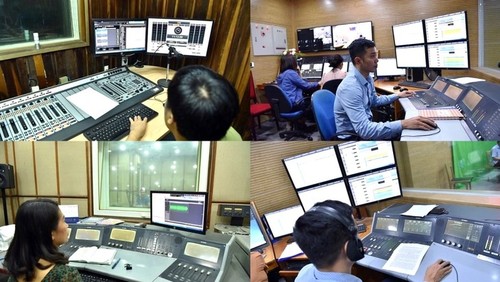 Technicians work in VOV's radio program studios. (Photo: Van Ngan/VOV) Technicians work in VOV's radio program studios. (Photo: Van Ngan/VOV) |
Mr. Quang said that to adapt to a digital environment, reporters, editors, and technicians need to improve their digital skills, such as using audio, video, and graphics editing tools to produce multimedia content and manage data in the digital environment; writing scripts specifically for digital platforms such as Podcasts, Reels, TikTok, and social media; and using AI to support content editing, Search Engine Optimization, and analyzing listener behavior to personalize content.
Engineers and technicians need to participate in building editing tools, content production, data and operation management, content distribution on digital and multi-platform environments, and integrating new technologies.
For digital transformation to be successful, Dr. Quang says radio stations need to change their way of thinking about content, improve the digital skills of employees, invest in technology, and make the most of effective distribution platforms such as podcasts, social networks, online radio, Smart Speakers, and Internet Radio. This will expand audience segments and increase competitiveness.