|
Artisan Nguyen Xuan Hien of Chuong My commune performs lion dance at Kim Ngan Temple, Hanoi.
|
“When I was a child, I lived in the Old Quarter. I watched the lion dance many times. One of the things I loved the most about the Mid-Autumn Festival was the lion dance. Whenever the sound of the drums echoed, all my Mid-Autumn Festival memories came alive in me. This event helps people distinguish the lion head dance from other dances, such as the kylin dance.”
“This is making me quite emotional. In the past, the sound of lion dance drums was heard more often because residential blocks used to organize lion dances for children. Now it’s less common. Every time I hear this sound, I feel very nostalgic.”
In the days before the Mid-Autumn Festival, events are being held in Hanoi’s Old Quarter to entertain the locals and the tourists with artisans demonstrating how to make star-shaped lanterns, rotating lanterns, paper figurines, and bamboo dragonflies. The most exciting part is the lion dance.
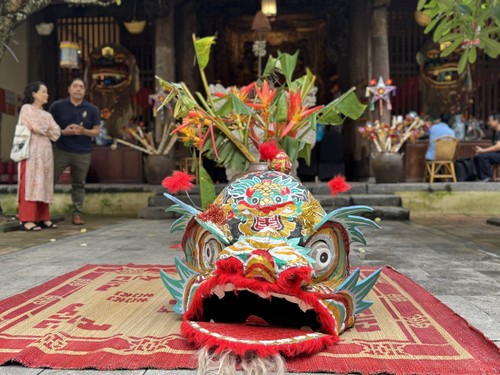 Artisan Nguyen Xuan Hien of Chuong My commune brings to the event the northern lion head made in 1932. (photo: Cam Thi) Artisan Nguyen Xuan Hien of Chuong My commune brings to the event the northern lion head made in 1932. (photo: Cam Thi) |
People are gathered in the courtyard of 500-year-old Kim Ngan temple on Hang Bac street, examining a large lion head that gleams with vivid colors. Its eyes and arched eyebrows convey strength and warmth, projecting an image at once powerful and inviting. Beside the lion head is an offering tray full of mooncakes, fruit carvings inspired by old folk tales, tiny figurines called to he made of edible dough, and more lion heads. These items invoke the nostalgic atmosphere of Mid-Autumn.
70-year old artisan Nguyen Xuan Hien of Chuong My commune, has been invited here to introduce the lion head and perform a traditional lion dance. Hien and his troupe will reproduce a lion dance which has been passed down by multiple generations of their predecessors.
“The lion head I’ve brought here was made in 1932. Our ancestor took it from Hang Giay street to Phung Chau commune, now called Chuong My commune. I was invited to introduce this authentic lion head of northern Vietnam and compare it to lion heads of other regions. I’m very happy that my ancestors’ tradition is still valued, and even happier to see young people helping to preserve this heritage. We have a lion troupe of 5 members. A full troupe can have up to 10 people,” said Mr. Hien.
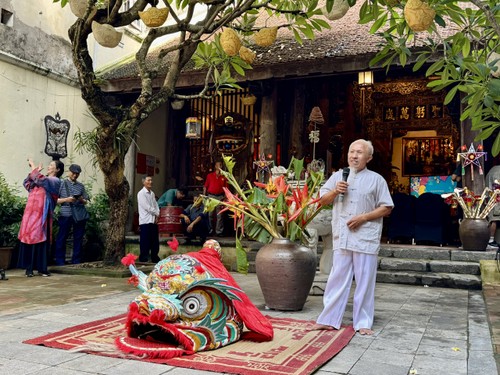 Artisan Nguyen Xuan Hien introduces special features of the lion head. (photo: Cam Thi) Artisan Nguyen Xuan Hien introduces special features of the lion head. (photo: Cam Thi) |
In northern Vietnam, the lion head is distinguished by its expressive facial features, which have a deep symbolic meaning. Its large, alert eyes and strong arched eyebrows shaped like carps symbolize vigilance and vitality. Its prominent teeth are designed to ward off evil spirits. Its whiskers add both fierceness and benevolence, symbolizing prosperity and good fortune. Mr. Hien said: “It weighs about 8 kilograms. Our ancestors crafted it with a bamboo frame covered in cloth. During restoration, we used around 2 kilograms of paint. Adorned with bronze bells and other embellishments, it produces a rich variety of sounds in response to every movement of the dancer.”
Unlike the more stylized lion heads of the south, the northern version emphasizes powerful yet friendly expressions, symbolizing both protection and benevolence. When combined with vigorous movements and the thunderous sounds of drums and cymbals, the northern lion head becomes a cultural guardian, channeling the community’s wishes for luck, health, and well-being.
A lion dance troupe usually includes lion dancers, a martial artist, and a joker carrying a fan. Whenever the lion or the martial artist appears exhausted, the joker fans them to lift their spirits and keep the performance going. The dance itself is thrilling, but the joker adds a playful touch that makes it even more entertaining.
Mr. Hien continued: “The lion dance is accompanied by a martial artist carrying a stick. He strikes the lion head with his stick, but the action is symbolic. He hits the ground diagonally, sending dirt and sand flying. The blows are so forceful that the lion collapses in pain, yet it circles back and rises again to bite. The martial artist may fall to the ground, but it is a deliberate movement, not a slip. Each sequence of actions carries a lesson and a symbolic meaning.”
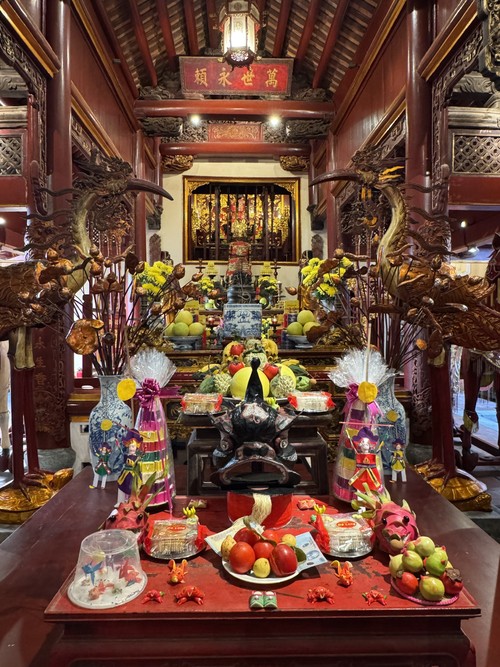 The altar at Kim Ngan Temple is adorned with offerings for the Mid-Autumn Festival. The altar at Kim Ngan Temple is adorned with offerings for the Mid-Autumn Festival. |
In Vietnamese people’s belief, the lion dance is believed to bring good luck, prosperity, and protection from evil spirits. The lion’s powerful movements, combined with the loud sounds of drums, cymbals, and gongs, are meant to drive away bad energy and welcome happiness. The lion dance also symbolizes strength, courage, and joy, and has become a cultural expression of community spirit and celebration.
The recreation of the traditional Mid-Autumn Festival at Kim Ngan Temple in Hanoi is part of the “Trăng Ta” (Vietnamese Moon) project by Kevin Vuong, an independent fine arts researcher. He has earned several prestigious awards and scholarships, including the Best Short Film Award from Media Aptech in 2010 and two scholarships in Germany.
Since 2020, Vuong has been dedicated to the “Trăng Ta” project, reviving handmade toys for the Full-Moon Festival in Vietnam. The first toy Vuong has chosen is a lion’s head from the north of Vietnam, which he discovered during his study. He found its distinct characteristics compared to the southern lion heads but with stronger Chinese influences.
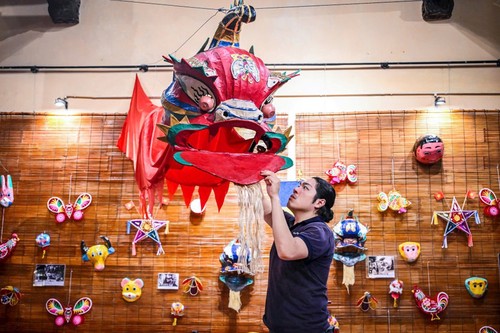 Kevin Vuong has studied folk toys for the Mid-Autumn Festival, especially the northern lion head since 2000. Kevin Vuong has studied folk toys for the Mid-Autumn Festival, especially the northern lion head since 2000. |
“The most recognizable feature about the lion’s head of the north is the eyebrows, which are a couple of fishes. It has many different meanings, the fish in Vietnamese folk tales can be transformed into a dragon, that it's like a wish from the elderly to the young children, that they will pass their exams and become a successful person in the future. The two eyebrows on the lion’s head are two fish, which means a wish that the kids will grow up and have a happy family," said Vuong.
Vuong has spent the past five years studying and collecting documents on northern-style lion heads. He has searched in many different places, from Hanoi’s Old Quarter to suburban areas such as Ha Dong, Ha Tay, and Nam Dinh, where villages once specialized in making paper lion heads. Even while working abroad, he continued his efforts to trace Vietnamese lion heads.
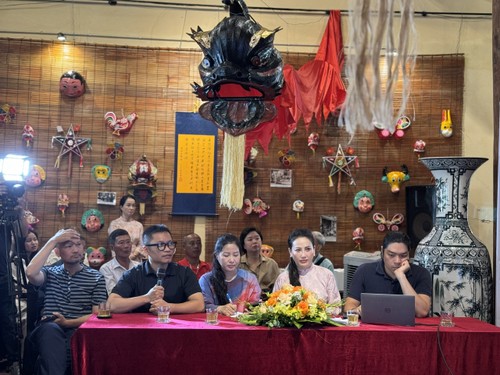 Kevin Vuong (first from right) and speakers at the event introducing his project “Trăng Ta.” A recreated northern-style lion head hangs from the ceiling. (photo: Cam Thi) Kevin Vuong (first from right) and speakers at the event introducing his project “Trăng Ta.” A recreated northern-style lion head hangs from the ceiling. (photo: Cam Thi) |
“I have visited the Musée de quai Branly in Paris to observe the lion head that was produced in 1931, and transferred to France. It’s kept in the museum until now. It was a big challenge because there are not so many artisans who are specialized in making the lion heads. While some young artisans make the lion head look more like the Kylin head from the south,” Vuong explained.
At an exhibition as part of the event at Kim Ngan temple, Vuong displayed two big lion heads remade to the original northern-model design, together with cloth bags and scarves printed with the images of the lion heads. Vuong said he’s planning to show people some different versions of the northern lion heads, because every village has a different design. But they have one thing in common, the fish-shape eyebrows.
Vuong shared his purpose: “The project is one of my biggest dreams to revive many traditional handmade toys for the Moon Festival. The first phase of the project is to remake the lion head, and the second phase is to apply it into modern life. Thanks to interior designers, fashion designers, they will bring the new image of the lion head to their products. It's like a river of culture. The lion heads will not stay in a museum, in an exhibition, but continue its journey into the modern life. I’ve named the project Trang Ta , because we have Tet Ta, the Lunar New Year. I want to have a name just simple and very Vietnamese, so I just named it Trang Ta, like Tet Ta."
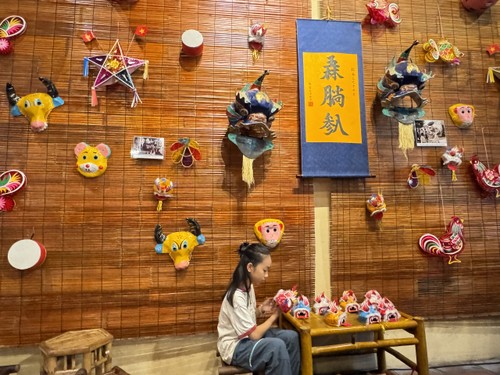 A child plays with the small lion heads. (photo: Cam Thi) A child plays with the small lion heads. (photo: Cam Thi) |
While pursuing his dream, Vuong has worked with some creators who are keen on using folk culture for their creativity. For example, Vuong and Do Project, which specializes in handmade paper, opened workshops to help people making different papers, rice glue, and lion heads.
A member of the Hanuyo Yosakoi team, one of the first Yosakoi dance groups in Vietnam named after the lively Japanese group dance, shared that they sought Vuong’s advice to bring authentic northern lion heads to their Mid-Autumn performance.
“We love Japan’s Yosakoi dance and want to infuse it with Vietnamese culture, using that Japanese foundation to convey our own traditions. For this year’s Full-moon Festival, in the performance ‘Becoming children gazing at the moon,’ we incorporated two distinct Vietnamese elements: the lion head and the star-shaped lanterns. Vuong explained in detail the differences between lion heads and unicorn heads, after which we commissioned a northern-style lion head that will serve as the highlight of our performance.”
Dr. Nguyen Hong Ngoc, a designer and lecturer of the National University of Ho Chi Minh City, said she is impressed with Vuong’s project: "The lion head presented by Kevin Vuong carries symbolic values and meanings. For example, the pair of carps represents certain meanings, while the butterfly placed on the lion’s head symbolizes good news and congratulations. The lion dance itself serves as a blessing, full of excitement and joy. There are many layers of symbolism that can be reintroduced into contemporary life. Our task is to fully embrace those original values and translate them into contemporary designs. In this way, heritage will be given new vitality in today’s life, instead of being confined and ‘frozen’ in museums.”
As the Mid-Autumn moon rises, its golden glow shines on both tradition and renewal. From the thunderous beats of lion dance drums in Hanoi’s Old Quarter to the delicate artistry of handmade lanterns and lion heads, the festival continues to bridge generations. For artisans like Nguyen Xuan Hien, the lion dance is a living heritage, carrying ancestral wisdom and community spirit. For researcher Kevin Vuong, it is a source of inspiration, transformed into creative projects that connect Vietnam’s cultural past with its future. Whether on a crowded street, inside a centuries-old temple, or in modern creative spaces, the lion’s powerful yet benevolent gaze reminds us of unity, hope, and prosperity.