|
Cheo People’s Artist Doan Thanh Binh, People’s Artist Xuan Hoach, and artisan Ta Hanh talk with Gen Z audiences (Photo: Organizing Board)
|
Amidst the cultural setting of Bich Cau Temple in Hanoi, the “Echoes of Rhythm” talk show brought together veteran artist of Vietnamese folk music, People’s Artist Xuan Hoach and Cheo artist People’s Artist Doan Thanh Binh, and artisan Ta Hanh, the Director of the UNESCO Traditional Arts Center in Hanoi, to engage with young audience to discuss whether Vietnamese traditional music can hold its ground amid the explosion of visual culture and digital sound and where does it stand in the lives of today’s youth?
Attending the talk, Bui Thanh Trang, a third-year student at the Academy of Journalism and Communication, said when presented authentically, folk tunes become a bridge to the past.
“There was no instrumental backing, but the way she breathed and shaped each syllable was excellent. She made me feel I was listening to the old masters. The sound took me back to the days when my grandparents often listened to such music on the radio,” said Trang.
While the performances moved young audiences, the masters are concerned about the preservation and promotion of Vietnam’s musical heritage like Cheo, the traditional opera rich with humor and moral lessons; Ca tru, the refined ceremonial singing once performed in royal courts and scholar gatherings; Tuong or Classical Opera, and Xam, the soulful street-singing tradition once voiced by blind wandering artists.
The folk theaters are embracing a wave of innovation. Emerging “mini-Cheo” performances in cafés, cultural houses, and temple courtyards are attracting younger, urban audiences.
Some modern productions integrate contemporary themes like city life, youth aspirations, and social issues while preserving traditional vocal techniques and staging. Experimental groups fuse folk genres with modern instruments or subtle visual design to make them more accessible.
Additionally, digital platforms like short-form video, livestreams and school outreach programs help introduce these art forms to new generations.
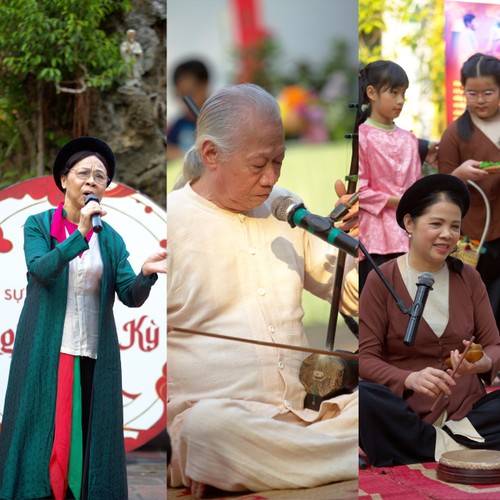 (From left) Cheo People’s Artist Doan Thanh Binh, People’s Artist Xuan Hoach, and artisan Ta Hanh perform during the talk show. (Photo: Bao Tram) (From left) Cheo People’s Artist Doan Thanh Binh, People’s Artist Xuan Hoach, and artisan Ta Hanh perform during the talk show. (Photo: Bao Tram) |
According to People’s Artist Xuan Hoach, recognized by UNESCO as a World Artisan, innovation must grow from a preserved foundation and the original values of the genre.
"For me, true innovation must come from composing poetry. Vietnamese well-known poets like Nguyen Binh, Tan Da, and Nguyen Khuyen all used poetry to create their melodies and tunes. Now, young people have the freedom to create, but don't write free-form poetry. You should strictly adhere to the traditional six-eight-word distich meter, the soul of Vietnamese poetry. This poetic form is the essence that visually impaired people can hear and memorize, and from which many melodies are born,” said Mr. Hoach.
He noted that the Tale of Kieu, for an example, is a masterpiece partly because it is written in six-eight-word distich meter, which everyone remembers easily. There is no need for complexity. The soul of your poetry will harmonize with the singing.
Meanwhile, Ta Hanh, who is also head of Hanoi’s Xam Club, is concerned about the severe decline in practitioners. “What troubles me is that so few people enjoy traditional arts,” said Ms. Ta Hanh, adding, “There are too many choices in the age of information overload. Those of us who work in and love traditional arts in Hanoi and the northern region all know each other because the community is so small. The number of Xam artists can be counted on one hand. This makes me very sad.”
The masters agreed that any innovation should be built on the principle of preserved identity with a focus on the language as the core.
People’s Artist Doan Thanh Binh who masters in Cheo theater said that Vietnamese traditional music is extremely rich, and each form has its own uniqueness.
“If you want to sing well, you must practice hard and have passion and perseverance. Because Vietnamese is a tonal language, if you don’t articulate the tones like hỏi (low rising), sắc (high rising), nặng (low broken), and huyền (low falling) properly, you can change the meaning entirely. These tones are the sounds of our language,” said Ms. Binh.
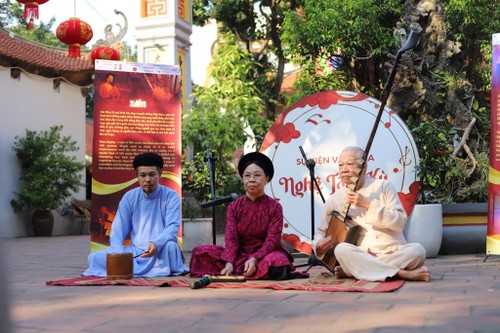 A performance by People's Artist Doan Thanh Binh and People's Artist Xuan Hoach at the event (Photo: Organizing Board) A performance by People's Artist Doan Thanh Binh and People's Artist Xuan Hoach at the event (Photo: Organizing Board) |
Traditional art forms, though centuries old, are finding new audiences through community clubs, school programs, festivals, and digital platforms.
Young performers are increasingly taking interest, blending traditional melodies with contemporary expression while maintaining their original essence. With support from cultural institutions, and the passion of artists and listeners alike, these quintessential musical traditions continue to echo in today’s bustling cities, showing that Vietnam’s folk music remains a living, evolving part of the national identity.
Bui Thanh Trang, who once found traditional music “distant,” said: “Traditional music comes from the everyday spaces of our ancestors, like the village banyan tree, the communal courtyard, farm work, and moonlight gatherings. Electric lights and tall buildings make it harder to notice. but traditional music is still present.”
Le Huy Du, a first-year student at Hanoi Architectural University, said, “It’s not difficult to listen to or approach. It’s just a matter of each person’s perception. If we want to preserve it, we have to find new ways to introduce it so young people can know it and appreciate it.”
Du and Trang agreed that young people aren’t turning away from traditional music but as Gen Z lives on TikTok, Reels, and YouTube Shorts, traditional music needs to appear on those platforms.
Trang said: “Young people today excel at using digital technologies and platforms, like the Nghe Tan Ky project in which journalism students from the Academy of Journalism and Communication start with posts and short videos on Facebook and TikTok to attract the public’s attention. People must first know something exists before they can find it interesting.”
One of the most debated issues of Vietnamese traditional music is whether innovation means dilution or revival. Mixing traditional music with modern elements like electronic music, Western orchestration, or theatrical staging often sparks mixed reaction. Some fear that adding contemporary elements risks distorting the soul of the music, while others believe that evolution is necessary for survival.
That concern is shared by People’s Artist Thanh Binh, who emphasized the need for a strong foundation.
“Uncle Ho said, 'Don’t plant sesame and expect to harvest corn.' That means we must preserve the quality, the melody, and the spirit of the original tradition. If you want to innovate, you must first master the roots. If you don’t, it will become something else entirely,” said Binh.
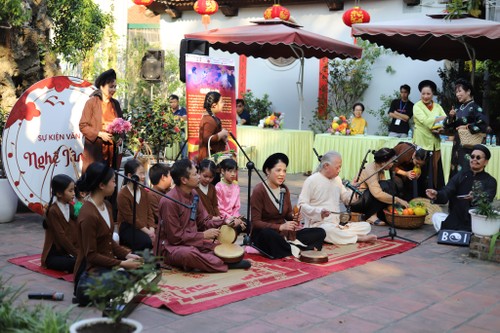 Artists perform the famous Xam song, depicting the bustling life and market scenes of Dong Xuan Market. (Photo: Organizing Board) Artists perform the famous Xam song, depicting the bustling life and market scenes of Dong Xuan Market. (Photo: Organizing Board) |
Yet the push for innovation continues to gather momentum, especially among young artists searching for ways to keep these traditions alive.
Many argue that adaptation is not betrayal but evolution, a way to let ancient melodies breathe in today’s fast-changing world. They point to successful experimental shows where traditional instruments meet gentle electronic soundscapes, or where Cheo and Xam appear on digital platforms, drawing millions of views.
These efforts, they say, do not erase the past but illuminate it for new audiences. Between preservation and reinvention, Vietnamese traditional music is finding a path shaped by both respect and creativity.
Architecture student Du said the younger generation advocates for integration, combining traditional elements with contemporary music, as a gateway. They view this fusion as a necessary step to familiarize young people before they seek a deeper discovery of the original forms.
Du, a fan of Chau Van, said, “I think we should combine traditional music with contemporary music. Artists like Tu Long and recent music shows have already mixed in traditional music, which helps young people know and perhaps want to discover traditional music genres later.”
At the heart of the debate lies a deeper question that what place does Vietnamese traditional music hold in a rapidly globalizing world? For veteran artists who have devoted their lives to safeguarding these art forms, the answer is not withdrawal but confident participation.
They believe that tradition grows stronger when it engages with the wider musical landscape, as People’s Artist Xuan Hoach talks about a global perspective for the 21st century.
“Music belongs to the world, to humanity. If we Vietnamese can listen to and play different types of music, then others can explore Ca tru, Xam, Chau Van, and Cheo. In that case they will have to embrace the Vietnamese soul. Our top mission is to preserve the Vietnamese essence, the folk identity of our music,” said P.A Xuan Hoach.
If People’s Artist Xuan Hoach speaks to the global journey of traditional music, others focus on nurturing its future at home. They believe that long-term preservation begins not on grand stages but in everyday spaces where children learn, play, and form their earliest impressions of culture.
Artisan Ta Hanh, who has taken on the mission of planting the seeds of Xam in the hearts of the youngest generation, ensuring the art lives on through curiosity and early exposure, suggesting bringing Xam into elementary schools.
“I want to introduce Xam and other traditional arts forms to schools, starting at the elementary level, because children are like blank paper, pure and curious,” said artisan Ta Hanh, adding, “I can take poems from their Vietnamese textbooks, especially the ones they already know by heart, set them to Xam melodies, and teach them. It becomes natural for them. I’ve applied that model in my residential area and a number of schools, but not all the schools in Vietnam. What’s a pity!”
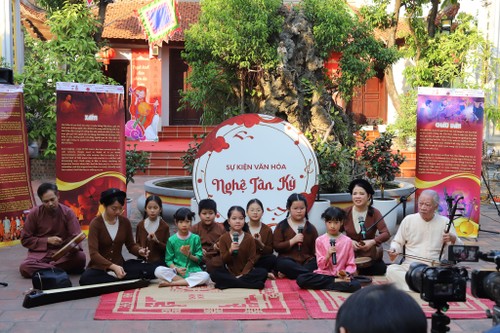 People’s Artist Xuan Hoach, artisan Ta Hanh, and young members of the UNESCO Traditional Arts Center in Hanoi (Photo: Organizing Board) People’s Artist Xuan Hoach, artisan Ta Hanh, and young members of the UNESCO Traditional Arts Center in Hanoi (Photo: Organizing Board) |
As the final notes of Xam drift across the courtyard of Bich Cau Temple, one thing becomes clear that Vietnamese traditional music is not a relic of the past, but a living, breathing art form waiting for new hands and new hearts to carry it forward.
The masters have offered their wisdom, the young have shared their curiosity, and together they form a bridge between generations that is stronger than any single melody. In the age of digital noise, the survival of Cheo, Ca tru, Xam, and other folk traditions will depend on this shared commitment to honor the roots, embrace thoughtful innovation, and bring these sounds into the spaces where young people live, learn, and imagine their futures.
If the spirit in the music continues to meet the spirit of its listeners, then these ancient rhythms will not fade. They will rise, transform, and continue to echo through modern Vietnam.